Helping the Minoritized Achieve in Academic Science

Archive for the ‘TimeManagement’ Category

Women’s Leadership Backlash

Woman_standing_next_to_a_wide_range_of_tire_sizes_required_by_military_aircraft._-_NARA_-_196199A wonderful post from a WomanOfScience friend on women’s leadership. In particular, women in academic administration. Choosing to go the administrator route may be an exit from the research track.

Enjoy!

I’ve always recognized the advantages of being a female faculty member in a male dominated field and try not to dwell on the instances of overt or subtle discrimination. For example, when I entered grad school (15-20 years ago), there were few women in my field that my gender alone made me memorable. Certainly I did good work, but also it was likely that a member of a faculty search committee was likely to remember me which no doubt helped my job search in a subtle way. When I was an assistant professor and gave birth to our first child, there were obviously some disapproving glares from some colleagues, but still I brought the 7 day old child into my office (in a cradle) and proved to my colleagues that this wasn’t disturbing to them and allowed me to maintain my productivity. Then the slippery slope began…

Some time ago, university administrators decided that one way to relatively painlessly reduce implicit bias was to have female faculty present on key committees (most importantly search committees, graduate admissions, and many policy setting committees). The result was that every female faculty member I knew was doing far more service than her male peers. The optimistic view, however, was that we made contacts and networks both within our home institutions and nationally that were far more expansive. Down the road a decade, we had far more administrative exposure and experience and were therefore ideal targets for administrative/leadership roles (at a time when many institutions would like to showcase their strong female leaders)… except that we were/are too young (many of us in our late 30s and early 40s). It is flattering to be asked to take over a high profile chair or deanship at a young age. And I wasn’t unique in this respect. Looking nationally, female chairs and deans are trendy.

This is where the glass is half full perspective ends… Our male peers are hitting their strides as full professors and racking up the high profile awards and kudos that will allow them to build their scientific reputations. While I was able to maintain this level of creativity and productivity through the births of my three children, there is no way to do the same in the face of the unrelenting distraction of running a large organization well. The inevitable result is to take the research hit in favor of building an administrative career. I am fully aware that I am complaining about an opportunity that women just 5-10 years older than me were denied simply for their genders. On the other hand, I worry that we’re complicit in self-imposing a glass ceiling. In my experience, great scientists look down on administrators that do not have scientific stature (I would contend that young female full professors have credibility, but not yet stature). Worst yet, one of my most creative, deeply thinking graduate students informed me she was leaving my group to join that of a male colleague. She said she joined my group because she loved the atmosphere of teamwork and close mentorship that I had a reputation for, but in the last couple of years (since she joined the group) she’s watched that decay exponentially as my administrative duties increased. I am deeply ashamed that I allowed the day to day fires of running this organization get in my way of educating my students! Worst yet, she cited my case as a reason to _not_ go into academia. That talented women get duties loaded on them until they drop the ball (she described it almost as a form of titration). I’ve sadly become the anti-role model.

This summer, my family and group will be uprooting to move to a new university. Everyone (my extended family included) keeps asking what job I will have there and I have been glorying in telling them that I will be “just” a professor again!

Thanks for that post! What do you think? Post or comment here. To follow this blog, push the +Follow button to get an email every time a new post appears.

Getting It All Done

TimeManagementv2In science, there is a lot to be done. When you are an undergraduate, you had problem sets, lab reports, maybe even a capstone to complete. You were maintaining your grades while having some fun and doing some extracurricular activities. As a graduates student, you passed classes, TAed, performed novel research, became the world’s expert in your exact experiments, perhaps organized some science-related on-campus activities, attended conferences, made posters and talks, wrote papers and a thesis, and got a postdoc. As a postdoc, you juggled multiple projects, learned new techniques, wrote proposals for fellowships, mentored graduate students and undergraduates, perhaps juggled multiple mentors, wrote papers, edited papers, edited theses, attended conferences, networked, gave talks, wrote papers, applied to jobs, interviewed, got a job, and wrote papers.

Now, as a faculty member, your job tripled because in addition to doing all the stuff above, you are now having to manage other people (posts), get enough funds to support other people (write grants, see post), teach courses (perhaps some that you never took yourself, see post), work on service for the department and college (post), and take on larger and larger service roles for your scientific community. Each of these has a huge number responsibilities and components to it, and could be a job unto itself. So, how do you do everything?

I have had some posts about starting a new job here and here, but at the beginning, the job isn’t as much. It definitely ramps up over time. I have one post that is good for helping to organize yourself over a yearly time frame, but there is also something to be said for a monthly or weekly schedule that is conducive to getting everything done. One extra issue with academia, is that your schedule changes throughout the year depending on when you are teaching, what you are teaching, who is in your lab, and other what naught. I will give some examples of weekly schedules that worked well for me over the years, in a hopes that they will help you to organize your schedule, too.

Example 1 – 10am class for 1 hour. Several semesters, I taught at around 10am for about an hour three days per week. This time slot was pretty close to ideal, which is probably why they are so popular in the schedule. The students were awake, I had time for last minute prep before class, and I took the entire morning for “teaching.” Here is how I actually arranged my schedule. On the days I was teaching, I got in around 9am and did some last minute psyching up for class, making sure I had demos, and my computer was set up. I would print off and make copies of anything needed for class. I would go 15 minutes early to the classroom to set up projectors and demos and also talk to students as they came into the lecture hall. After teaching, I would go to the gym for an hour to get exercise and decompress after teaching. After the gym, I would shower and go to lunch. I would spend the afternoon working on leftover class stuff, like scanning and posting my notes or homework solution sets, office hours, and meeting with students. On the other days, I would try to take the entire day for writing grants and papers. In the evening the day before I would teach, I would spend a couple hours in the evening re-writing my lectures.

Example 2 – afternoon lab course. Other semesters, I taught afternoon lab courses two times per week for several hours in the afternoon. Lab classes take less preparation because there are not lectures to make up. I usually try to keep all the teaching stuff on the same day, so any preparation, photocopying, or equipment set-up that I might need to do would be done in the morning. Again, the other days are reserved for research. I would also try to go to the gym first thing in the morning on research days before going into work but after getting the kids to school. Sometimes working out was a great way to kick my brain into gear and get it working for the rest of the days on research days.

The key to all of these ideas is to give myself the time I need to do what I need to do. I block out full days for research and I do not allow committee meetings to be made on those days. The days I teach classes, I put other meetings and office hours, so that it is all on the same day. Although I have been failing recently, I also try to get to the gym 3 days per week. Also, I eat lunch with friends almost every single day, and I try to sleep 7-8 hours per night.

Also, none of this includes any family stuff, which happens outside of 9-5. But, here is the key, by giving myself time for stuff like rest and the gym, I have some slack that I can take up with family stuff happens. The week when the baby has a fever and he has to stay home, I cut out gym and some other stuff so that I can still get the important stuff done take the time I need to be with the baby at home. (My spouse and I split days off with sick baby, and negotiate which days/times we can be home. We often don’t schedule important, non-rearrageable meetings at the same time not he same days, so we can do this. We have a joint-shared set of calendars.) If my time is already stretched to the breaking point, a sick kid or other family emergency will wipe me out. If I am giving up going to the gym for a week, so I can get more research done, it isn’t as bad.

So, what do you think? Do you have a way to arrange your time that enables you to get it all done? Post or comment. You can receive an email every time I post by pushing the +Follow button.

Conference Thoughts

2475011402_bf70c92575_oAs I am sitting in a session at the world’s largest conference in MyFieldOfScience, I am thinking about conferences. I am thinking about how important they are for your career in a lot of ways. For those of you who recently joined the blog (thanks for following!), you may have missed some previous posts about networking. I had one about general networking and another on networking on campus, which are both super important for getting tenure, getting jobs and just good for your career. Conferences are key for networking, being seen, and building your mentoring and scientific connections vertically and horizontally. I have come to the realization that networking is basically “professional flirting.” You can chat about science, but most convos are about family, travel, weather, grants, clothes, students, jobs, or whatever. Academic life has other aspects that we can talk about too. I had a great conversation about teaching and how to teach 400+ effectively with a colleague from another university.

Another thing conferences are great for is energizing your science. When I was young, and I think this is the case for my students, I loved going to conferences because it gave me confidence that people were actually *interested* in my science. I was able to talk about my work, have some people listen, and get validation that what I was doing was of worth. Further, seeing the work of other people that was similar to my own made me feel like I had a community of scientists who were interested in the science. Conferences re-energized me and made me look forward to working on more science and getting my work published.

Now, my science gets energized, but in a different way. Now, I look around and say, “Oh crap, we are more behind than I thought! Everyone is doing the cool experiments I thought of but haven’t gotten off the ground yet!” This is both bad and good. First the bad. It is scary to compete with your science against other groups that are better funded, have more students, and might be ahead on the same ideas you have. Also, I am so so crappy at hiding my science. I cannot keep secrets about the cool stuff we are doing. In some fields, telling people what you are doing helps to mark your territory. In others, it can be giving them the keys to all your best ideas. I have to be careful, but I can’t help but be communicative, open, and excited about our newest stuff. It might hurt me sometimes, but in the long run, I would rather collaborate than compete.

Now the good. Much like when I was young, seeing all the great stuff my colleagues are doing that is similar to my own work can be energizing and maybe even light a fire under your ass to get going. Further, it helps you to focus. If you had an idea to do X experiment and you see it done (probably slightly differently) at a conference, you can refocus your idea to probe the still open questions. Another good thing about people working on similar stuff – it shows your work is hot, important, and in fashion. As in other realms (like fashion) styles change, but if you are hitting hot you have a better chance of getting high profile publications and getting noticed.

So, those were my thoughts about conferences. What do you think? Post or comment here!

Desperately Seeking Mary Poppins

mary_poppins_by_nightwing1975In my last post about traveling, I mentioned the plight of my poor HusbandOfScience while I was away. Since he is a HusbandOfScience, he had several deadlines during the time when he was shoveling snow while tending to 2 children. I think I have finally convinced him that we should get a housekeeper/nanny. But, how do you find one?

Here are some helpful tips from WomanOfScience, Robin:

For new parents, it’s understandable if they both prefer to minimize travel for 12-18 months postpartum, especially for lactating moms. Pumping milk and pouring it down the sink in the women’s bathroom at a conference is not my idea of a good time.

Once you are ready to travel again, I would recommend having a nanny (or, possibly, a grandparent) available at home to assist the parent left behind, to alleviate the stress of solo parenting. It’s especially helpful if the nanny can help with laundry, shopping, driving kids to activities, cooking, and at least light housekeeping.

Nannies deserve decent pay so prepare to have less disposable income. An ideal candidate might be a semi-retired adult who will mostly work a few hours/day before or after school/daycare (or both), and who is also available on an emergency basis to cover the daytime hours in case of (heaven forbid) a sick day or snow day.

When our kids were little we spent a lot on nanny salary (often nanny-sharing with another family); and, later, private school tuition + after school nannies. The trade-off is that for a long time we drove older cars (purchased used and kept for well over 10 years) and lived in an older home in a not particularly trendy neighborhood.

I viewed each nanny as a professional co-parent and we did our best to treat them with kindness and respect. Most stuck around for a long time. There were a handful of nannies who didn’t really work out and stayed for less than a year, but most stuck around for two to five+ years. A tip: One way to promote a nanny’s loyalty to your family is to put her on your family cell phone plan, on the condition that she will keep the phone handy when on duty.

With good support at home you and dear husband should both be able to travel without too much stress on either of you. And with all the frequent flyer miles you earn, you can take the whole family on a nice vacation.

The tricky part is what to do when both you and your dear husband need to attend the same conference. Your best bet is to have both a familiar nanny and a beloved grandparent stay at home with the kids. That way they at least have their familiar environment even if not all the familiar people.

Here is something that we did for you to consider: hire a personal assistant. This is one benefit of living in a college town. There are often college students who will do stuff you need for money. I currently have a personal assistant. Sounds weird, right? It’s totally awesome. Here is how I did it: Last year, at the beginning of the fall semester, I had a small infant, a 6-year-old, and a basement crowded with crap. I needed someone to help me while I was on maternity leave to get my house in order. HusbandOfScience and I had spent the past 5 years living in a house, but not really maintaining it or organizing it. No time while trying to get tenure.

So, I put an ad on the electronic job board at UState. I specifically asked for a personal assistant/organizer. I was specific about heavy lifting and cleaning. I had several applicants, and one very good one in particular. We worked out a deal for hourly wage and discussed some of the grosser aspects of the job. She didn’t run away screaming, and thus we landed someone to help us clean and organize the house. The basement went from impenetrable to organized and actually clean. This year, we hired the same student to watch and drive our oldest to after school activities, such as gymnastics class. Unfortunately for us, and happily for her, our amazing helper is graduating this year.

Next year, I want to graduate to a real housekeeper/nanny. I figure, in the 1900’s people who did even work had staff in their house. Now, HusbandOfScience and I work 60 hours per week on our jobs and we are supposed to be able to keep our house tidy, clean, with fresh sheets, and clean toilets? No fair! We can’t afford full time staff, but I think it would be better to have a functional house with a house keeper instead of a rats nest and new stuff that just gets trashed because we can’t do the upkeep.

What do you think? At what stage do you make the leap to full housekeeper? Post or comment? Push the +Follow button to receive an email every time I post.

On the Road Again

Travel-smallI am wrapping up the end of a couple weeks of travel. At first, it was nice to have a break from my gigantic class and my crazy household and the snow snow snow, but I am ready to go back home and get into a comfortable groove again. I am sure my HusbandOfScience will also be happy to have my help around the house again, too.

HusbandOfScience and I seem to do a lot of traveling. This semester, I am traveling for 3 conferences and 3 seminars. That doesn’t really seem so bad, unless you add in the travel of HusbandOfScience. If we each travel once per month, than someone is traveling every other week!

I think I should start phasing out most seminars, but people come back and ask every semester. You feel flattered and you feel guilty for saying no. The requesters come back and ask you again so nicely and politely.  So you make a date for a year in advance hoping that FutureYou will be in a better position than PresentYou as far as traveling. But FutureYou has always been in a worse position because PresentYou is an a-hole who keeps schluffing her travel onto FutureYou. This is all screwed up even more because some fancy, exciting invitations might come up on shorter notice than one year causing all wave function to collapse into a coherent travel particle.

But, here is a problem with phasing out going to give seminars – we get evaluated every year on our research accomplishments that help to determine the measely 0.5-0.7% raise you might get. People who don’t travel are dinged because they must not be important enough. Seminar invitations count toward your visibility as an academic, so you don’t want to ignore them completely. So, what is a happy medium? How many seminars is enough to make sure you are getting out your research message, but no so much that you drive your wonderful SignificantOther bonkers because you are never there? And is it really important to travel at all?

Some of my WomanOfScience friends who have new babies are having trouble getting back into the groove of travel. They are saying “no” and feeling guilty because it is for family reasons. Again, I ask if this is hurting their career? It seems to me that if they get out a reasonable number of scientific papers and other written works each year (say, 2-5?) then their scientific research “cred” is really not in jeopardy. I think not getting manuscripts submitted and published is a more negative issue for your career than the number of talks you give. So, I don’t think these MothersOfScience should worry about getting back to the swing of travel so fast, if they want to take a few years to settle into motherhood before hitting the road again. For when you are ready to get back, I have a lovely post contributed by one of my mentors and AllAroundWomanOfScience about this topic called, “Back in the Saddle” you might want to check out.

One thing I do want to say is that I get a lot more manuscript writing and submitting while away traveling and on the road (actually mostly on the airplane) than I do at home. So, for me, keeping up that paper count may depend on my seminar schedule being full.

What do you think? How essential is travel? Does it matter more before or after tenure? Comment or post. Push the +Follow button to get an email every time I post.

Maternity Leave Considerations

Yawning-1I was recently having an email conversation with another WomanOfScience. She was describing her concerns about getting a tenure-track faculty position. She has a HusbandOfScience, and a one-year-old BabyOfScience, and they will all be on the job market very soon. She relayed a story about how, two weeks after giving birth, she was on the phone with a program officer at a FederalFundingAgency. The baby cried, and she was embarrassed and had her HusbandOfScience move the screaming baby to another room. She felt that the PO might think she wasn’t serious because she had a baby. This made me think of several things:

Would a man with a kid crying in the background have been as anxious about the sound?

People have all kinds of noises in the background of phone conversations. What if a dog had barked? That is annoying, but does owning a dog make you less serious of a candidate?

She was worried that having a baby would make her seem less dedicated, but she was having a phone conversation with a program officer 2 weeks after giving birth! What could be more dedicated?

I think we need to discuss that maternity leave is partially a medical leave! It isn’t just women being hard on themselves. When I was prego as a postdoc, I had two advisors. One was a WomanOfScience who had two kids, and knew that having kids can actually make many dedicated WomenOfScience more efficient and productive. The other was an OldWhiteMaleProfessor who had a stay-at-home wife while his kids were young. When I told him I was pregnant, he was happy. And he said how I was lucky that I had such a supportive advisor like him. This, as I know now, was a red flag.  Anyone who says they are super supportive is probably trying to convince themselves. As the end of my pregnancy loomed closer and my belly loomed larger, he started driving me harder. He would make me stay late – until 9pm to meet with him on a couple of occasions. My belly became too big to actually work on parts of my project. In particular, I was aligning optics, and I noticed the beam shoot across the room because my belly had accidentally moved the mirrors in the front of the optics table. I decided it was getting dangerous to be a fat prego in the optics lab. There was plenty other stuff to do, so I decided to work on other stuff.

One of the other things I was working on was a manuscript. My WomanAdvisor was reading drafts, making edits, and pushing it forward. My OWMP Advisor would not read it. WA said it would be best if I got it submitted before the baby came. I agreed. OWMPA still wouldn’t read it.  He finally read it and said it was ready to submit AFTER I gave birth!

One night I was working late, OWMPA asked me, “What are you doing on your vacation?” I said, “What vacation?” He said, “You know, when you are away.” I said, “That’s not a vacation, its maternity leave.” I was flabbergast. He said that he just wanted to check that I would be working while I was away. This was pretty ridiculous because up to this point, I have had one paper published in a high profile journal, a second that he wouldn’t read, and I already had a job waiting for me at UState, which I was postponing for a year to stay in the lab. In what world would I not come back to work? How could I possibly quit and give it all up just when I was getting everything I wanted?

Further, I have something to say else: MATERNITY LEAVE IS NOT A VACATION! It is a not a leave for fun. VACATIONS DO NOT START BY HAVING YOUR WHOOHA BLOWN OUT OR BEING CUT IN HALF LIKE A MAGICIAN’S ASSISTANT! Maternity leave is a medical leave because you have had a traumatic event destroy your body. It feels like you got hit by a truck, and you can barely move the next day. And, it takes you 6 weeks to physically recover from the experience. So, I hate when people act like maternity leave is anything but what it really is – a medical leave!

Let’s put it in terms an OWLP can understand: If you have surgery for, let’s say, a kidney transplant which cannot be done laparoscopically, and requires you to be cut in half, you would not expect that person to be reading papers and coming into work before the doctor-prescribed recovery time, right? It would be insensitive to expect that person to work, so why is to cool to ask that person to, say, submit a manuscript 6 days after giving birth?

So, let’s get real.

Women: don’t put so much pressure on yourself to act like everything is totally normal right after giving birth. Your husband may be able to go back to work right away, but you cannot because your body needs to HEAL. Don’t be so hard on yourself. Take your leave, get some sleep, and figure out being a mom. The time is really very short, and will not harm your career to be away for 6 weeks. What if you were in a car accident? and had to recover for 6 weeks?

Men: don’t act like maternity leave is not a real, medical leave. Women need time to recover, and it doesn’t mean they aren’t dedicated. It doesn’t mean they aren’t going to come back. Give them time to adjust. It will be alright.

I hope my description of the post-birth experience didn’t swear anyone off of having kids. Post or comment. Push the +Follow button to get an email every time I post.

Productivity and Effort

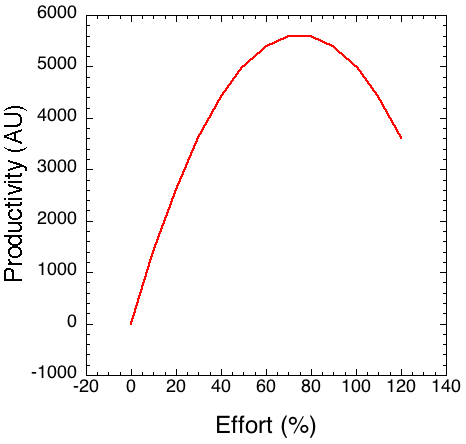
ProductivityPlotI just gave my State of the Lab address to orient the newest students joining the group to the ways of the lab. I have described the State of the Lab address before herehere, and here. In that address, I have a slide on how important it is to rest in science and to take breaks. It is very important to get a good nights sleep. It is essential to stop and eat. Doing exercise is also good for the body and mind. Taking breaks and getting sleep gives your mind a chance to work out solutions to problems. Ultimately, it makes you more productive to take these breaks. In the lab, I have been known to supply modeling clay for students to use during breaks. We ended up with a wonderful menagerie of little animals thanks to these breaks.

The entire discussion was prompted by the fact that I sometimes get a very hardworking and dedicated student who starts doing overnight runs and working non-stop. Inevitably, their Productivity goes down. I think that people of all ranks and stations do not realize that Productivity is not always a linear function of Effort. Figure 1 shows the true dependence of Productivity on Effort, which is really more of a parabola. I want my students to be in the linear regime of the curve. Although this is not the most productive location, the linear regime is good because if they need to give a little more Effort it will likely result in more Productivity. Indeed, being up at the apex, which does maximize Productivity, is very dangerous. If you need to add a bit more Effort, you will actually be less Productive. Further, that’s the region where small mistakes could cause accidents in the lab.

I was thinking about this over the past 2 weeks because I am living at or near the apex currently. Even my students told me that I need to get back into the linear part of the curve. They are right. I am running myself ragged, and it is only the second week of classes. This is because I am co-teaching 440 students in 2 sections for the first time and flipping the class to boot. The email burden alone is astounding. The most stressful part for me is having 30-50 unread emails in my inbox all day. I don’t even read them because I don’t have time to respond, so I read and respond in the evenings. This has been perhaps the most stressful, and I did not realize how much anxiety this would give me.  In addition, I had a paper returned from review that needed to be revised with 10 days (that’s the shortest turn around time I ever had).  Before I was given this teaching assignment (mid-semester last fall), I already made arrangements to travel 3 weeks during this semester for conferences. I am planning to use this time to actually work on research during the semester, which I would probably not have the opportunity for if I wasn’t co-teaching. I have two half-finished manuscripts that I need to get out before spring break! My service has also picked way up, and I am just barely performing there. I  dropped out of a few of the less important service items – even though one was university-wide.

I should say that even though I feel like I am at the apex, or perhaps past it, I am still getting 8 hours of sleep per night. Somehow I magically found Friday was easier, so it could just have been an adjustment period? Or maybe all the students don’t do my class on Friday. Only time will tell. So, I finally did have time to write this post on Saturday night.

So, where are you sitting on the Effort-Productivity curve? Post or comment!

Writing a Grant

Power of WordsWe had a nice post previously from Robin about the importance of grant writing. This post had some very good suggestions, and you can find it here. This post is more on the mechanics of writing  grant. Most importantly, you are staring at a blank screen, and you need to get some stuff out because the deadline in maybe a month away. Where do you start? What do you write? What needs to be in there and be included?

Apparently, there is big money to be made in answering these questions, because I get science spam at least once a day trying to sell me books, seminars, and webinars to address these questions. I actually do have one of these books – my university gave them out to us all at some point. I have to say that it was fairly useful because it listed all the parts of the grant that needs to be included. Obviously, if you don’t include a particular part of the grant, it is far less likely to get funded. But, so many people have these books now that the particular style described in these books has become a bit of a joke during review panels. Even so, it is better to follow one of those books and their format than to have no idea and do entirely the wrong thing.

When starting to write a grant, the first step is two fold: (1) read the call for proposals. Many calls, especially special calls, have specific required sections. ALSO, simultaneously (2) get some example proposals.  The last post on requesting proposals from others is a good guide on how to do this. It is best to get examples from the exact agency, division, and panel where you are going to submit.  Use these together to check come up with an outline for the components of the proposal.

Outline. Yes, outline. I know, it is boring and old fashioned to outline, and I am not suggesting anything too detailed. I am suggestions coming up with the headers for different sections of your proposal. To get you started, I am pasting in an outline I use (you can probably tell this is for proposals to the National Science Foundation):

Title

1. SIGNIFICANCE: Why is this important? You need to have the why before the what.

2. HYPOTHESIS: Not all divisions expect hypothesis-driven research. Get an example to see it this section is typical.

3. BACKGROUND:

4. APPROACH:

4.1 Experimental Methods and Preliminary Results: Here we outline our experimental approach and present preliminary results.

Experiment Type 1:

Experiment Type 2:

Experiment Type 3:

4.2 Simulation Methods and Preliminary Results: Here we outline our simulations/analytical approach and present preliminary results.

5. EXPERIMENTAL WORK PLAN:

Objective 1: State it here.

Rationale:  Why do we want to study this? Why is this objective important? Everyone needs a reminder.

Proposed Experiments for Objective 1: No methods. That is all described above. This is just the “what” experiments – not the “how” experiments.

Control Experiments and Alternative Methods for Objective 1: You must have something about controls and alternatives. They will look for it!

Significance of Expected Outcomes for Objective 1: This is where you drive it home why these experiments and results are important. Again.

Objective 2:

Rationale:

Proposed Experiments for Objective 2:

Control Experiments and Alternative Methods for Objective 2: 

Significance of Expected Outcomes for Objective 2:

Objective 3: This is the objective that can be a little more out there with less preliminary data.

Rationale: 

Proposed Experiments for Objective 3:

Control Experiments and Alternative Methods for Objective 3:

6. INTERDISCINPLINARITY, COLLABORATION WORK PLAN, AND TIMELINE:

6.1 Interdisciplinarity.

6.2 Collaboration Work Plan. I will do this. Collaborator will do that. I like to include a ven diagram figure that cartoons the roles of each person.

6.3 Timeline. You must have a timeline. I like to make a chart. Funding agencies requests it.

7. INTELLECTUAL MERIT AND TRANSFORMATIVE ASPECTS:

8. BROADER IMPACTS: Here is where I put grad student training, undergraduate student training, and any other outreach plans.

9. RESULTS FROM PRIOR SUPPORT: This has a specific format. Make sure you use it. If you don’t have prior support, you can remove this section.

10. SUMMARY. Reiterate the significance again.

Another secret to getting a grant done is to take advantage of the time you have. There will always be a time when you have time to work on the proposal, but not the drive to write. If that happens, use the time to work on the myriad of other things that need to be apart of the grant such as the Budget, Budget Justification, Your Biosketch (you the correct format!), your Current and Pending, your Facilities and Resources, your Postdoc Mentoring Plan, and other documents. These documents are pretty boiler plate with tweaks, so they don’t require a ton of thought, but you still need to do them. Or, just get your proposal started on the online submission system and input all the data.

So, this is my method. And, as far as grant writing goes, I have done a lot of it – almost a dozen per year. I might even be good at it. I am batting 1000 on my last 4 proposals. What do you do to actually write a proposal? Post or comment here. Click +Follow to get email updates when I write new posts.

Writing a Draft Manuscript

typewriterI have been working on a manuscript about some pretty nifty science. I have been working on it for some time, and I finally just submitted it last week. As part of the “how to write” series, I thought I would give my personal process for how to write a manuscript. I am sure there are as many ways to write a manuscript as there are manuscripts that have been written and published. This is my way, and it also how I instruct to my students to help them get over the hurtles of writing.

1. Make figures. Science is all about the data. The data is the story, so the first thing I do is make figures. This can be pretty challenging in and of itself. When working with students, I often have them make the figures – or at least the first draft of the figures. They often don’t know exactly what to do – even if they have presented some nice plots and graphs in group meetings. I usually sketch out the figures with them on the white board before I set them to work getting the data into figure form. Also, I try to get the students to think about the figures as they are taking the data. I usually sketch out plots when we discuss the experiments. If you are already thinking about your data in figure format as you take it, making the figures becomes much easier.

If you figures are missing data, if often become clear at this step. It is obvious that something – some data, some plot – is missing in the figures. We don’t go onto the next step until we have all the data in figure form.

Just FYI, I use Illustrator to make my figures. I hate Powerpoint. It does not allow very much control or good resolution. I know some people love Powerpoint for figures, but I think it is clumsy compared to Illustrator.

2. Long figure captions. After the figures are all made – with ALL the data – we write long figure captions. The figure captions include how we did the experiments, what the figure results show, and what the results mean. The point of a long figure caption is to have an easy way to move from the data to the rest of the manuscript. The “how we did it” becomes part of the materials and methods. The “what the figure results show” become the results section. The “what the results mean” becomes part of the discussion section. The point of the long figure captions is just to help students get over their fear of writing. It is much easier to write while you have a figure to look at and to write about.

3. Methods. I find that the methods are often one of the easier parts to write – especially for students. This is where they get to say what they did. One issue I find, especially when working with undergraduate authors, is that this section can be harder to write than it seems. Yes, it is just what you did, but it has a specific style. For instance, it is not helpful to describe the volumes used in your assays – it is important to describe the concentrations of the reagents. The experiment *should* work the same if you mix up 1 ml or 100 ml, as long as the concentrations are the same.  I have a few favorite papers of my own or from others that I think have particularly good methods sections. I often give these to students to read to help them get the style and tone in their heads before they write.

4. Results. I, personally, find the results easiest to write – especially if you have the figures made up already. Often, each figure is a section of the paper’s results section. Again, this is where one can just describe what the data says. I write as stream of conciousness from the images and describe the data. Doing it this way tends to make the paper a bit long-winded, and it needs a lot of editing, but it is better than to stare at a blank page. It is always easier to cut and edit than to come up with perfect words the first time. A lot of times, I end up writing implications or how the data relates to other work in this section. These ideas are really better suited for the discussion, but it is easier to write them here and move them, if they belong somewhere else.

5. Discussion. After writing the results, I write a discussion section. Sometimes, the results and discussion sections are melded together, and for each figure, I write results and then discussion/implications. If they are separate, I still often write discussion-like ideas in the results and just cut and paste them into the discussion afterwards. These are the starting point, and I expand the discussion from there. At this point, I often have to do additional reading of the literature in order to put my work into context. I add in the references as I think of them with some sort of demarkation that my citation software can recognize. I use {curly brackets} and author name and year. If I know I need a citation as I am writing, I might highlight {cite}, so I can go back and find it later.

6. Introduction. I write the introduction after the discussion. How else will I know what topics I need to introduce and background literature to ground the work until I know the results and implications. I often need to do more reading at this point to make sure I have good and correct references. I insert the citations as I describe above in the text as they come up in the introduction. I often have to read other introductions, especially if I am stuck for words. By this point, I have a good idea of where I am sending the manuscript, so I read introductions from published papers in the same journal to get the style in my head.

7. Abstract. After the paper is pretty much written, I then write the abstract. The abstract is difficult because you need to be brief, for some journals less than 150 words! But, you have to get all the information of why it is important, what you did, and why is matters to the field. Again, I often write something much longer and have to cut cut cut. I think of an abstract as an inverted pyramid – start broad and focus down. You also want to hook the reader – tell them why this work is important early on so they want to read the paper.

8. Other stuff. This stuff I kind of do when the whim hits me. If I am having a hard time writing, then I might write the Acknowledgements section. This takes looking up all the funding agencies and getting the numbers. I had it on a sticky note (an electronic one on computer – not an actual sticky note), but I started being more organized with it all in an excel spreadsheet. Something like the title might change as the paper is being written and different important parts come into view. I like it to represent the results or the implications – it depends on the journal. The authors and author order are usually obvious and depend on the amount of effort, type of person, and the field you are in.

9. Cover letter. The cover letter. I think this is very important, and I think I have been doing it wrong until recently. Once you know the story, the cover letter is the place where you sell it to the editor. The higher “impact” the journal, the more important the cover letter is. This is especially true if the scientific editors are professional science editors and not Principle Investigators acting as editors. You have to educate the editor about how important your field is and why your work is an important piece of the puzzle that was missing until now. You have to discuss what your results are in laymen’s terms – like when you write a proposal for generally educated scientists who might not be right in your field. It must be clear and convincing.  I hope my recent cover letter works. It is far superior to any cover letter I have even submitted before now.

10. References. This is the absolutely last thing I do. Many of the references are being inserted in {curly brackets} along the way, but some will still be missing. They will also be missing from my reference software, so I have to spend some time getting all the citations into that, too. I personally do not use EndNote, but many people do. I use a program called Sente. Either way, I have to get the references into this software system to get inserted at the end. Once my references are inserted in the journal’s style, I cannot modify them or add more, so this is why I wait until the very very last to insert them – otherwise, I am wasting my time.

Before putting in final references, I have my entire lab read and edit the paper. They edit for typos, grammar, spelling, and tell me if things are not clear or confusing.

After all these steps, then I spend a lot of time submitting. The submission processes online are actually easier now than when I was a graduate student, but they still take several hours of inputting names by hand and getting the figures, tables, and writing all uploaded. So, even when you are done with the manuscript, you aren’t quite done.

And there it is, now you have a submitted manuscript! Easy, right? No, but it works, and it is relatively painless – at least for me. So, what are your tricks for writing manuscripts? Comment or post here.

Better Self-Organization

2475011402_bf70c92575_o‘Tis the season… for writing a huge number of letters of recommendation. This is happy, but I am always worried that I will miss one and be the reason why some poor person didn’t get into UniversityOfTheirDreams. It is a big responsibility to be a letter writer, and I do not engage in this activity lightly.

Each student who asks me for a letter, I require them to send me a statement of their research and give me a CV or resume. This helps me to write a better, more informed letter. It is also the same as when I suggest that you prep your letter writers in previous post. You should always have a conversation and give them written information to help your letter writers.

I have also started something new this year to help keep myself organized: a list. This year, I am asking all  students who ask for letters to give me a list of the schools to which they are applying, so I can make sure I send them all. Most students were surprised that I asked for all this information. But, it is all part of my new leaf to be better organized.

My new organizational schemes have been working most of the semester, and I am happy to say. Another thing that I rehashed was to have a notebook I always have with to do lists and notes for work. Much like a lab notebook, which I was really excellent at retaining, this notebook has all my important information. This semester, I ticked off entire do lists. Sadly, as soon as one was complete, I was able to create a new list de novo from my memory entailing an entire page work of more “to dos.”

I have also started a spreadsheet for manuscripts to track their progress and what I still need to do. This idea came from another, very coordinated WomanOfScience. It is a little disheartening at first to see all the papers I need to work on laid out in their various states of incompleteness, but it is also good to see when they make progress. I am hoping to clear some into the submitted regime over winter break.

So, what about you? Any special organizational schemes to keep on top of your work? If so, please share.


Tag Cloud