Helping the Minoritized Achieve in Academic Science

Archive for the ‘Career’ Category

Management: Progressive Discipline

Skamvrån_av_Carl_Larsson_1894OK, the final topic from my management course that was new to me was Progressive Discipline. I am sure my friends in industry and the private sector will scoff and laugh at my ignorance, but I had no idea what this was. I also had no idea how to enforce what I wanted to happen in my group. If someone didn’t listen to me (they were insubordinate – another word that I “knew” but didn’t use before my management course), I would ask them to change and when they didn’t I would fire them. It wasn’t usually one strike and you are out, but I would not have any nuanced response. I didn’t have the  knowledge of progressive discipline.

So what is progressive discipline? Progressive discipline is the process of using increasingly severe steps or measures when an employee fails to correct a problem after being given a reasonable opportunity to do so. As you know, I have a Research Group Rules document, when I have described in the past (described here and here). After learning about progressive discipline, I updated the lab rules to include a section about it. Here is what the new section says:

Progressive discipline

  • Failure to comply with these rules or other requests made by me or failure to fulfill your assigned duties will result in the initiation of progressive discipline.
  • Warning. First indication of a problematic action will result in a conversation with me. A follow-up email to you from me will follow the conversation so that you are clear about the problem and the solution.
  • Official Verbal Warning. If the problematic actions persist, you will receive a verbal warning. The verbal warning will be documented and the documentation will be sent to your union (postdocs or other unionized workers), to your graduate program director (graduate students), to your undergraduate/major program director (undergraduate) and to the departmental personnel and business directors.
  • Official Written Warning. If the problematic actions persist after the verbal warning, you will receive a written warning. The written warning will be documented and the documentation will be sent to your union (postdocs or other unionized workers), to your graduate program director (graduate students), to your undergraduate/major program director (undergraduate) and to the departmental personnel and business directors.
  • Dismissal. If the problematic actions persist after the written warning, you will be dismissed from the laboratory. The dismissal will be documented and the documentation will be sent to your union (postdocs or other unionized workers), to your graduate program director (graduate students), to your undergraduate/major program director (undergraduate) and to the departmental personnel and business directors.
  • For undergraduates receiving a grade for credit, a verbal warning or worse will result in a lower grade for the semester.
  • There are two offenses that will result in immediate discipline and possible dismissal from the lab:
    • Safety violations. Actions that endanger the safety of the lab, yourself, or your labmates will result in immediate dismissal from the lab. You have many opportunities to learn how to conduct your experiments safely in the lab including Health and Safety training classes and online courses, the BootCamp, and this Lab Rule guide. Safety violations will not be tolerated.
    • Insubordination. Failure to perform your duties as outlined in your contract, in this Lab Rule guide, or verbally conveyed from WomanOfScience will result in immediate verbal warning (see above) or higher level discipline depending on history of insubordination.

This all sounds very strict and formal, but I think it is better than randomly firing people, which is what I felt like was my only recourse before. For each type of discipline that requires documentation, there are example letters with fill-in-the-blank regions to put the name and date and to fill in the offense. Examples can be found at your HR office and online.  Another note is that the written warning is a big step because it the last straw before termination/dismissal. For that step, you must have a lot of documentation. This is partly why you are documenting about your people (see last post), but also, you may need corroboration from others in the group.

Although this may feel like gossip or talking behind someone’s back, you need to gather this evidence. If someone keeps leaving the door to the -80C freezer open, you must find out who is doing it. If all fingers point to ParticularPerson, you must be able to find out to have a talk with ParticularPerson. Often other students in the group don’t want to rat out someone else, but you need to tell them that you cannot remedy the situation if you do not know the specifics. It is important that they feel comfortable telling you what is going on. Further, if you ask all the people in the lab, and 4/5 say it was ParticularPerson, but ParticularPerson says it was SomeoneElse or there isn’t an issue, then you have decent evidence that it was probably ParticularPerson doing the offensive activity.

Finally, different unions might have different rules for progressive discipline and the steps in the process. That being said, I have never once had a union-rep come to talk to me about this or tell me what the steps are. They are praying on your ignorance. If you fire a unionized person without using progressive discipline, and that person complains to the union, you could get in serious trouble and risk being sued by the union. Make sure you are aware of what the unions require.

So, what do you think? Going to try progressive discipline? It can really work to turn someone around and help you manage them better. It can also relieve you of guilt and stress because you have a rubric for getting rid of someone. You don’t have to sit with a terrible, lazy, nogoodnick in your research group waiting for the grant or contract to expire. You can take action and cover your butt at the same time. If you have other ideas, post or comment here. To get an email whenever I post, push the +Follow button.

Management: Documentation

documentationMy management course is now officially over. I feel that I learned a lot. I think I will actually be a better manager. That doesn’t mean I am terrible now, or that I will be perfect later, but I have gained the knowledge of several specific activities/actions that I can do to be a better manager. The last two things I will endeavor to do better are (1) documentation and (2) progressive discipline. In this post, I will discuss my new approach to documentation.

When I took the management course I thought I was documenting what was going on in the lab enough. Here is what I was doing before:

  1. I have people give weekly lab meetings. They make a weekly Powerpoint that goes into a Dropbox Folder.
  2. Everyone is supposed to write a report at the end of each semester and at the end of the summer. The report has specific things for them to write about. It includes them doing a self-evaluation.
  3. When I met with people one-on-one, I took notes in some notebook.

But, I realize that I can’t remember what people in the lab did over the entire last year. I can only remember the last 3 months. And, I don’t go back to look at those things they produced before. Sometimes they don’t do what I ask, and I don’t have Powerpoints in Dropbox or end of semester reports. Then, I have nothing to document what they did. Further, these are all self-documentations of stuff they did as they saw it. It is useful, but they are not necessarily my impressions of what they did or (more importantly) how they performed. I realized I needed a new system.

My first thought was to have paper files for each person where I write my thoughts and comments, but then I was worried my office might look like that picture above, and decided against it. Instead, I asked around at the management course, and a couple of people there were already documenting things well. They have a word document (or other program- pick your favorite) for each employee. Whenever the person does something good, they write it down and date it. If the person does something bad, they write it down and date it. By the end of the year, when they need to do an annual review, they have all the goods and bads documented, and can just pull up the document and read it to remind themselves.

Based on this approach, I made my own plan. Here is my plan:

  1. I have a word document for each person.
  2. When I have a one-on-one meeting with the person where we discuss what will be done, experiments, things for graduate program, tasks, I will write it up there and date it. For tasks and assignments, I will copy and paste it into an email, so we are all on the same page.
  3. I will also monthly or twice a month write my impressions from the most recent weeks. I will say things like, “GradStudent did a good job this week on xyz experiment,” or, “Postdoc was OK, but needs to focus on ABC and defocus from LNMO. Jenny will have a discussion with Postdoc about this within a week.”
  4. I will use this information for grad students when talking to their committees. I will use this information for postdocs when writing their letters for jobs. I will use this information for undergrads when writing letters of recommendation or determining their grades for semester research credits. I will use this information for technicians when performing their yearly evaluations.
  5. I will use this information when documenting performance and if I need to implement “progressive discipline.” What is progressive discipline? Tune in next time to find out more.

So, what do you think of this plan? I think the hardest part will be remembering to do it. Remember to bring your computer. Remember to open the document while talking. Remember to make notes on the person once a month or so. I have held on for a month so far.

Are their any suggestions you would recommend? I am open to alternatives. Comment or post here. Also, to receive an email every time I post (I promise to be better once I get over the current hump in work load), push the +Follow button.

Management: Delegation

I was feeling pretty down about how crappy my meetings are. I am glad to hear that not all academic meetings are so bad from readers and friends. It gives me hope that my meetings will go better if I try and practice good meeting habits.

The same week, we also talked about delegation. As bad as my meetings are, my ability to delegate was inversely awesome! We took a little quiz, and I scored great on it. Take the quiz here:

Delegation Quiz:

YES NO
1. I spend more time than I should doing the work of my students. Y N
2. I often find myself working while my students are idle. Y N
3. I believe I should be able to personally answer any question about any project in my group. Y N
4. My inbox mail is usually full. Y N
5. My students usually take the initiative to solve problems without my direction. Y N
6. My research group operates smoothly when I am away. Y N
7. I spend more time working on details than I do on planning or supervising. Y N
8. My students feel they have sufficient authority over personnel, finances, facilities, and other resources for which they are responsible. Y N
9. I have bypassed my students by making decisions that were part of their job. Y N
10. If I were incapacitated for an extended period of time, there is someone who could take my place. Y N
11. There is usually a big pile of work requiring my action when I return from an absence. Y N
12. I have assigned a task to a student mainly because it was distasteful to me. Y N
13. I know the interests and goals of every student in the research group. Y N
14. I make it a habit to follow up on jobs I delegate. Y N
15. I delegate complete projects as opposed to individual tasks whenever possible. Y N
16. My students are trained to maximum potential. Y N
17. I find it difficult to ask others to do things. Y N
18. I trust my students to do their best in my absence. Y N
19. My students are performing below their capacities. Y N
20. I nearly always give credit for a job well done. Y N
21. My students refer more work to me than I delegate to them. Y N
22. I support my students when their authority is questioned. Y N
23. I personally do those assignments one I can or should do. Y N
24. Work piles up at some point in my operation. Y N
25. All students know what is expected of them in order of priority. Y N


Scoring:

Give yourself one point each if you answered “Yes” for #5, 6, 8, 10, 13, 14, 15, 16, 18, 20, 22, 23, 25

Give yourself one point each is you answered “No” for #1, 2, 3, 4, 7, 9, 11, 12, 17, 19, 21, 24.

Score 20-25: You have excellent delegation skills that help the efficiency and morale of your research group. You maximize your effectiveness as a leader and help develop the full potential of your students.

Score 15-19: Your score is adequate, but not excellent. To correct, review the questions you did not receive a point for and take appropriate steps so as to not repeat the mistakes.

Score <14: Inability to delegate is reducing your effectiveness as a leader. This results in lower performance. Determine if you are unwilling to relinquish power and why. Inability to delegate can cause dissatisfaction among your students. They will not develop job interest and important skills unless you improve.

How did you score? I had a 22/25. The other classmates, who all work in regular offices or as crew managers, were grumbling about my awesome score. One person said, “I know what the correct answers are, but I answered honestly,” (not meanly, but in a dejected sort of way). The thing is, delegation is essential to running a research group. If you do not properly delegate, you will probably not succeed at running a research group in academic science.

The reason for this is two fold:

1. You cannot do all the things to get this job done by yourself. You will not be able to do all the research, write all the papers, make all the figures, write all the grants, teach all the courses, review all the papers and grants, serve on all the committees, yadda yadda yadda. Delegation is a matter of survival.

2. Your job is to train people. The best way to train someone to replace you is to give them some parts of your job to try out. This means not just doing the research, but all practice writing the papers and making figures, practice giving the talks, even practice reviewing papers. These things will have to be done with more or less supervision depending on the student’s abilities and maturity in research. But, by delegating tasks, the student will learn, feel apart of the team, and you will get more work done.

Another reason why I can delegate more than my peers in the management course is that running a lab is like running a small business. I can run it how I see fit. Delegating certain responsibilities of the job to my students make me more effective and efficient, so I take full advantage. I can also hire and fire, which many of my peers cannot do. If someone really can’t handle any task I give them (including research), I let them go. I don’t think it does anyone any good to keep someone in the lab who cannot make any contribution at all.

What do you think? Is delegation important? How well do you delegate? Is there a difference between delegation and training? Post or comment here. To receive an email every time I post, push the +Follow button.

Management: Effective Meetings

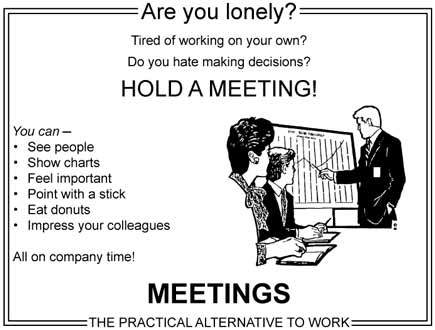
hold-a-meetingThis week at my supervisory management course, we learned about something I wish every single one of my colleagues would learn: how to have an effective meeting. As I am one of only a couple of faculty members in this course, it was quite startling to compare/contrast the types of meetings I am used to, to the types of meetings my colleagues on staff have. I would say that many faculty meetings have a lot of talking. In fact, in recent meetings that I have run (poorly), all I did as the meeting lead was stand at the front, mentally note who raised they hand when, and make sure people spoke in order and didn’t trample over each other. We spoke for over an hour! Just talking one after another. I also took notes in a notebook or on a black board so that I could transcribe them later. There are so many things wrong with how I run my meetings, it is ridiculous. But, these meetings are weird, because they are between a bunch of people who are basically equals who all like to talk – a lot, and all think that they are the smartest person in the room. That makes faculty meetings harder. When I have a lab meeting, where I am clearly the top of the hierarchy, they run very differently – maybe more like my counterparts’ meetings. I run the meeting, I set the agenda. People talk and comment, but I control it and don’t let it derail. Actually, sometimes I do let it derail because I like to make a fun environment and chatting is part of that.

What is the definition of an effective meeting? Meetings are effective when the goals of the meeting are achieved using a minimal amount of time and all participants are satisfied. Most meetings can be classified into two types: Information and Decision Making. Information meetings are used to convey information to a group or convince a group of something. Decision Meetings are used for goal setting, problem solving, and action planning. Most of the meetings I seem to have in academia, both with my research group and with colleagues on committees seem to be the second type. Straight information is (thankfully) usually conveyed in email format. Although sometimes it is useful to convey information in verbal forms (if it might get people upset, for instance).

Below are 10 characteristics of Effective Meetings. Here is a fun exercise: score your typical faculty meetings using the following rubric:

0 points if this never happens/never done for meetings,

1 point if you are not so good at this or this rarely happens in your meetings,

2 points if you are OK at this, or this occasionally happens in your meetings,

3 points for being generally good at this and this normally happens in your meetings,

4 points is your meetings always have this.

Score       Attribute

____     Seating in the room is arranged so that every person can see everyone else.

____     Equipment is available at the front of the room to record ideas/plans.

____     Your meeting has an agenda.

____     The agenda has time estimates for discussing each topic of the meeting.

____     At least 1-2 times in the meeting, there is a probe into how effective the meeting is going.

____     During the meeting someone records the ideas and decisions of the meeting. The data is prepared and handed out afterward to all concerned.

____     Meeting notes indicate who has agreed to do what before the next meeting.

____     Dates of future meetings are set in advance so people can arrange to attend.

____     Those in attendance decide who else should be involved for future meetings and those people are included.

____     At the end of the meeting, people review and confirm who is doing what.


So, how did you score? I score quite badly (about 13 out of possible 40) – getting a zero in many of the attributes. I often do not have an agenda and it certainly doesn’t have times set for each part. We always have a place to write notes – chalk/white board and projector, but most of the time someone doesn’t take note. I usually take notes, but sometimes I don’t have the time to transcribe and distribute them. Have you ever been to a meeting where it was stopped and someone asked how it was progressing? Big, fat goose egg on that one for me. Never, ever happened ever. Dates of meetings set in advance. Does 24 hours ahead of time count?

Are these things feasible to do at meetings in academia? I think they are, and I think it would make meetings more useful and less dreaded. I am going to endeavor to implement these attributes into my meetings from now on. I hope my colleagues say, “I love having meetings with WomanOfScience running them. They are so efficient and effective. We get stuff done without wasting time!” OK, that might be wishful thinking! What do you think? Post or comment here. To get an email every time I post, click the +Follow button.

Management: Know Thyself and Themselves

Myers-BriggsThe first week of the supervisory management course was all about getting to know who you are and who the people you manage are. The course I am taking decided to go the classic route: Myers-Briggs. The Myers-Briggs is a personality test that classifies your personality using 4 descriptors. Also, did you know that Myers and Briggs were a mother-daughter science pair? Pretty cool. Anyway, in the test, you answer some questions, and it uses your answers to give you some feedback about your personality. You can find an online version here. Other versions cost money, and are more detailed, but they are pretty similar. I should say that almost everyone I talked to who took a management or leadership course started by taking some sort of personality test. It didn’t really matter on the exact type of test, but they all basically had the same result – getting to know yourself.

After you take the test, you get put into personality type categories. For the Myers-Briggs, the four categories are:

Extravert (E) or Introvert (I)

Sensing (S) of Intuition (N)

Thinking (T) or Feeling (F)

Judging (J) or Perceiving (P)

Some of the names are unfortunate because there are good/bad connotations, but you have to understand that each one is a measure of how you intrinsically deal with the world in a variety of ways. Also, the personality type you get depends on where you are and what you are doing. For instance, my personal personality type was different when I was at home with my kids than when I was at work.

Extravert (E) or Introvert (I): This is about energy. How do you draw energy and what spends your energy. If you are an extrovert, you get energized by hanging out with people and talking. Being alone is draining for an extravert.  If you are an introvert, hanging out with people is tiring and takes up energy, but being alone is revitalizing.

A fun exercise to do with your research group: Have them line up based on how extroverted or introverted they believe they are with extreme cases at the far ends. Working with the 2-3 people nearest them have them answer this question: How do you feel and act if you have to go to a party for work? Do you want to go to the party? When you are there, who do you talk to? The answers are quite interesting. You will find the introverts will not want to go to the party and will only talk to people they already know. Extraverts will be fine or excited about going to the party and will talk to all new people.

Things to think about when managing or talking to extraverts: They think out loud and may say things off the cuff but not truly believe them. They may seem more into or excited about things than they really are. They often hate silence in conversations.

Things to think about when managing or talking to introverts: They are more likely to think before speaking and may need time to think about the ideas before they answer. They may seem unexcited or less attached to ideas than they actually are. They are comfortable with silence in conversations.

Sensing (S) of Intuition (N): This is about information gathering. How do you notice or take in information about the world around you. Do you notice the forest (broad, general) or the trees (individual components, close). If you are a sensing, you are interested in the details and have a high attention to detail – you are interested in the trees.  If you are an intuition, you are interested in generalizations and larger concepts – you are interested in the forest.

A fun exercise to do with your research group: Have them line up based on how sensing (detailed) or intuition (general) they believe they are with extreme cases at the far ends. Working with the 2-3 people nearest them have them answer this question: Give directions from the room you are in to your house. Sensing people will give very specific directions using cardinal directions, street names, and landmarks. They will likely even give directions about how to get to the street from the room. Extreme intuition people will give very general directions – maybe point toward their house and say, “that way.” In my research group, people were pretty in the middle, which I think is a good thing for experimental scientists. They are focused enough to see the details to follow the directions correctly, but are interested in the big picture about what the experiment is saying.

Things to think about when managing or talking to sensing: They will need a lot of details. Giving general directions about what you want them to do, will not work. If you are an extreme intuition person, you will have to try to be a bit more specific when talking to students who are sensing.

Things to think about when managing or talking to intuition: They will be fine with less detail, and will think you are micromanaging, if you give them too much detail. On the other hand, they might not be able to determine the details and might not have an attention for detail needed for complex experiments or analysis.

Thinking (T) or Feeling (F): This is about decision making. What do you consider most when making a decision? Do you rely on facts? Or are people’s feelings more important to you? If you are thinking, you make decisions based on the facts and that is more important than people’s feelings. You will be a hard-ass, if you need to be. If you are feeling, the most important thing to you is how others feel. The facts are not as important as making others happy.

A fun exercise to do with your research group: Have them line up based on how thinking or feeling they believe they are with extreme cases at the far ends. Working with the 2-3 people nearest them have them answer this question: How do you pick a gift for someone else? Thinking people will try to pick out something useful and extreme thinkings will just opt for money – the ultimate useful gift. Feeling people will not just want to buy a personal gift, they will often want to make the gift for the person. As a follow-up question, ask them: Do you want to be present when the person opens the gift?

Things to think about when managing or talking to thinking: They will value and be convinced by facts over emotions of feelings. Use data and facts for examples and to convince them of your decisions.

Things to think about when managing or talking to feeling: They will care more about the personal feelings of people. You can make emotional pleas with them to convince them of your decisions.

Judging (J) or Perceiving (P): This is about how you organize yourself and your work. Judging people will pursue things linearly. They make lists, and they have a straight-forward approach to solving a problem. They don’t necessarily have clean desks, but the mess is organized. They prefer deadlines and might self-impose deadlines. Perceiving people work sporadically seemingly on disparate parts of the project. They can seem disorganized and often work best under pressure of a deadline.

There is no fun exercise on this. Most people think that the judging way of doing things, with making lists and approaching problems linearly, is the best way to go about getting work done. Because of that, most people will think they are judging, even if they aren’t.

Things to think about when managing or talking to judging: They will work best when given direct instructions in a linear fashion. It is best to give them deadlines and specific straightforward instructions.

Things to think about when managing or talking to perceiving: They will work best on a variety of things within a bigger project at the same time. They will need help keeping track of what they have already done, and making sure they don’t lose track of the tasks needed to be done. Many people are naturally perceiving, but try to force themselves to be judging. By understanding their true nature, you will at least understand their natural tendency, even if you both agree that a linear fashion is the best way – it might not be possible for a perceiving person to perform their tasks linearly.


I did these activities with my lab and I asked them to take the Myers-Briggs. They thought it was fun and interesting. It was a great way to get to know their peers and how they experience the world. It was super fun! I have a WomanOfScience friend who says she has always done this with her research group, and it really helps her to understand where her students are coming from and how they make decisions and can be convinced and persuaded of what is best for them (this is important when giving feedback – more on that in future posts!).

What do you think? Do you do this? Do you already know how your students are? Post or comment here. To get an email every time I post, push the +Follow button.

More Management Stuff

S._Sgt._Lorraine_Robitaille,_switchboard_supervisor,_from_Duluth,_Minnesota,_looks_down_the_line_of_the_Victory..._-_NARA_-_199009Over the past year and a half of this blog (has it been that long?) I have had a number of posts about research group management (i.e. here, here, here, here, herehere, and here). Wow! That’s a lot. I spend a lot of time thinking about how to manage my group well, but I don’t always think that I succeed. I had previously lamented before that I could not find a course locally to help with leadership or management. Well, I am happy to say that I have found and I am currently enrolled and taking such a course at my university.

How I found a course: Every year, we get a flyer about workplace development at UState. In some years, I went through it looking for interesting courses that would help me, but found nothing. Other years, I was so overwhelmed with stuff and getting tenure that I have no idea if i even got the flyer. This year, I noticed, looked, and saw two courses. One was half day workshop on stuff that seemed useful, but the one I signed up for meets 7 weeks for three hour sessions and is about being a Supervisor. A supervisor! That is what I am! I was using the wrong word before. This is why I stink at Googling. Anyway, I found the course and signed up.

Who this course is for: This course is geared toward anyone at UState who supervises others. It is also geared toward staff. The course has a majority of participants who are on campus staff, several participants who work for local non-profits and the local town governments, and two professors – myself and another WomanOfScience I convinced to take the course. The sessions are 3 hours every week for 7 weeks, and the time is during a seminar that I normally attend, so I am giving up some things to attend this course. I was a bit worried that they wouldn’t professors take the course, but we were welcomed to the course.

Is it good?: We have had two sessions (I will talk more about them in follow-up posts), and I am very happy with it. I feel like I am learning a lot! I would highly recommend taking  course like this. Also, having the course mostly filled with “normal people” who do not live for their jobs, but rather deal with a 9-5 business is good. It is great to see that they have similar issues that academics have. The course is taught in an active learning style where we discuss in small groups, share with the class, role play, and often do kinesthetic activities. Also, even though it is 3 hours, the time flies by, because the topic is interesting and I am very excited in learning about it.

So, I will be giving some updates about both the lessons I am learning and the effectiveness of trying to implement these lessons over the next few weeks. Stay tuned to have a bad version of a second-hand management course. To get an email every time I post, push the +Follow button.

Miscarriages Happen

ICSI_WebAlthough a lot of the advice and stories on this blog are not necessarily for women only, there are some issues that are specific to women. For instance, I should have taken more bathroom breaks during my recent seminar trip. I was saved by wearing very dark jeans… The women know what I am talking about.

During my seminar visit, I had an explosion of women’s issues emails from 3 different women. Many of these were really specific women’s issues, and this post is one of them. Please enjoy!

I’ve had three miscarriages. There, I said it. I asked to write this guest post to highlight the cultural taboo against discussing miscarriages and infertility, and argue that this is a BAD THING. It’s a double standard that hurts women, especially those in academia with the special time pressure associated with being on the tenure track.

I am an assistant professor at Average Private University; this is my fourth year on the tenure track. Overall I really like my job and my department is great and friendly. My husband is also an assistant professor at APU, so we managed the two-body problem, which is a whole separate post. I have one wonderful daughter who is a year and a half old. Between her and the three miscarriages I’ve been pregnant or breastfeeding for about 3 of the 3.5 years I’ve been on tenure track.

Only two of my department colleagues know this. I have generally been fairly sick during the first trimester of pregnancy: vomiting, dizziness, extreme fatigue. But I didn’t feel comfortable telling most work colleagues about these issues, because you’re not supposed to tell anyone you’re pregnant until the second trimester. Why? Because what if you miscarry?

All three miscarriages also happened late enough in the first trimester that my doctor recommended surgery. In some sense I was lucky; I can’t imagine having a miscarriage or stillbirth in the second or third trimester. But in any case, I had to go in for outpatient surgery three times over the past three years. Of course, all three had to be scheduled during important faculty meetings. Did I feel comfortable explaining to my colleagues why I was absent from these important faculty meetings? No. Now I wonder how many of them think that I’m flaking out on faculty meetings and shirking my responsibilities as a faculty member.

This is bull. If my non-pregnant colleagues had the same symptoms I did, they would definitely go see a doctor, perhaps even take a few days of medical leave, and most of them would be perfectly willing to explain to other colleagues that they were behind because they weren’t feeling well. They would certainly tell a colleague they missed a faculty meeting because they had surgery.

This is not just academic. I know of a colleague who struggled with infertility (which can also be a taboo subject) and missed a lot of department functions/meetings while dealing with testing and treatment for that issue. Her department did not strongly endorse her for tenure, and the tenure process turned into a mess. While of course there’s a lot more to the story, I think the fact that she was dealing with infertility instead of a different medical issue made it more difficult for her to get the time off of work and the empathy and understanding of her peers.

And its not just work colleagues. Over the past three and a half years, I’ve turned down countless social invitations and opportunities to have fun because I was too “morning sick” to go or I didn’t want to explain why I wasn’t drinking alcohol or I was too emotionally/physically exhausted from the miscarriages themselves. In many cases, people have just stopped inviting me because I never say yes, and I don’t blame them. I’ve also heard more than a few stories of women who went to great lengths to hide the fact that they weren’t drinking due to pregnancy; one friend would fill up an empty beer can with water and carry it around for an entire party. Can I just say that THIS IS INSANE? I – we — should be able to explain to social acquaintances and potential new friends that we are sick and/or pregnant and provide some context for our absences or behaviors.

Why are miscarriages and infertility such a verboten subject? Many reasons, of course. It probably ties into our society’s general ambiguity about the human status of a fetus throughout pregnancy. I think it mostly ties into the fact that for almost all of human history, women who couldn’t (or chose not to) have babies were third-class (or worse) citizens. Women were supposed to have babies, and if they couldn’t, it was due to an inherent flaw in their womanhood. While most of us would acknowledge that this is complete crap, that narrative persists in our collective inability to discuss miscarriage and infertility.

It’s certainly not uncommon; unfortunately about 50% of conceptions end in miscarriage. To me as a scientist, it’s amazing that something as complicated as human development works out at all. (Of course, if it didn’t, we wouldn’t be here.) According to the US Department of Human Health and Human Services, about 10% of women struggle with infertility.

The statistics on miscarriage and infertility especially suck for academics. As discussed elsewhere, we often have to make difficult choices about when to try to have children, if we want them. Many folks (including me) decide to postpone until we get a tenure-track job (typically late 20’s, early 30’s) or get tenure (typically mid-to-late 30’s and beyond). This puts us at greater risk for miscarriages and infertility issues, and it also puts an increased pressure to keep trying NOW despite the emotional and physical toll of dealing with these medical problems.

So, what can I (we) do? I think that if I do have another pregnancy, and I have medical symptoms, I am going to openly tell colleagues early in the first trimester. It may make them a bit uncomfortable, and it will be difficult if I have to tell them that I miscarried again, but I think it beats the alternative, which is worrying that I might have a problem with tenure because of it. It also means that I can finally explain to people why I’m turning down social invitations, and say that I’d sure like to be invited again in about three months.

In general, I think women (and their partners) should be more willing to talk about our miscarriages/infertility and the way it affects our lives. By talking about it, we can make sure that women who experience these issues get the support they need instead of falling behind. Miscarriage or infertility is not something to be ashamed of, and it certainly shouldn’t hurt a person’s career.

So what do you think? What would you do? Tell early so people understand your medical conditions? Or not let them know because it is really none of their business. It is a tough call, but one we all have to make. Comment or post here. To get an email every time I post, push the +Follow button.

Sabbatical Report

cycling_sabbatical_by_katandkitty-d5eakjxI have two WomenOfScience Friends who just went away got sabbatical with entire family in tow. I have been asking them to write a blog entry about the do’s and don’t’s of going on sabbatical, but it turns out, when you go on sabbatical, life gets really hectic when you get back. Note to self: Life After Sabbatical is rough – try to take it easy.

Anyway, despite the huge amount of work and catch-up, I got one to write a little “report” on reflections on her sabbatical. If you like this blog, push the +Follow button to get an email every time I post.  Enjoy!

My husband and I are both faculty members at the same university. This past year we took an amazing sabbatical for the entire academic year. We called it “Our BIG Year.” We were fortunate enough to both be awarded fellowships that helped to support our sabbatical research. We spent the first half year in Tokyo, Japan. I worked at the University of Tokyo and my husband worked at Keio University. Our two young sons attended day care and kindergarten in traditional Japanese schools where no English was spoken. The second half of our sabbatical was in Paris, France. I worked in a laboratory at the Pasteur Institute and my husband had an appointment at Paris 12th University. Again our two sons attended day care and at that point 1st grade in a typical French school.

For me there were two major concerns going into the sabbatical. The first was maintaining the base I had worked hard to establish in my research group during my first seven years as a faculty member. My second concern was about how my kids would adapt to multiple school situations on two different continents both taught in languages with which they had very little to no experience. I would say that my concerns were appropriate; those were the two major areas that most impacted my sabbatical experience.

When I applied for fellowships and sabbatical, I imagined that I would have a senior postdoc/research assistant professor to act as a stabilizing force in my laboratory while I was away. Due to some unforeseen funding changes, and problems with the visa of the postdoc/research assistant professor, I was not able to have that stabilizing force present in my lab I was gone. I decided to go on sabbatical anyway. Overall, it was a truly amazing experience, and I’m glad that I did it. In case you are considering a “Big Year” here is my list of considerations the next time I consider a sabbatical:

  1. One year was a very long time to be away from my research group without a senior staff member. I think 6 or 9 months would have been okay but one year was too long. I am afraid that some of my graduate students may have suffered a little bit during my absence. One graduate student decided to leave the lab about 5 months into my sabbatical. I think he would have stayed in the lab if I had not been abroad. This was the most significant casualty of my year-long sabbatical.
  2. The kids were extremely resilient. It was very difficult for them for the first month in both Japanese school and French school. Our 1-year-old had never had any problems at daycare drop-off in the US, but for the 1st month in Japan started crying the moment we left the house saying I don’t want to go to daycare. The transition for him seemed to be much harder than for six-year-old son. But after 4 to 6 weeks both of the kids were happily playing with the Japanese or French classmates, so I think the painful transition was worth it. Our dinner table conversations are now conducted in the melange of three languages. My six-year-old son loves to speak French and Japanese and recently told me “I’m thinking about taking up a new language, maybe Chinese.” He certainly takes pride in being multilingual.
  3. For both halves of my sabbatical, I established entirely new interactions with my host labs. I did not have an established collaboration before I approached either of them about being a sabbatical visitor in their lab.   Given the constraints I had with the responsibilities of mentoring my graduate students and the very real need to land and renew grants to support my research program, I could not devote all of my time to working in my sabbatical lab. I think the sabbatical would have been quite a bit more productive if I had gone to a lab with whom we were already involved in an ongoing collaboration. While my sabbatical was productive, I can imagine that a sabbatical could be even more productive under different circumstances.
  4. In both Japan and France I did (some) lab work. Of course it was highly inefficient, because I was in a new laboratory. I thought every day “If I’m going to be spending time in lab it’s really a pity that I’m not spending this time in my own lab in the US with my own graduate students.” On the other hand, I know that if I had stayed in the US for my sabbatical, I would have spent that extra time doing university related work, not lab work – because I’m not good at saying “No.”
  5. Due to financial considerations, we rented our house out. I tried to be mentally prepared for the fact there could be damage done to our house. Still, I was surprised upon our return. In the future I would definitely hire a management agency to deal with the renters, the assessment of damages, and the return of deposit.
  6. I had heard that Parisians dislike Americans and were extremely rude to Americans. I found the opposite to be true for us. We lived in the 15th arrondissement near the Montparnasse station and the Pasteur Institute in Paris. One of my personal side goals of a sabbatical in Paris was to resurrect the French I had studied in high school and college. I spoke to everyone I could in French. I really loved this. Perhaps partly because I was outgoingly speaking in French, people were very welcoming to us. In France parents pick up their children from school by standing outside of the school doors. Every day during this time I would strike up a conversation with another French parent. I will admit that no French parents ever struck up a conversation with me, unless we already had met. Nevertheless I found that all of them were very happy to speak with me. We soon felt welcomed into the community. One mother invited my son to join her son for lunch at their house once a week. This was a highlight for my son. Early on he was also invited to a birthday party where we met many other parents and classmates. Thus we became part of a social group that met for dinner, picnics in the park and play dates. For us having children in the Paris school system definitely helped us to become part of the community.
  7. The time difference between Tokyo and the East Coast of the US was 12 or 13 hours depending on daylight savings time. This was brutal. Because all of the members in my group were graduate students, I felt it necessary to speak to each of them on an individual basis once every other week by Skype. I also conducted our weekly group meetings and our weekly multi group meetings by Skype for the year that I was gone. During the time I spent in Tokyo, I had nearly daily meetings both at 6 AM and 10 and 11 PM Tokyo time. Therefore, although I expected my sabbatical to be very restful and rejuvenating, it was extremely exhausting. Next time I plan a sabbatical I will definitely take the time zone into consideration.

Culturally and personally Our BIG Year was an unparalleled experience for our family. There were so many elements that I loved (the language, the trips around Japan and France, the learning lots of new things, the exciting seminars, the connections on different continents). I am extremely grateful that we had this opportunity and this experience. Perhaps because it was complicated and exhausting and is too fresh in my mind, I am not sure if I would take another sabbatical abroad. Maybe a few years of being back at my home university will change my mind. It is likely that three years from now I’ll be planning another BIG year in some far flung location, but for now, it is great to be home where I can talk to my students casually on a daily basis and my kids can play in their own back yard.


The Ups and Downs of Science

catenary_bikeMy kid was watching “Bang Goes the Theory” this morning (nerd mom, so proud), and they had a segment about making a bike with square wheels. Obviously, such a bike only rides smoothly on a surface that is humped. I wish I had a personal life bike like that, so I can navigate the ups and downs of being an academic.

Not sure if others agree with me, but I feel like this job is very cyclic in how it makes you feel. At some times you feel amazing, like you are invincible and you walk on water and can do no wrong (e.g. you get your first paper, you get your Ph.D., you land a tenure-track job, you get a big grant, you get tenure, you win a big award). At other times, you feel worse than the crap someone accidentally stepped on and are trying desperately to scrape off onto the side of a cement step (your reviews come back from a paper or grant and they say you are stupid, your colleagues are jerks and bully you, you get no respect, attention, or credit for your work). Somehow the great things flocculate to make the highs so high, but that only makes you have farther to fall when the crappy things also flocculate.

For me, the timescale of a full cycle (up to up) is about 2-3 years. I am currently in my second “down swing” after getting a tenure track job. I had one just before turning in my tenure packet and it lasted about a year. This one is even worse than last time, but I am trying to see the long-time trends. This too shall pass, and I just have to fight and scramble and push until I pull back out of it. This adds a lot of stress to an already stressful and (frankly) overworking and overtiring job.

Another issue is that the personal issues (your health, your family’s health, your fitness) all flocculate down together, too. So, that adds immensely to the stress, and you can easily downward spiral. I know just when this recent down swing started because I gained 5 pounds. In this down swing, my health got wonky and my baby most likely has asthma and is allergic to cats. So, we had to give away a cherished family member who was may older child’s cat. And we now have to clean the house top to bottom to remove all cat hair and dander. Right. Because I was cleaning my house so well before. I do have a cleaning service and grass cutting people (as previously discussed in prior posts about getting the help you need here, here), but now I need them to come every week. Cleaning people won’t move furniture and clean behind it – even if you pay them extra. Instead of spending more time having fun on the weekend with my kids, I spend time moving furniture, vacuuming and mopping behind it, and moving it back.

But I am a fighter. So I am pushing back. I am turning around and pumping out new versions of rejected papers. I am cleaning my house top to bottom. I am even trying to get back on the wagon with the gym to stay sane. I will survive. I am wondering if you have any tips? Have you battled your way out of a slump? What is the collective wisdom for reaching those high highs again? Or even just leveling out the ups and downs? Do people think it gets better or worse over time?

Post or comment here. To receive an email every time I post, push the +Follow button.

The Chain of Command

WomenPilotsAcademia is weird. Each research group is a little autonomous fiefdom where the professor is the lord and master. Yet, we are tied to and answer to a departmental structure. The department holds the key to our jobs at tenure and promotion time. We need the department to help us with administration. As I have said before, I think of my lab as a small business. I think of the department is the administrative unit that helps me run. It’s like being a small craft shop with an e-store on Etsy. I need the department to find students and manage my business, but the department doesn’t have much say about what goes on in my lab. So that is why it is sometimes weird when you have to go through the department structure to do things that you need for your research.

Yet, we do have a department and there is a chair, or a head, who is the leader of that department. The chair/head is responsible for many things – depending on your department. They are likely in charge of assigning committee work and teaching assignments. They might be in charge of space allocation and can give support for cost share on grants. Many times your chair/head is supposed to be your advocate and voice to help you get difficult of large things done. But, sometimes things don’t work that way. You have to go Around The Chain of Command.

I have a friend/mentor who was appalled by this idea. He is a department chair himself, and he advised me to never, ever go around my chair. But, I still think their are times when you have to risk it and go over the chairman’s head. If you have to go above your chair because they are not advocating for you like you need, you should be aware of the risks. If you succeed, you might not even need to say you are sorry for having bucked the chain of command. Here is an example from another WomanOfScience. Enjoy!

In my second year in my tenure track job, I did a small lab renovation to put in more electrical circuits. Of course, I soon purchased a piece of equipment that needed 208V instead of 110V. Classic new lab screw up. No problem, I had just had 8 110V circuits installed, and you only need to tie two 110V circuits together to make a 208V, right. Easy peasy? No. The guy from facilities or alterations or physical plant (yes, we have three, seemingly redundant groups on campus to do renovations that, of course, don’t talk to each other) came to visit and basically told me he couldn’t make the change for me. What? It was ridiculous. So I called back, hoping to get a different person. He came back. He told me I didn’t have enough circuits. See, he was confusing “outlets” with “circuits,” and he thought I was doing the same. Despite the fact that I had the circuits installed only 3 months earlier, he continued to tell me that I did not have enough “circuits” to do what I wanted.

{I would also like to point out that: (1) The facilities dude refused to look inside the circuit boxes to see how many circuits there were. (2) I got the impression that he thought I didn’t know what I was talking about because I look like I am an 18-year-old little girl. (We all know that you should judge a book by its cover, so I was probably incompetent.) (3) I continued to insist that I did have enough circuits, and told him to look up the recent renovation information that one of the other on campus groups (physical plant? alterations? facilities?) did. That was when I realized that my university did not keep records of renovations, nor did they share any plans or records with the other groups that did renovations on campus. (That’s a good bureaucracy!)}

During his third visit, he finally took out his screw driver from his tool belt and used it to open the box on the wall (gasp! what an idea!), where he proclaimed that I had 2 circuits inside each box and he could, in fact, tie them together to make a 208V circuit. (Duh! I told you that!)  This pursuit of getting the job approved took a several months, but at least they were going to move forward, right? Wrong. After that, all advances seemed to halt.

I went to my chair to get his help in pushing the renovation forward faster. I wanted him to advocate for me with the renovation people. My department chair told me he couldn’t do anything. His advice: If I wanted 208V, I should just punch a hole in the wall of my dark room lab to the lab on the other side and pull a 208V circuit from my colleague’s lab. WHAT THE F*CK?!?

Here are several reasons why this is not a good idea:

  1. The walls are cinder block and require a hammer drill to get through them.
  2. My lab needed to stay dark for my experiments.
  3. Such activities are illegal. The building is a state building and any renovations must be done by contract union workers.
  4. Such activities are dangerous because the equipment and wall are dangerous and the walls are full of asbestos. Further, I had equipment in the lab that I didn’t want accidentally damaged by reckless activities such as this.
  5. My neighbor is using the 208V circuit in his own lab that I was supposed to take.
  6. MY NEIGHBOR WAS PULLING 208V CIRCUIT FROM MY LAB IN THE FIRST PLACE. The reason why I couldn’t use the 208V circuit from my own lab was because (a) my colleague was already using it, and (b) because the circuit box was so old the plugs looked like something from a Mary Shelley novel, and I couldn’t actually use it legally because it wasn’t up to CODE.

So, what else could I do? I went over his head. I contacted the Vice Dean for Research in my College. I told him the situation and how long I had been waiting, and asked if he could find out what was taking so long. Within a week, I had the answer. They were waiting for Environmental Health and Safety to make sure their wasn’t asbestos in the electrical box. I told the ViceDean that this was ridiculous, since the box was brand new, as of  6 months ago, and it was highly unlikely that asbestos was used in the installation, and could he facilitate moving this forward and getting the redundant and silly inspection sped up? He did, and within a week after that, I was getting the circuit fixed, which literally took 1 hour. So, for a one hour job, it took about 5 months delay in the building of my lab. If I hadn’t gone over my chair’s head, I think it would have taken even longer.

So, this story illustrates that, although you should try to work through your department chair, sometimes you have to go around to get stuff done. In this case, the chair wasn’t mad at this WoS. But, there are other cases where going above your chair can get you in big trouble. Do you have any examples of when you went over your chair’s head and got in trouble? Was it worth it? Comment or post here. To follow this blog, pouch the +Follow button and type in your email.

Tag Cloud