Helping the Minoritized Achieve in Academic Science

New Faculty Needs

WomenTrainingI was chatting with some new and not-so-new faculty recently. We all agreed that the first year of being a faculty is really tough. The toughest part about it is trying to figure out how to do, well, EVERYTHING. We go from being postdocs where we are trained how to conduct science research, write science papers, maybe mentor and give talks to having to… manage physical space, manage people, manage money, teach students, write grant proposals, and more. Many schools have an orientation to help new faculty “adjust” to the new role, but we found many topics to be sorely lacking. Below, I list and discuss several topics that could go in a new faculty handbook, if any such thing existed.

Laboratory Safety. When you get to your new position, you must take laboratory safety along with the students of various ages. If you are hoping that the lab safety officers are going to help you out and tell you the extra you need to know to manage the safety of a lab of other people, guess again. You are just going to get the same schpeel you got as a grad students and as a postdoc. But, you really need more. Like, how do you fill out all the extra paperwork the university will require for you to even do what you need to do? Need lasers? Extra paperwork. Need to use recombinant DNA? Lots of extra paperwork. Need to use cells? Mammalian cells? Even more paperwork for Biosafety Level 2+. If I was to design an orientation for new faculty, it would have an option to have a faculty-specific lab safety course where they emphasized the managerial aspects of lab safety and gave you examples of the paperwork you will be required to write out.

Grants and Contracts. Although there is some orientation about writing grants, it would be good to get some pointers on some of the drudgery of grant-writing. For instance, no one informed me at first about the 5 business-day rule.. you know… that you have to get your grant into the university grant office 5 business days in advance? Does the university require a full budget? Even if the granting agency doesn’t? How do you use the online submission software to submit your budget and proposal to the university for approval? Some of these items probably have training sessions of their own, so keep your eyes open, but a handbook of the basics would have helped a lot.

College Administrators and Their Duties. At the college level, there are likely various associate deans. Some may be assigned to new faculty development, some are designated for research, others are for teaching. Knowing which is which will help you when your lab needs new electrical or something comes up with the course you are teaching. Also, does your college have grant-writing support staff? Or is that housed at the departmental level? Where is the person who is supposed to help you write up budgets? It seems like a small thing that you should be able to do, but the rates of pay for you, your postdocs, and grad students change fairly often at my school, and I never seem to know who gets how much. Having someone to help with that is huge.

Departmental Administrator Duties. This was a big issue for me. Our department has several administrative assistants, but I had no idea who did what. I learned the hard way by asking the wrong person repeatedly and being rerouted. I really needed an ides of which admins did which jobs because our understaffed department had them all wearing multiple hats. Another issues was that sometimes they actually didn’t know how to do what I was asking. Sometimes it was because it really wasn’t their job. Even though my postdoc department had someone who’s job was to do XYZ thing, that responsibility was now mine here. Or, sometimes it was something they should do, but no one ever asked before. Since most faculty come into a department one at a time, having a department-level orientation is probably fairly uncommon. If you are a new faculty and you have a senior-faculty mentor – ask them and take notes on what they say. I wish I had done that. I wasted a lot of time running after administrative assistants asking them for stuff they didn’t do or know how to do.

If you made it through that, and your still want advice from me, check out these older posts with advice on starting your new job:

LabOf OneWhatDoIDo?YouBelongHiringWoesManagementSolutionsGettingCopiesOfGrants

What do you think? Post or comment! Click the +Follow button to receive an email every time I post.

DoorPinsMost harassment is not very subtle to women, but I realize that not everyone is as clued in and keyed up about it as I am. I was recently harassed, probably not on purposed or even pointed directly at me, but I inadvertently stumbled into some harassment, and I wanted to have a little talk about it. What to do, how to report, and make it clear to my male friends and advocates that this stuff is not just annoying, it affects us pretty much daily. So, I am going to post about “subtle” harassment – the pervasive kind that wears you down.

Chalk Board Harassment. In my career, I can clearly recall two instances of chalkboard harassment. In both cases, I literally walked into the harassment without warning. I reported the harassment to authorities, and nothing was done about it.

The first time, was in graduate school. I was TAing, and I had to use a photocopier to make copies for my class. The photocopier was in what I call a “party office” where many grad students have desks and work. It wasn’t really a party office in the sense that I never once saw a party or celebration occurring, but it was a “party” more like a “party line” for phone service in the olden days. You might also call it a “grad student ghetto,” which probably better captured the mood of the room. Anyway, this day, like many others, I went in to make my copies. The copier was directly in front of a 6 foot chalk board. This day, I looked up from the copier to see a 3-foot tall, very detailed drawing of a penis. I stopped my copying and went to the department office directly to the chairman, and actually got him to come to see the masterpiece. He actually took me seriously and came to see it for himself, but erased it immediately upon seeing it. He was quite harassed, as well as me. I informed him that it was this type of, well, not subtle, but pervasive harassment that scared women away from male-dominated fields.

Recently, now that I am a professor, a similar situation has occurred. On the chalkboard outside my lab and near my office, the word “penis” was written. This is certainly not as bad as the graphic drawn in gory detail when in grad school, but it is perhaps more troubling because it was drawn immediately next to some drawings my daughter (elementary-school age) had made on the same board. In fact, she wrote the word, “LOVE” and immediately next to it, was the offending word. Nice. As before, I informed the department chair and this time, I also took a picture and emailed it to the UniversityDiversityOffice who is responsible for following up such offenses.

A couple of things occurred to me about these two situations:

1. Why are dudes so obsessed with penises? Why not be obsessed with vagina? It is weird to me. Statistically speaking, some of the dudes in my department are likely to be homosexual. They don’t seem to be out. We do have an openly gay faculty-member, and there doesn’t seem to be overt homophobia in the department.  I could be wrong, but no student has come to discuss it with me.

2. I was surprised about how much more offended I was by the word in the second instance compared to the drawing in the first instance from grad school. I think it was because of the proximity in space and time to my daughter. It pissed me off that they defiled some nice drawings and lovely writings that were clearly done by a child. My child.

3. Finally, in the same note as number 2, I couldn’t help thinking that they had targeted my space in the department. In the first instance in grad school, the picture was in a closed office and was more likely not targeted at me. Yes, there were other women in that office, and they were the likely targets of the harassment, but it wasn’t targeted at me. But, this second version felt targeted because the board is right between my office and lab. That made me feel badly, too.

Everyday Stuff. Last week, there was a particularly horrific situation on the campus at UCSB, and I am sure most blogs dealing with women’s issues are mentioning something about it. The misogynistic rantings of the shooter are worrying to any woman who works in science, particularly some fields that are male dominated. Scary.

One of the topics that was described in the commentary of the “Yes, All Women” trend was women trying to explain that we often feel uncomfortable in situations, even everyday situations, because of the very real threat of men. One of my favorite comedians has a particularly clear view of this idea (See a video here).

After the women comments, there was a backlash with the tagline “Not All Men,” where dudes were trying to say, “Hey we aren’t all like that!” but as many women pointed out, WE CAN’T TELL WHO IS OR WHO ISN’T LIKE THAT. You all look the same to us.

Here’s a hypothetical: Let’s say 1% of men are like that. Now, you are a woman running a class of 400 students where only 20% are women. So, you are in a classroom with 320 men, and 1% are women-haters – that is 3-4 woman-haters are in the room with you.  Not that many, but enough to harass and demean you, if they sought to do so. I have talked to women who have been physically intimidated by male students in classes with these types of numbers. The students physically get into their personal space and demand differential treatment. I, personally, don’t let students get near me. I have a very large personal space bubble. But even so, there are other ways to cause trouble.

Outside of classroom situations, I have tried to notice my reactions to other, regular, situations in the past week. I have noticed that I make certain decisions about myself because of a fear of men. Let me give you two examples.

1. I was at the gym with HusbandOfScience. I wanted to stretch in the area near the mirrors. There were two men in the area – basically taking up all the room in the area in front of the mirror. There was just enough space between them for me to fit, but I didn’t do it at first. Why? I was afraid of them. Not deathly afraid, but wary enough to avoid. I decided that the likelihood that these two guys were both bad guys was low, statistically speaking. I was right. They were fine – just taking up more than their fair share of space, as men often do unconsciously (Not All Men).

2. I was taking my child into daycare. Normally, I park right at the front door, but there wasn’t room, so I had to park half way down. At the far end of the parking lot was a group of men. They laughed when I got my kid out of my car, and it made me sort of flinch. I noticed that I was wary of them. I went to drop my kid. After coming back to the car, I took a closer look, and I realized that they were latino, and that made me feel safer. Statistically speaking, dudes who hate women are white. (Sorry to my white men friends – I realize it isn’t all white men, but stats are stats.)

So, here is my say. The WomanOfScience addition to the #YesAllWomen movement. What do *you* think? Comment or post. Push the +Follow button to receive an email every time WomanOfScience posts.

Negotiations

NegotiationsA former student of a colleague was coming back to visit and brought some great news. He had landed a big fancy-named fellowship and a job offer. He started asking me questions that one has when put into a new situation – a rare situation – negotiations. He was at the negotiations stage. This is something that you don’t get to do very often, and thus, none of us are all that practiced at it. I have had a couple older posts about negotiating (Everything and Practice and StartUp).

One of the interesting things I noticed was that this student had not received much help from his advisors about how to go about the job search nor about negotiations. As I kept giving him advice on this and that, much of which was covered in the previous posts, he was very enthusiastically eating it up. It felt good to mentor this student to whom I thought I could have offered nothing.

As I was recently traveling, I had many conversations with other WomenOfScience that I do not usually get to interact with. One was a woman who did a particularly spectacular job at negotiating her first position, so we discussed some tactics and of negotiation. Although she negotiated everything from salary to office furniture, she warned against looking greedy and being too picky. She suggested that one strategy is to prioritize your request list. For instance, equipment for your experiments is likely to be crucial. Money for people is probably essential.

As I think back on my own original negotiations, I know I did things wrong the first time. I was very bad at negotiating my salary. I knew it was important, but I felt like I was negotiating my husband’s salary and his whole job, and I shouldn’t look too greedy (see previous post on solving the Two-Body Problem). I think not negotiating my salary at all was a mistake. Even starting a few $1000 ahead would have been better. I think this is very typical for women. Further, society tells us that women who ask for more money (even equal pay) are greedy and that is somehow less tolerable in women than in men. Men who ask for more money are not as likely to be thought of as greedy. There is some advice I have heard recently that I think is good to help overcome this: When you need to negotiate for more money – don’t think you are negotiating it for yourself, but rather for your family. You need more money so that your family has a better life. I think that would have helped me. Your salary is for your family to make sure they can live comfortably while you are busting your hump getting tenure – make sure you frame it that way in your mind.

I didn’t have any trouble negotiating for what I needed for my lab, because it was, in effect, not just for me, but also for the department and the lab, which is bigger than just me. If I could have framed some of the other aspects – salary and other personal needs – in a bigger context, I think I would have been more successful negotiating for those things.

What do you think? Any advice or suggestions to help others negotiate better? Post or comment. To get emails whenever I post, push the +Follow button.

Don’t Say It

2014-05-08 13.36.39The end of classes is here or near – depending on your school. That means that course evaluations will be filled out, perhaps online or perhaps with paper and tiny pencils.  Although this may be coming too late for this term, the end of the semester/quarter is a good time to reflect upon how the course went, and maybe some of these things can be altered for next semester/quarter. Perhaps these are some of the 20% changes you can make for next time, as I have posted about in previous posts (here and here).

One big thing I have noticed with student evaluations is that they are parrots. They will parrot back in your course evaluations ANYTHING you have said to them. If you say, “I know this homework is hard, but it is for your own good.” You will get about 50% of the students commenting that the homework was hard in the course. If you say, “This book is not great, it isn’t my favorite.” They will say, “The book was terrible.” If you say, “This is my first time, and I am worried I might not do a good job.” They will say, “She didn’t do so great a job because it was her first time.” So my advice: Don’t say it. Don’t say anything negative to the class at all.

Is this dishonest? Let’s say it is the first time to teach a course, and it isn’t going great. The scientist who truly wants to be honest and report facts wants to share with the class. But RESIST the urge to share. It doesn’t make them feel better to know it isn’t going well. Yes, you are withholding information, but it is not important information that they need. They do not need to know that the course is veering off the rails. Since it doesn’t help them and doesn’t make them feel better, why say it?

Does it make you feel better? There might be some cathartic feeling of sharing a traumatic experience that is alleviated when you share with the students, but the negative impact it will have on your evaluations will leave you hurting in the long run. There is no way to explain away a course that is going poorly.  Even if you promise to do better next time, it won’t be with these students, so it doesn’t do them any good that you learned from this experience.

If the class is going so badly the students will know, won’t they be mad if you act like it is all rosy? Yes, they might, but at least you aren’t giving them ammunition to shoot you down. Make them come up with their own words for how crappy the course went. Their complaints about you will likely be less severe than your complaints about yourself. Further, you don’t have to act like it is perfect. You can make reasonable changes throughout the class that attempt to solve problems. The students will appreciate it, too, and your evaluations will probably be better if you try to course correct. What I am suggesting is not to act like you are perfect, but rather to not be so honest and blunt about your self-evaluation during the course, which is likely to be worse than they think and probably worse than you deserve (if you are like me…). As you make these reasonable changes, give credit to the students. You can say, “Several students have brought it to my attention that it would be better for you if we…” By stating it this way you, (1) give credit to the students, (2) don’t say the old way was bad – just this new way is better, (3) make a change that will be favorable, such as changing the homework due date for the class from Thursday to Friday or allow students to redo a question on an exam for half the points back, or whatever. Don’t point out that the old way wasn’t as good – it isn’t necessary!

As I write this, I am thinking, is this for others or for myself? I am so amazingly guilty of doing all the things that I just told you not to do. So, my NextSemesterResolution to change 20% is to try to not make any negative comments about my course. What do you think? Post or comment. You can get an email every time I post by pushing the +Follow button.

2475011402_bf70c92575_oOver the past year, I have had to have a similar conversation with two different MenOfScience. These MenOfScience are relatively young. Both of these men are in tenure-track jobs at decent places. Both of these men are in male dominated fields of science. Further, both of these men are not overtly sexist, but both men had the same very strange notion which I tried to disabuse them of.

See, it turned out that when these guys were up for tenure track jobs, in the same year there was a super-star candidate. This super-star candidate got many, many interviews and several offers. In fact, this super-star person got almost all the offers in the field. And guess, what? This superstar person just happened to be a woman.

So what conclusion did these guys draw? Just guess…

Did they conclude that this woman had worked her ass off? Did they conclude that this woman was clearly the smartest, best, cleverest scientist of the field on the market that year? Did they conclude that because the bar was so much higher for the women of their field that this woman was truly the most excellent? Did they conclude that not only was this woman so amazing as to surpass all other candidates that year (men and women), but probably also ended up as the only woman on the market in that field in the entire year?

No, of course, they concluded that, this woman (each was a different woman in each of their different fields in different years) only got all those offers because she was a woman. And, of course, they felt slighted. They felt that this woman did not deserve the accolades and offers that she received. If not her, than who? Should they have been given all those offers? Would they have been so resentful if there was a man receiving many interviews and offers? Surely that must happen often in these male-dominated fields. Yet, somehow I doubt that anyone would say, “He only got those offers because he was a man.”

During these conversations, I strove to set their attitudes correct. I made it clear that the outstanding woman must have been truly outstanding because the bar is much higher for women than men. I do not think they bought that. I let them know that there is still a lot of bias against women, notice how few their are in their own departments and in their own fields, so that if this woman was getting so many offers, she must have been truly amazing. I do not think they bought that. They were still very focused on the fact that a woman had somehow beaten them. Like it was a personal offense.

And here is the kicker – these dudes have jobs! Because at the end of the day – no matter how many offers that one outstanding woman got, she is still only one person who will only be able to take one offer. So, it doesn’t really matter how many offers she got, because it did not inhibit them from getting jobs. So, why are they so resentful? It must be that they really feel that they are as good as this woman. Maybe they are, maybe they are not, either way, they still got jobs! They are still around, doing science, getting tenure.

So, what is the best way to convince them? I do not think my method of trying to offer facts and statistics about women in science worked. Unfortunately, at the end of the day, they will never be convinced because the true answer was that this woman was probably better than them. And no one likes to hear that someone else is better than they are. They do not want to hear the truth: “they’re just not that into you.” Nobody wants to hear that.

It is especially important to get these young men who will we need as our advocates and cooperative partners in change to understand women’s issues and help to support us. Do you have any idea how to help these guys to see that just because a woman was successful does not detract from them and ultimately did not do them any harm? We need them on our side, and if they continue to hold a grudge about one amazing woman that got lots of offers 4 years ago, we could lose them to the dark side of sexism.

Any ideas, comments, or suggestions? Post of comment. Push the +Follow button to get an email whenever a new post goes up.

GoodSenseCorsetWaists1886page153And now the thrilling conclusion to the previous story…

A female Ph.D. friend in the company told me that if I wanted to escape from the anger (which was getting to be a regular experience) and the permanently low pay, I needed to switch managers.  She also explained that Dr. Jekyll had been removed from management roles in multiple companies because of his poor performance.  The fact that his only report (me) was trying to leave would be particularly upsetting to him.

It took me more than six months to act on my friend’s advice.  Leaving Dr. Jekyll’s team meant leaving research and development.  Opportunities for first-authoring a paper with exciting new results would pretty much disappear.  Returning to academia would be much harder.

On the other hand, the economy wasn’t in great shape at the time.  I didn’t know of any opportunities outside the company.  Plus, my field is quite small.  I wanted to “clear” my good name.

Note: I’ve since switched subfields.  I use the my science and knowledge from my “Dr. Jekyll” period but no longer interact with any of the people from this period in my career.  It would probably have been wiser to start fresh with a new team rather than sticking around to prove myself.

One day, Dr. Jekyll flat-out accused me of having a male colleague generate for me all of my results from the prior two weeks. I had worked long hours and weekends to get these results for an external deadline.

I finally relented to my friend’s recommendation that I go to Dr. Jekyll’s boss and request a transfer.   She also recommended I ask that Dr. Jekyll not be told of the transfer until right before.

Dr. Jekyll’s boss was understanding, but said that Dr. Jekyll should know about my request to leave his team.  “We’re all adults,” I thought, “Why not tell him I’ve asked for a transfer?”

I will never forget the next meeting with Dr. Jekyll. He said:

  1. I don’t think you belong at this company, but I can help you find another job elsewhere as your friend.
  2. You don’t belong in science and engineering as a career choice
  3. Have you just stuck with this engineering thing because your father is an engineer?

Unfortunately, this meeting was also my annual merit review.  I was told that because so many of our projects had been cancelled, I didn’t really “get anything done” that year.  What’s really crazy is that after this nasty meeting, he fought to keep me from transferring out of his team for months.  Yet he also continued to repeat to me that I didn’t belong in science and engineering as a career choice.  I was wise enough not to respond to most of his remarks.  I did, however, ask him point-blank to stop saying such unprofessional things to me.  He said no, that I needed to hear “the truth.”  I had to go above his head again and tell his peers and boss about his abusive words to get out of his team.

The worst part about all this was that I was so alone.  When I talked with other engineers about my work, Dr. Jekyll accused me of wasting their time “getting help.”  When I actually asked them for help, he said they were “doing my work for me.”  As a result of this and the lack of female peers, I had cultivated little in the way of a social network within my department.

Note: Gender is a stronger determinant of friendships in the corporate world than age, race, or ethnicity.  Having guy friends wasn’t as effortless as it was in grad school.  I’ve since taken initiative to develop friendships with my mostly older, married male colleagues, but I usually have to work harder at them.

It didn’t help that Dr. Jekyll was strikingly kind, witty, and personable in public.

I once stopped to chat with the head of HR moments after leaving a particularly unpleasant one-on-one with Dr. Jekyll.  “You work for the nicest man in the company!” she said to me as I blinked back tears.

I’ll never know how much my gender had to do with this experience.  Dr. Jekyll occasionally made sexist remarks.  He told me I was “no good with mechanical things” despite the fact that I had successes in projects involving complicated “mechanical things.”  One of the only times Dr. Jekyll praised me was with “women are such great communicators!”  He also tried to give me social event planning tasks I associated more with administrative assistant than engineering responsibilities.  But the sexism was never more overt than this.

Note: My next manager told me that my communication style was my greatest weakness, which seemed like a fair assessment.  To date, I’ve heard Dr. Jekyll utter more sexist remarks than all the other people I’ve met in corporate settings combined.

After my transfer, I suffered for a couple more years. My new team was very pleasantly surprised at how productive I was given what Dr. Jekyll had said about me.  However, because of the way the ranking and raise system worked, I continued to be paid and ranked less than what my new managers thought was fair.  I eventually had to get an external offer to get to salary parity.

Dr. Jekyll never got another direct report after I left his team.  Two years after I left, I finally got the top ranking in a department-wide performance review.  I started hearing Dr. Jekyll say to other managers around this time what a great engineer I’d always been.  I was stunned the first time I heard it – this was most certainly not what he had been saying about me when I reported to him.  It sounded to me like his mis-representing of my work may have become uncomfortably transparent to the rest of the department.

I later met another person who had worked for Dr. Jekyll before me.  I found out that this person, too, had been isolated from colleagues and then “sold up the river” by Dr. Jekyll to make himself look less bad.  Apparently Dr. Jekyll had told outright lies about this individual that could have lead to a termination.  I was relieved to  hear that I wasn’t alone, and it all really wasn’t my fault.

I’m now at a new company making over three times what I made as a new hire into industry.  I’m being paid well more than the average male Ph.D. with my level of experience.  I got the job mostly through studying material from grad school and rehearsing for months, and in small part through recommendations by college friends.

Conclusions:

    • Build your network:
      • I got my first industry job offer through a connection.
      • I thought I was trapped working for a bad boss because I didn’t know of other opportunities outside my company.
      • I got out of the bad boss situation through advice from a colleague.
      • I got a new job with a kick-ass salary mostly though hard work but partly through friends.
    • If you find out your boss is blaming you for big things that aren’t your fault, start looking for a new job ASAP.
    • If you encounter anger when asking for a raise, think about whether there isn’t some lower-hanging fruit elsewhere.
    • Don’t directly criticize your boss’ pet project, even if it’s doomed.
    • Be very cautious about publicizing plans to leave before the move is final.
    • Fantastic career advice on handling bad bosses and navigating the professional world in general can be found at manager-tools.com

Thanks so much for the story! I think I speak for everyone when I say, I am happy the ending was positive, because the last post was very sad and scary. So glad that this WomanOfScience got out of that horrible situation and was able to get the credit and pay she deserved! Post or comment! You can get an email every time there is a new post by pushing the +Follow button.

3514668147_061a386342_zThis story comes from a fellow WomanOfScience who is in Industry. This is a two-part story, and should be read as an anecdote to help those of you interested in going into industrial science, and what you should watch out for in that route. Some of these characters and situations are quite similar to the academic track, which is sad. I hope you enjoy the story and learn from it, as I have. Part 2 will come online shortly.

Part 1:

I graduated from one of the nation’s most exclusive tech universities with what was considered a very “hard” major and nearly straight A’s at age 19.  I got my Ph.D. at 24, again with near-perfect grades.  I thought my math and science abilities would always allow me to overcome the occasional unprofessional encounter.

Then I entered the corporate world.

I had wanted to be a professor.  I found out a week before my planned start date of my second post-doc that there were some serious problems with the position.  Fortunately, a grad school connection asked me to interview at the only company in the world with commercial success at what I had studied in grad school.  I decided to accept a job at this company.  I thought I’d be able to prioritize my work and benefits to eventually re-enter academia.  Many departments in my FieldOfEngineering value a couple years of industry experience.  Some even require it.  Things looked bright.  My new manager “Dr. Jekyll” was world-famous in my scientific niche.  The two of us would be the only ones in the department doing research.

At the time of the job offer, I knew I should try to negotiate something more.  My father, who has a background in Science and Engineering Management, warned me that it’s much easier to negotiate options or stock, followed by salary.  Conference attendance would be very hard to negotiate.  As the company was still a start-up, I was willing to accept the low pay.  Low salary with the expectation of a big reward from stock options is the norm at many startups.  It had been drilled into me that women often wind up with lower salaries and benefits because they don’t ask for as much.  Because I still hoped to return to academia someday, I naively asked for more conference attendance (3 conferences/yr , thinking that would keep in touch with academia).   Indeed, I was told that I could go to the conferences  already in the pipeline (those at which I already had papers/abstracts accepted), but after that no more than one conference per year.

Note: In reality the only way that I was able to manage even the one conference per year that I did was because I was a member of the technical committees at those conferences.  Most other industrial scientists/engineers didn’t go to conferences every year. The lesson: be skeptical of all promises that aren’t in writing.


So now I was yet another female engineer with low pay.  Six months later, when I checked on Glassdoor to see how my salary stacked up against my peers, I was shocked that I was being paid 30% less than my peers.  I had thought the low pay applied to everybody, not just me.

Earlier, I had read “Women Don’t Ask”, about women, salaries, and negotiation.  Based on this, I put together some slides on why I should be paid more. Now, to be clear, the book had emphasized that women sometimes get penalized for asking for raises.  In spite of this, I thought that the fact that I was being paid so much less than my peers meant that I couldn’t possibly be penalized much for asking.  Here I was, working nearly every weekend while the other engineers were not.  Meanwhile, it was just a coincidence that Dr. Jekyll’s projects kept getting canceled, right?  I was still doing good work and deserved commensurate compensation, didn’t I?

The first time I made my case for a raise, Dr. Jekyll seemed taken aback.  He said he didn’t think there was much he could do.  He said our company didn’t value the research-y work he and I were doing, and that both our jobs were at risk.  Indeed, the answer he claimed to have received from above was “no.”

At this point, I was spending about a third of my time on Dr. Jekyll’s pet project, “Frankenstein.”  It became clear to me that Frankenstein would never succeed.   In private I started to mention to Dr. Jekyll the reasons we should drop this project.  He kept saying things like “It has to succeed.”  Near the bitter end, he even yelled at me for my “negativity.”

Note: the project was eventually handed off to another team.  The new team quickly realized the project was hopeless and cancelled it.  The new team couldn’t understand why it hadn’t been killed years earlier, around the time I started vocalizing my concerns…

I asked for a raise about 6 months after my first request.  Dr. Jekyll got visibly angry and said no.  I didn’t understand how he could possibly be angry at me.  I was getting more done than most engineers in my department and being paid much less.  I assumed his anger wasn’t directed at me personally.  Big mistake.
I heard about an opportunity to join another team in need.  I thought, if my current team’s work isn’t being valued and I’m at risk of losing my job, why not join another team?  The hiring manager of the other team was optimistic about my potential contribution.  However, when I next met with Dr. Jekyll, his demeanor was that of an adult who had just caught a kid with her hand in the cookie jar.  “Didn’t you know I’d find out you’ve been looking at other teams?”, he said in fury, before I could say a word.  I didn’t understand what he was so angry about.  If we were at risk of losing our jobs, wouldn’t it be better for all of us if I left for a more stable team?  A few months later, another inquiry into another internal opening yielded a similar result.

So, what do you think? Comment or post! Follow the blog by pushing the +Follow button! Part 2 will be online soon.

Fashion of Conferences

Attending a conference for the first time? Wondering what to wear? This is a common issue for women, especially young women, because women have a lot of options. Men have very few options, and thus, their world is clearer and easier to navigate. Women have many many options. Dress, skirt, suit with skirt, pants suit, jeans, boots, heels, flats, sneakers, sweater, button-up shirt, blazer, make-up, no make-up? And don’t even get me started on hair!

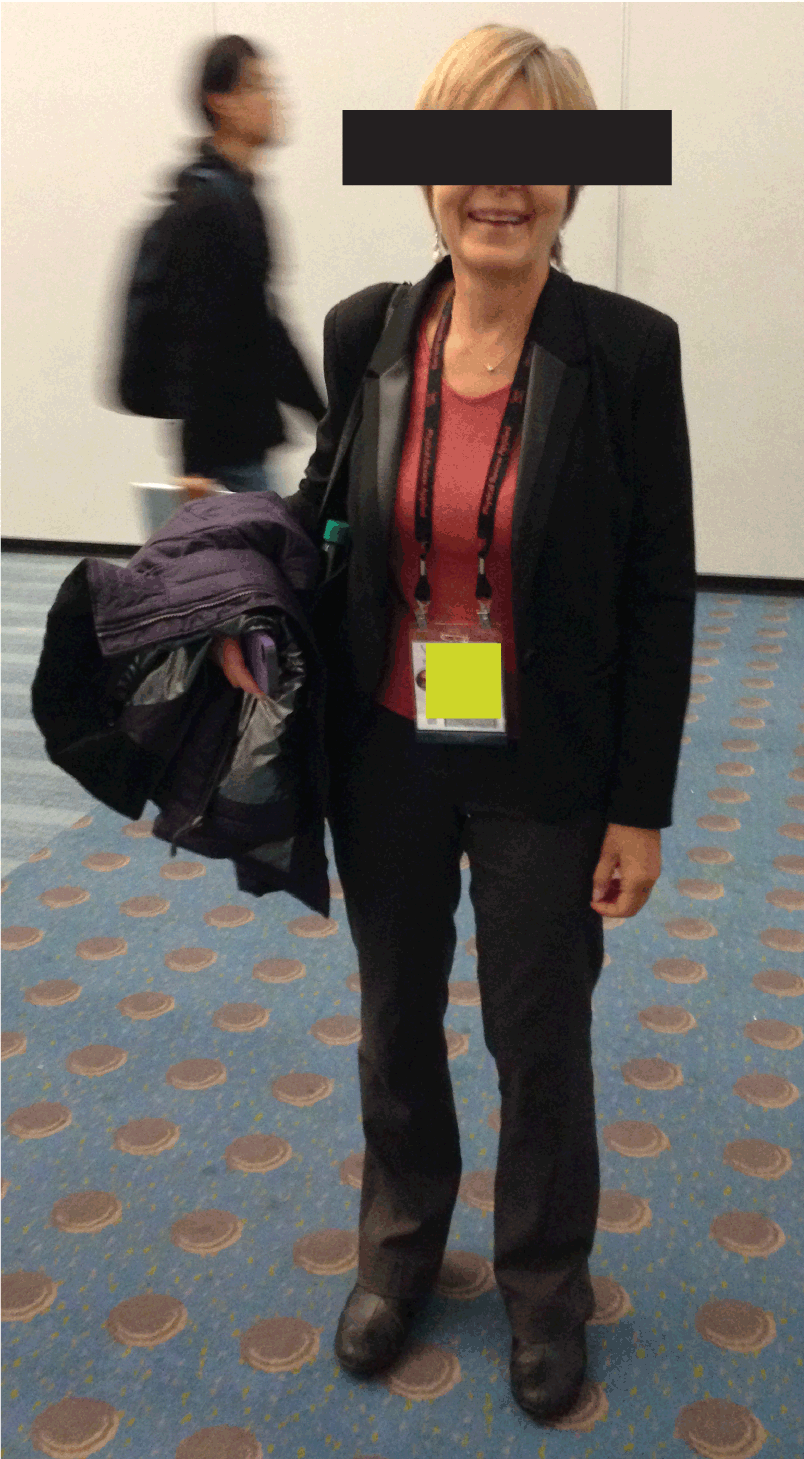
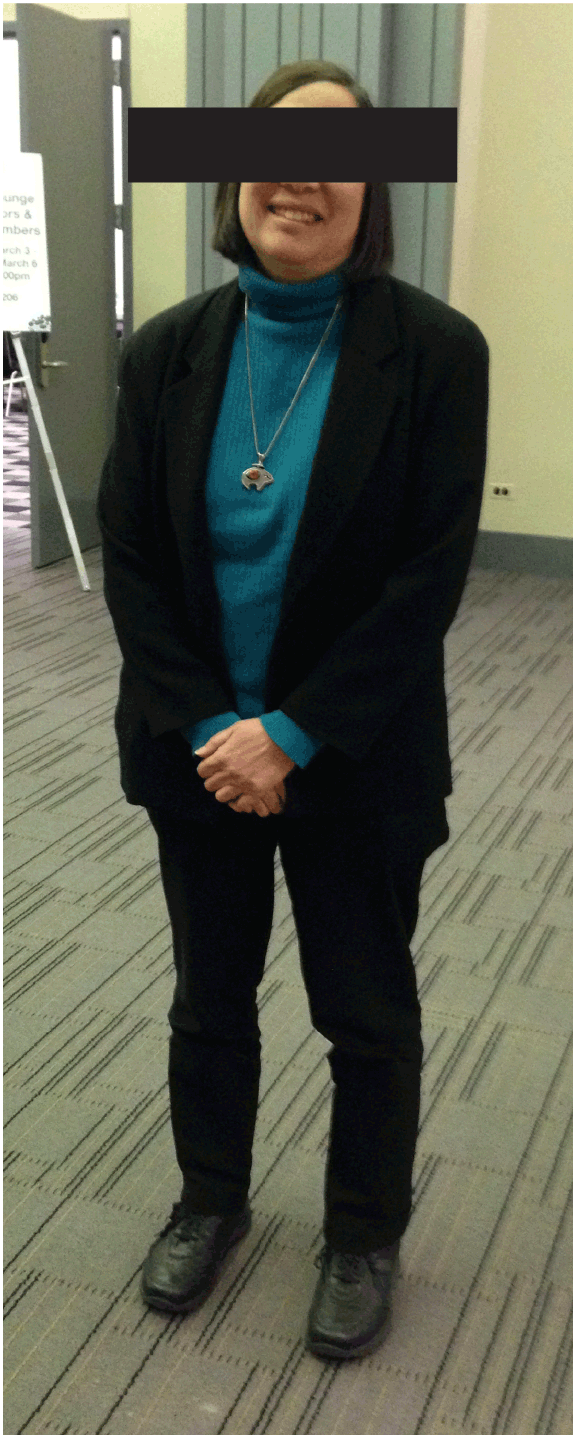
So, I am going to do what other women’s blogs have done and do a conference fashion show. Of course, different conferences have different styles, so I will be specific that these shots were taken from the world’s largest PHYSICS conference. I have poorly concealed the identities of our terrific models. I will add more in future from other disciplines in future posts. Until then, enjoy!

Our first selection is the suit look.

PhysicsFashion-2 PhysicsFashion-3 PhysicsFashion-6

Several women, especially on the day of giving their invited talks, will wear pants suits. Many are black, but gray was also spotted, although I don’t have pictures of those. You can also use separates – different color blazer and pants.   The shirt under the blazer is typically a nice color, but not low-cut. Physicists don’t really show cleavage, as you will see. I think when there are so few women, you don’t want to flaunt your boobs. The shoes are quite sensible. Typically physics-types favor flats. Also, though you cannot see it due to the censor bars, the make-up is very light or non-existent.


Our second selection is a very nice look that I really like – a nice dress.

PhysicsFashion-4 PhysicsFashion-1

The dresses are well-fitting and again – no cleavage. Opaque tights under knee-high boots can be dark, or just a flash of color if the dress and boots are too dark. A nice jacket or blazer over the top can finish the look to give a flare of color or make it look a little more professional. You can also add a nice scarf.


Finally, the most casual look is jeans and a sweater.

PhysicsFashion-7 PhysicsFashion-5

Physicists can be wonderfully casual, but you still want to look decent. Again – no cleavage. You want your jeans to fit fairly well. Both these models are wearing dark jeans, although I have seen colored jeans, and medium wash. Acid wash and other more flamboyant washes were not observed. When someone says that a conference is “casual” this is what they mean. They do not mean you can wear shorts or ratty clothes.

So, I hope this fashion show was helpful. I think the biggest thing I noticed, as I mentioned several times above, is that the clothing are not at all revealing. This should be considered since some “professional” shirts can be quite low-cut or skirts can be a bit too short. Scientists are basically conservative when it comes to sexualization due to clothing, so that should be kept in mind. In a field, like physics, where women are really under-represented, over-sexualizing yourself with your clothes is a risky idea, since men and more often other women will think you are a ditzy bimbo and think you are not competent due to your clothing. Is that fair?? No! But, it is life. You often have to the look the part you are trying to play.

Thanks again to all my models!

Equal Pay Day

Y12_Calutron_OperatorsToday, as you might have noticed, is “Equal Pay Day” where we women point out that women are still not being paid equal to men. If you haven’t seen some of these articles and statistics, I thought this one was nice. I was surprised by the wage gap as a function of race. Since we are all aware that these wage gaps are based on perceived “competence,” it is interesting to realize that your race convolved with being a woman can lead to you make HALF what a white dude makes!

The wage-gap definitely exists in academia – even at StateSchools where the wages are often public knowledge. For instance,  I was the lowest paid person in my department several semesters, and I brought it to the attention of my department chair who gave me a raise to raise me to the level of the next person. Interestingly, this correction to my salary still left me as the lowest paid person in the department. The only difference was that I was tied for last place with several other people after the correction.

Previously, I negotiated a small retention package at UState after going to an interview at another school. I made three requests for retention given in the order of (what I thought would be) least to most difficult to implement: 1. Teaching release for 1 course per year for 2 years. 2. A $5000 raise. 3. $25,000 per year for two years for research expenses. Surprisingly, I was given items 1. and 3., but not the raise! I was pretty shocked that the salary increase was off the table.

In addition to this, I have gone 2 summers with NO summer salary at all because I wanted to pay my students. I have a friend who basically just laid herself off so that she could pay for a postdoc for an extra year. Do men ever do this? I have male colleagues who say that they “don’t take summer salary,” but when I probed further, it turned out that they meant that they didn’t take the full summer salary – they only took 1 month instead of 2. This is not exactly the same thing. I suppose you could say that we do it to ourselves, but really, it is just that we are committed and used to not getting much for it. We are so used to being undervalued for our work by society, we even ourselves. We undervalue ourselves. Think about that. By not paying yourself, we are not even valuing ourselves or our work at the absurdly low level that society tells us.

So, on Equal Pay Day, let’s pledge to value ourselves. I am going to endeavor to value myself more from now on. I am going to endeavor to pull a white male and OVER-Value myself. I will not ask for the $5k raise next time. I am going to ask for $20k. How will that fly? I got zero when I asked for $5k, but I can’t get less than that, right? There is no such thing as a negative raise, right? So, since I now have tenure, and I am kicking *ss at my job, I am taking my one month of summer salary – damn it!

What do you think? Post or comment. Push +Follow to get an email every time there is a new post.

Woman_standing_next_to_a_wide_range_of_tire_sizes_required_by_military_aircraft._-_NARA_-_196199A wonderful post from a WomanOfScience friend on women’s leadership. In particular, women in academic administration. Choosing to go the administrator route may be an exit from the research track.

Enjoy!

I’ve always recognized the advantages of being a female faculty member in a male dominated field and try not to dwell on the instances of overt or subtle discrimination. For example, when I entered grad school (15-20 years ago), there were few women in my field that my gender alone made me memorable. Certainly I did good work, but also it was likely that a member of a faculty search committee was likely to remember me which no doubt helped my job search in a subtle way. When I was an assistant professor and gave birth to our first child, there were obviously some disapproving glares from some colleagues, but still I brought the 7 day old child into my office (in a cradle) and proved to my colleagues that this wasn’t disturbing to them and allowed me to maintain my productivity. Then the slippery slope began…

Some time ago, university administrators decided that one way to relatively painlessly reduce implicit bias was to have female faculty present on key committees (most importantly search committees, graduate admissions, and many policy setting committees). The result was that every female faculty member I knew was doing far more service than her male peers. The optimistic view, however, was that we made contacts and networks both within our home institutions and nationally that were far more expansive. Down the road a decade, we had far more administrative exposure and experience and were therefore ideal targets for administrative/leadership roles (at a time when many institutions would like to showcase their strong female leaders)… except that we were/are too young (many of us in our late 30s and early 40s). It is flattering to be asked to take over a high profile chair or deanship at a young age. And I wasn’t unique in this respect. Looking nationally, female chairs and deans are trendy.

This is where the glass is half full perspective ends… Our male peers are hitting their strides as full professors and racking up the high profile awards and kudos that will allow them to build their scientific reputations. While I was able to maintain this level of creativity and productivity through the births of my three children, there is no way to do the same in the face of the unrelenting distraction of running a large organization well. The inevitable result is to take the research hit in favor of building an administrative career. I am fully aware that I am complaining about an opportunity that women just 5-10 years older than me were denied simply for their genders. On the other hand, I worry that we’re complicit in self-imposing a glass ceiling. In my experience, great scientists look down on administrators that do not have scientific stature (I would contend that young female full professors have credibility, but not yet stature). Worst yet, one of my most creative, deeply thinking graduate students informed me she was leaving my group to join that of a male colleague. She said she joined my group because she loved the atmosphere of teamwork and close mentorship that I had a reputation for, but in the last couple of years (since she joined the group) she’s watched that decay exponentially as my administrative duties increased. I am deeply ashamed that I allowed the day to day fires of running this organization get in my way of educating my students! Worst yet, she cited my case as a reason to _not_ go into academia. That talented women get duties loaded on them until they drop the ball (she described it almost as a form of titration). I’ve sadly become the anti-role model.

This summer, my family and group will be uprooting to move to a new university. Everyone (my extended family included) keeps asking what job I will have there and I have been glorying in telling them that I will be “just” a professor again!

Thanks for that post! What do you think? Post or comment here. To follow this blog, push the +Follow button to get an email every time a new post appears.

Tag Cloud