Helping the Minoritized Achieve in Academic Science

Archive for the ‘ImpostorSyndrome’ Category

Work Life Balance – Other Stuff
HairdoneThe age-old woman’s issue: work-life balance. First, this is clearly not a “woman’s issue,” yet it is still labeled as such. Men make these choices, too. BUT, it feels different. I feel like, when I say I am leaving early to do a family-related activity, it is frowned upon, and I often do not reveal why I am leaving early. But, my male colleagues often use personal excuses for leaving early or not showing up to work and they seem fine with using these explanations.

Second, we have discussed many of the big work-life issues on this blog. For example: When should you have kids (see these blog posts: flexibility, grad school, pre/post tenure, postdoc)?  Should you take a job when you don’t have one for your spouse (see our posts on two-body problems: problems, surprisenegotiations)?

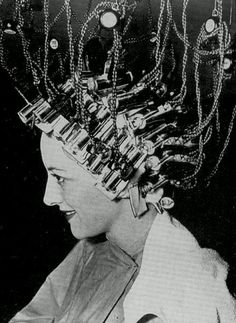
This weekend, I was thinking about the little work-life issues. Many of these issues are not about kids or family at all. Many times they concern myself – my personal well-being and how I don’t do things for myself because I am prioritizing work and other life choices first. I was thinking about it because I have been trying to dye my hair for about 2 weeks. The process takes about an hour, and I did not seem be be able to find that hour until today.  Here are some of the other things I prioritized over my personal activity: hanging out with my kids, making a figure for a paper, working on a grant report, writing this blog… You get the idea. And these other things are more important than dying my hair, so I was making the right choices, but I also want and need to dye my hair, too.

I always find the personal stuff hard to schedule and hard to prioritize such as hair, eye, dentist, and doctor appointments, or going to HR to fill out non-essential, but helpful, paperwork. Unless I am actually sick, I never go get regular check-ups. I should, but it seems like a waste of time. I go to the eye doctor once every 2-3 years and only because my glasses have broken and are hanging off my face.  I try to schedule a lot of this stuff in the summer, but that is also when I am busting my butt to get my papers out and get research done and traveling to conferences, so it still isn’t ideal. Are others like this? Am I a weirdo because I don’t keep my life on track?

I would think that it was just me except I have also been thinking back to my advisors, and I remember weird stuff coming out of their mouths. For instance, I had a graduate advisor who once told me that it was annoying when students (me, I was the only student) went to conferences because they not only missed 4-5 days from the lab for the conference, but they always had to leave early to do laundry and pack. My advisor also used to not go to the bathroom and do a sort of pee-pee dance. Maybe my advisor also didn’t want to waste time evacuating her bladder. I also had a postdoc advisor who told lab members that they should schedule dentist appointments on the weekends. I don’t even know any dentists who are open on the weekends.

So, maybe I was “raised” to be this way. I do try to be careful around my students so that I do not affect them the way I have been. I don’t want them to not go to the doctor or dentist. I don’t want them to not urinate because they feel they are wasting time. And I want to stop feeling that way, so I continue to fake it in the hopes that some day I will not feel weird about taking the time I need to clean my clothes and pack before a conference. (I am sure my fellow conference attendees also prefer I wash my clothes before the conference).

So, what about you? Do you have weird tendencies to be self-depriving spurned by an internal feeling that you are not working hard enough and still need to prove yourself? I do, clearly. I should say this is better after getting tenure. The removal of the feeling that you are going to lose your job if you don’t work hard enough hasn’t stopped me from working hard on science, but it has allowed me the freedom to go to the dentist. But, these feelings are clearly ridiculous. I try to stop them and “act normal.”

If you have something to say, comment or post here. To get an email every time I post, click the +Follow button and give your email address.

“Subtle” Harassment

DoorPinsMost harassment is not very subtle to women, but I realize that not everyone is as clued in and keyed up about it as I am. I was recently harassed, probably not on purposed or even pointed directly at me, but I inadvertently stumbled into some harassment, and I wanted to have a little talk about it. What to do, how to report, and make it clear to my male friends and advocates that this stuff is not just annoying, it affects us pretty much daily. So, I am going to post about “subtle” harassment – the pervasive kind that wears you down.

Chalk Board Harassment. In my career, I can clearly recall two instances of chalkboard harassment. In both cases, I literally walked into the harassment without warning. I reported the harassment to authorities, and nothing was done about it.

The first time, was in graduate school. I was TAing, and I had to use a photocopier to make copies for my class. The photocopier was in what I call a “party office” where many grad students have desks and work. It wasn’t really a party office in the sense that I never once saw a party or celebration occurring, but it was a “party” more like a “party line” for phone service in the olden days. You might also call it a “grad student ghetto,” which probably better captured the mood of the room. Anyway, this day, like many others, I went in to make my copies. The copier was directly in front of a 6 foot chalk board. This day, I looked up from the copier to see a 3-foot tall, very detailed drawing of a penis. I stopped my copying and went to the department office directly to the chairman, and actually got him to come to see the masterpiece. He actually took me seriously and came to see it for himself, but erased it immediately upon seeing it. He was quite harassed, as well as me. I informed him that it was this type of, well, not subtle, but pervasive harassment that scared women away from male-dominated fields.

Recently, now that I am a professor, a similar situation has occurred. On the chalkboard outside my lab and near my office, the word “penis” was written. This is certainly not as bad as the graphic drawn in gory detail when in grad school, but it is perhaps more troubling because it was drawn immediately next to some drawings my daughter (elementary-school age) had made on the same board. In fact, she wrote the word, “LOVE” and immediately next to it, was the offending word. Nice. As before, I informed the department chair and this time, I also took a picture and emailed it to the UniversityDiversityOffice who is responsible for following up such offenses.

A couple of things occurred to me about these two situations:

1. Why are dudes so obsessed with penises? Why not be obsessed with vagina? It is weird to me. Statistically speaking, some of the dudes in my department are likely to be homosexual. They don’t seem to be out. We do have an openly gay faculty-member, and there doesn’t seem to be overt homophobia in the department.  I could be wrong, but no student has come to discuss it with me.

2. I was surprised about how much more offended I was by the word in the second instance compared to the drawing in the first instance from grad school. I think it was because of the proximity in space and time to my daughter. It pissed me off that they defiled some nice drawings and lovely writings that were clearly done by a child. My child.

3. Finally, in the same note as number 2, I couldn’t help thinking that they had targeted my space in the department. In the first instance in grad school, the picture was in a closed office and was more likely not targeted at me. Yes, there were other women in that office, and they were the likely targets of the harassment, but it wasn’t targeted at me. But, this second version felt targeted because the board is right between my office and lab. That made me feel badly, too.

Everyday Stuff. Last week, there was a particularly horrific situation on the campus at UCSB, and I am sure most blogs dealing with women’s issues are mentioning something about it. The misogynistic rantings of the shooter are worrying to any woman who works in science, particularly some fields that are male dominated. Scary.

One of the topics that was described in the commentary of the “Yes, All Women” trend was women trying to explain that we often feel uncomfortable in situations, even everyday situations, because of the very real threat of men. One of my favorite comedians has a particularly clear view of this idea (See a video here).

After the women comments, there was a backlash with the tagline “Not All Men,” where dudes were trying to say, “Hey we aren’t all like that!” but as many women pointed out, WE CAN’T TELL WHO IS OR WHO ISN’T LIKE THAT. You all look the same to us.

Here’s a hypothetical: Let’s say 1% of men are like that. Now, you are a woman running a class of 400 students where only 20% are women. So, you are in a classroom with 320 men, and 1% are women-haters – that is 3-4 woman-haters are in the room with you.  Not that many, but enough to harass and demean you, if they sought to do so. I have talked to women who have been physically intimidated by male students in classes with these types of numbers. The students physically get into their personal space and demand differential treatment. I, personally, don’t let students get near me. I have a very large personal space bubble. But even so, there are other ways to cause trouble.

Outside of classroom situations, I have tried to notice my reactions to other, regular, situations in the past week. I have noticed that I make certain decisions about myself because of a fear of men. Let me give you two examples.

1. I was at the gym with HusbandOfScience. I wanted to stretch in the area near the mirrors. There were two men in the area – basically taking up all the room in the area in front of the mirror. There was just enough space between them for me to fit, but I didn’t do it at first. Why? I was afraid of them. Not deathly afraid, but wary enough to avoid. I decided that the likelihood that these two guys were both bad guys was low, statistically speaking. I was right. They were fine – just taking up more than their fair share of space, as men often do unconsciously (Not All Men).

2. I was taking my child into daycare. Normally, I park right at the front door, but there wasn’t room, so I had to park half way down. At the far end of the parking lot was a group of men. They laughed when I got my kid out of my car, and it made me sort of flinch. I noticed that I was wary of them. I went to drop my kid. After coming back to the car, I took a closer look, and I realized that they were latino, and that made me feel safer. Statistically speaking, dudes who hate women are white. (Sorry to my white men friends – I realize it isn’t all white men, but stats are stats.)

So, here is my say. The WomanOfScience addition to the #YesAllWomen movement. What do *you* think? Comment or post. Push the +Follow button to receive an email every time WomanOfScience posts.

Negotiations

NegotiationsA former student of a colleague was coming back to visit and brought some great news. He had landed a big fancy-named fellowship and a job offer. He started asking me questions that one has when put into a new situation – a rare situation – negotiations. He was at the negotiations stage. This is something that you don’t get to do very often, and thus, none of us are all that practiced at it. I have had a couple older posts about negotiating (Everything and Practice and StartUp).

One of the interesting things I noticed was that this student had not received much help from his advisors about how to go about the job search nor about negotiations. As I kept giving him advice on this and that, much of which was covered in the previous posts, he was very enthusiastically eating it up. It felt good to mentor this student to whom I thought I could have offered nothing.

As I was recently traveling, I had many conversations with other WomenOfScience that I do not usually get to interact with. One was a woman who did a particularly spectacular job at negotiating her first position, so we discussed some tactics and of negotiation. Although she negotiated everything from salary to office furniture, she warned against looking greedy and being too picky. She suggested that one strategy is to prioritize your request list. For instance, equipment for your experiments is likely to be crucial. Money for people is probably essential.

As I think back on my own original negotiations, I know I did things wrong the first time. I was very bad at negotiating my salary. I knew it was important, but I felt like I was negotiating my husband’s salary and his whole job, and I shouldn’t look too greedy (see previous post on solving the Two-Body Problem). I think not negotiating my salary at all was a mistake. Even starting a few $1000 ahead would have been better. I think this is very typical for women. Further, society tells us that women who ask for more money (even equal pay) are greedy and that is somehow less tolerable in women than in men. Men who ask for more money are not as likely to be thought of as greedy. There is some advice I have heard recently that I think is good to help overcome this: When you need to negotiate for more money – don’t think you are negotiating it for yourself, but rather for your family. You need more money so that your family has a better life. I think that would have helped me. Your salary is for your family to make sure they can live comfortably while you are busting your hump getting tenure – make sure you frame it that way in your mind.

I didn’t have any trouble negotiating for what I needed for my lab, because it was, in effect, not just for me, but also for the department and the lab, which is bigger than just me. If I could have framed some of the other aspects – salary and other personal needs – in a bigger context, I think I would have been more successful negotiating for those things.

What do you think? Any advice or suggestions to help others negotiate better? Post or comment. To get emails whenever I post, push the +Follow button.

They’re Just Not That Into You

2475011402_bf70c92575_oOver the past year, I have had to have a similar conversation with two different MenOfScience. These MenOfScience are relatively young. Both of these men are in tenure-track jobs at decent places. Both of these men are in male dominated fields of science. Further, both of these men are not overtly sexist, but both men had the same very strange notion which I tried to disabuse them of.

See, it turned out that when these guys were up for tenure track jobs, in the same year there was a super-star candidate. This super-star candidate got many, many interviews and several offers. In fact, this super-star person got almost all the offers in the field. And guess, what? This superstar person just happened to be a woman.

So what conclusion did these guys draw? Just guess…

Did they conclude that this woman had worked her ass off? Did they conclude that this woman was clearly the smartest, best, cleverest scientist of the field on the market that year? Did they conclude that because the bar was so much higher for the women of their field that this woman was truly the most excellent? Did they conclude that not only was this woman so amazing as to surpass all other candidates that year (men and women), but probably also ended up as the only woman on the market in that field in the entire year?

No, of course, they concluded that, this woman (each was a different woman in each of their different fields in different years) only got all those offers because she was a woman. And, of course, they felt slighted. They felt that this woman did not deserve the accolades and offers that she received. If not her, than who? Should they have been given all those offers? Would they have been so resentful if there was a man receiving many interviews and offers? Surely that must happen often in these male-dominated fields. Yet, somehow I doubt that anyone would say, “He only got those offers because he was a man.”

During these conversations, I strove to set their attitudes correct. I made it clear that the outstanding woman must have been truly outstanding because the bar is much higher for women than men. I do not think they bought that. I let them know that there is still a lot of bias against women, notice how few their are in their own departments and in their own fields, so that if this woman was getting so many offers, she must have been truly amazing. I do not think they bought that. They were still very focused on the fact that a woman had somehow beaten them. Like it was a personal offense.

And here is the kicker – these dudes have jobs! Because at the end of the day – no matter how many offers that one outstanding woman got, she is still only one person who will only be able to take one offer. So, it doesn’t really matter how many offers she got, because it did not inhibit them from getting jobs. So, why are they so resentful? It must be that they really feel that they are as good as this woman. Maybe they are, maybe they are not, either way, they still got jobs! They are still around, doing science, getting tenure.

So, what is the best way to convince them? I do not think my method of trying to offer facts and statistics about women in science worked. Unfortunately, at the end of the day, they will never be convinced because the true answer was that this woman was probably better than them. And no one likes to hear that someone else is better than they are. They do not want to hear the truth: “they’re just not that into you.” Nobody wants to hear that.

It is especially important to get these young men who will we need as our advocates and cooperative partners in change to understand women’s issues and help to support us. Do you have any idea how to help these guys to see that just because a woman was successful does not detract from them and ultimately did not do them any harm? We need them on our side, and if they continue to hold a grudge about one amazing woman that got lots of offers 4 years ago, we could lose them to the dark side of sexism.

Any ideas, comments, or suggestions? Post of comment. Push the +Follow button to get an email whenever a new post goes up.

Fashion of Conferences

Attending a conference for the first time? Wondering what to wear? This is a common issue for women, especially young women, because women have a lot of options. Men have very few options, and thus, their world is clearer and easier to navigate. Women have many many options. Dress, skirt, suit with skirt, pants suit, jeans, boots, heels, flats, sneakers, sweater, button-up shirt, blazer, make-up, no make-up? And don’t even get me started on hair!

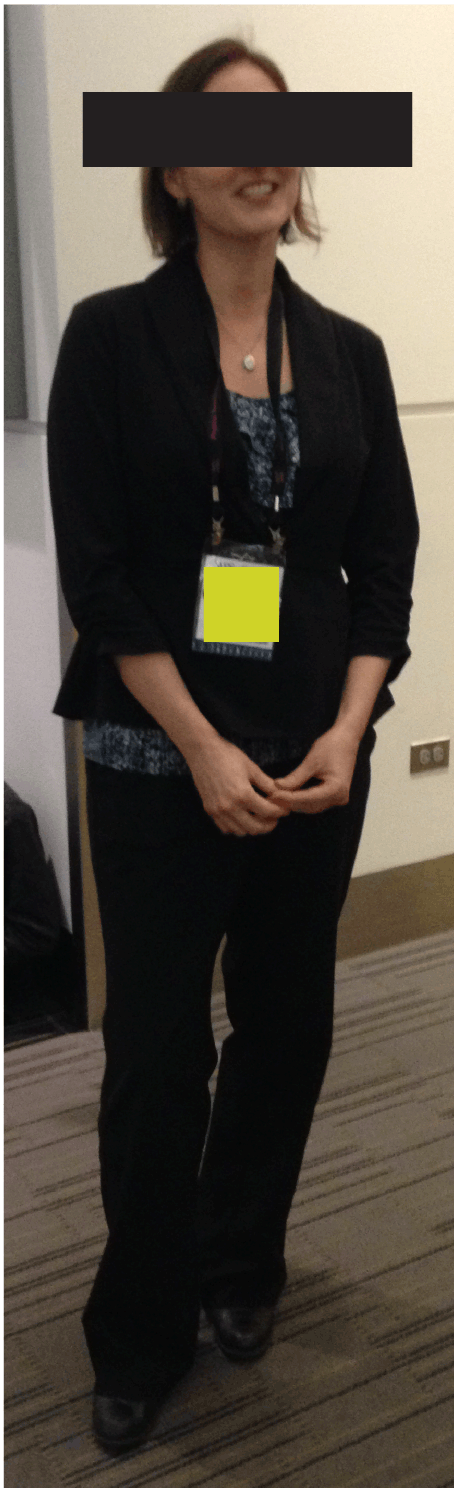
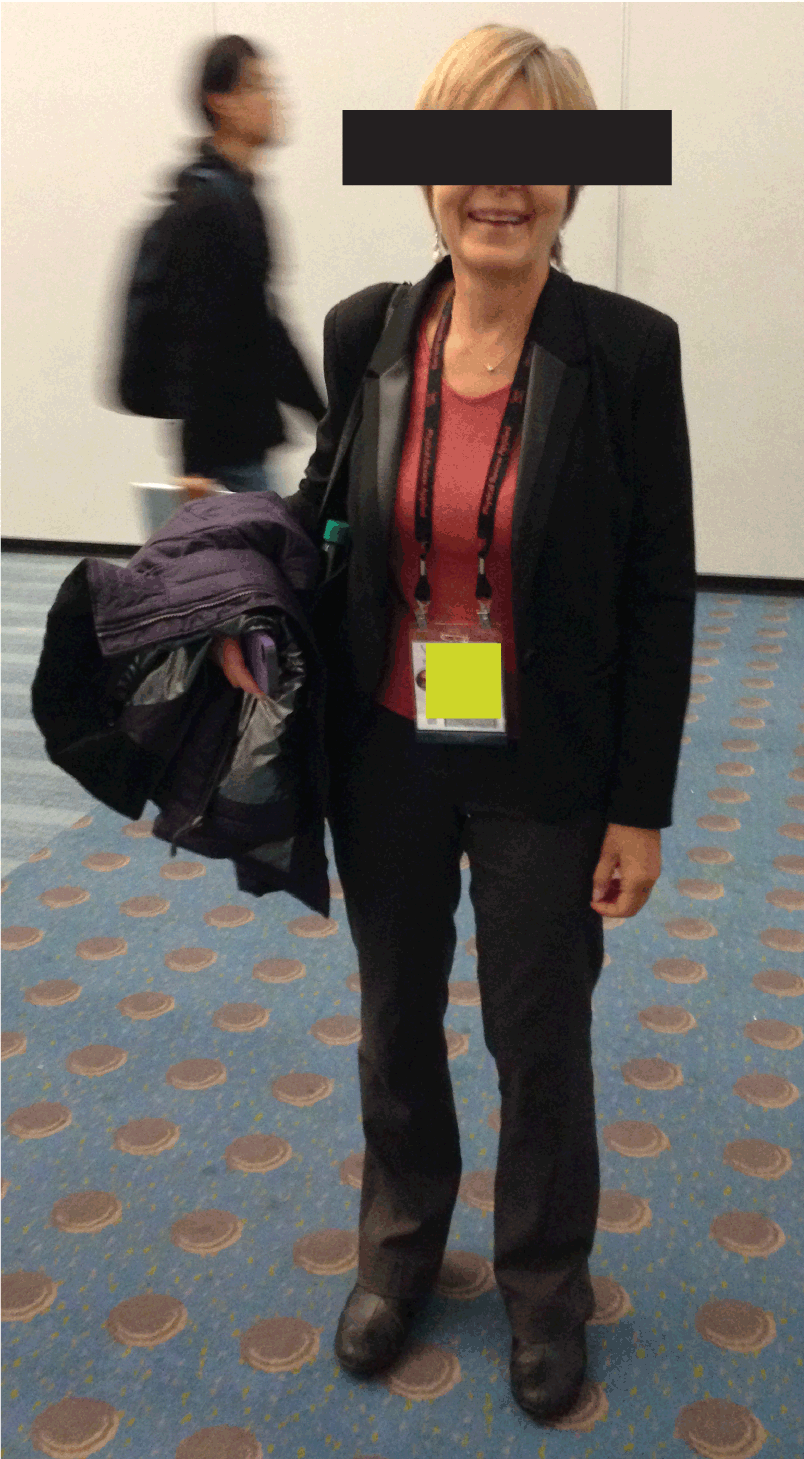
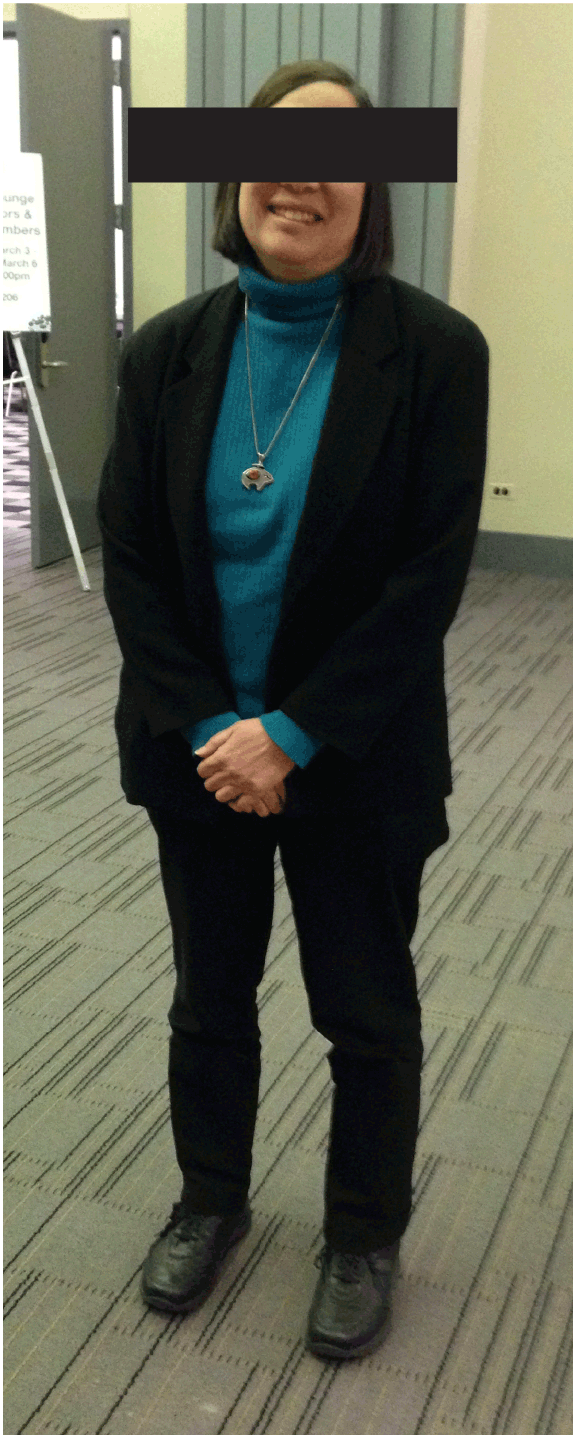
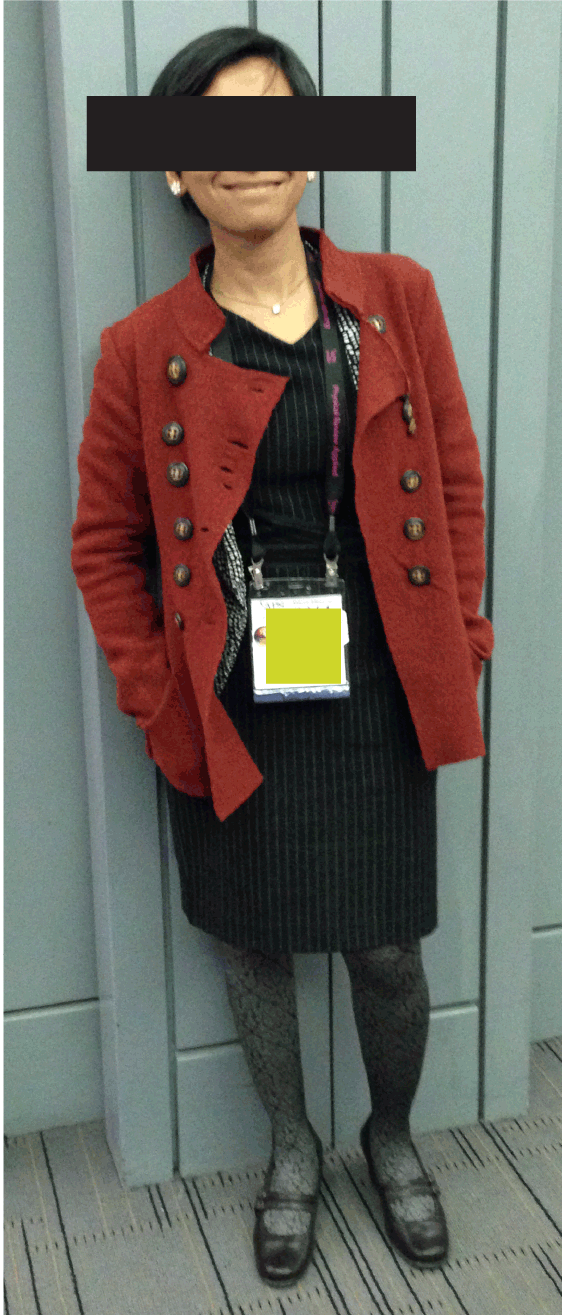
So, I am going to do what other women’s blogs have done and do a conference fashion show. Of course, different conferences have different styles, so I will be specific that these shots were taken from the world’s largest PHYSICS conference. I have poorly concealed the identities of our terrific models. I will add more in future from other disciplines in future posts. Until then, enjoy!

Our first selection is the suit look.

PhysicsFashion-2 PhysicsFashion-3 PhysicsFashion-6

Several women, especially on the day of giving their invited talks, will wear pants suits. Many are black, but gray was also spotted, although I don’t have pictures of those. You can also use separates – different color blazer and pants.   The shirt under the blazer is typically a nice color, but not low-cut. Physicists don’t really show cleavage, as you will see. I think when there are so few women, you don’t want to flaunt your boobs. The shoes are quite sensible. Typically physics-types favor flats. Also, though you cannot see it due to the censor bars, the make-up is very light or non-existent.


Our second selection is a very nice look that I really like – a nice dress.

PhysicsFashion-4 PhysicsFashion-1

The dresses are well-fitting and again – no cleavage. Opaque tights under knee-high boots can be dark, or just a flash of color if the dress and boots are too dark. A nice jacket or blazer over the top can finish the look to give a flare of color or make it look a little more professional. You can also add a nice scarf.


Finally, the most casual look is jeans and a sweater.

PhysicsFashion-7 PhysicsFashion-5

Physicists can be wonderfully casual, but you still want to look decent. Again – no cleavage. You want your jeans to fit fairly well. Both these models are wearing dark jeans, although I have seen colored jeans, and medium wash. Acid wash and other more flamboyant washes were not observed. When someone says that a conference is “casual” this is what they mean. They do not mean you can wear shorts or ratty clothes.

So, I hope this fashion show was helpful. I think the biggest thing I noticed, as I mentioned several times above, is that the clothing are not at all revealing. This should be considered since some “professional” shirts can be quite low-cut or skirts can be a bit too short. Scientists are basically conservative when it comes to sexualization due to clothing, so that should be kept in mind. In a field, like physics, where women are really under-represented, over-sexualizing yourself with your clothes is a risky idea, since men and more often other women will think you are a ditzy bimbo and think you are not competent due to your clothing. Is that fair?? No! But, it is life. You often have to the look the part you are trying to play.

Thanks again to all my models!

Equal Pay Day

Y12_Calutron_OperatorsToday, as you might have noticed, is “Equal Pay Day” where we women point out that women are still not being paid equal to men. If you haven’t seen some of these articles and statistics, I thought this one was nice. I was surprised by the wage gap as a function of race. Since we are all aware that these wage gaps are based on perceived “competence,” it is interesting to realize that your race convolved with being a woman can lead to you make HALF what a white dude makes!

The wage-gap definitely exists in academia – even at StateSchools where the wages are often public knowledge. For instance,  I was the lowest paid person in my department several semesters, and I brought it to the attention of my department chair who gave me a raise to raise me to the level of the next person. Interestingly, this correction to my salary still left me as the lowest paid person in the department. The only difference was that I was tied for last place with several other people after the correction.

Previously, I negotiated a small retention package at UState after going to an interview at another school. I made three requests for retention given in the order of (what I thought would be) least to most difficult to implement: 1. Teaching release for 1 course per year for 2 years. 2. A $5000 raise. 3. $25,000 per year for two years for research expenses. Surprisingly, I was given items 1. and 3., but not the raise! I was pretty shocked that the salary increase was off the table.

In addition to this, I have gone 2 summers with NO summer salary at all because I wanted to pay my students. I have a friend who basically just laid herself off so that she could pay for a postdoc for an extra year. Do men ever do this? I have male colleagues who say that they “don’t take summer salary,” but when I probed further, it turned out that they meant that they didn’t take the full summer salary – they only took 1 month instead of 2. This is not exactly the same thing. I suppose you could say that we do it to ourselves, but really, it is just that we are committed and used to not getting much for it. We are so used to being undervalued for our work by society, we even ourselves. We undervalue ourselves. Think about that. By not paying yourself, we are not even valuing ourselves or our work at the absurdly low level that society tells us.

So, on Equal Pay Day, let’s pledge to value ourselves. I am going to endeavor to value myself more from now on. I am going to endeavor to pull a white male and OVER-Value myself. I will not ask for the $5k raise next time. I am going to ask for $20k. How will that fly? I got zero when I asked for $5k, but I can’t get less than that, right? There is no such thing as a negative raise, right? So, since I now have tenure, and I am kicking *ss at my job, I am taking my one month of summer salary – damn it!

What do you think? Post or comment. Push +Follow to get an email every time there is a new post.

Bullying Backfire

bullyFor the past several years, the topic of bullying has been hot in the media. Most people, especially nerds, realize that bullies have always been there. Although academia is supposedly some liberal bastion of cushy touchy-feely softies who “can’t do,” so they teach, it is actually full of bullies. Those nerds who were bullied most as young people are the most likely to bully others in the future. It is a cycle of abuse that is disturbing. It doesn’t help that many of the people in academia are not good communicators and can often be stubborn and unyielding in their emotional ideas. All of these circumstances lead to a high amount of workplace bullying. In addition to sexual harassment that is still pervasive, the more subtle workplace bullying by chairmen, peers, or even students can make women and minorities feel bad about their job and abilities.

Currently, UState is requiring a workshop on Workplace Bullying. Based on what I discussed above, this would seem like a great idea, right? Ironically, these workshops appear to have a backfire effect. What I mean by this is that known bullies are coming out of the workshop convinced that they are being bullied themselves. Mostly, they are claiming to be bullied by the very people they are bullying! Why is this happening? Because the bullies and the bullied are in fact having a disagreement. Unfortunately, the inept abilities of most scientists to communicate mean that the more aggressive person comes across as a bully. The less aggressive person seeks relief, help, or just a chance to gripe, and they are branded as talking behind someone’s back, forging alliances against the other person, or just a troublemaker. In the new definitions of bullying, these defense mechanisms are also a form of bullying.

In talking to my female peer-mentors, it seems like most women coming out of the workshop think to themselves, “Oh no, I have been inadvertently bullying someone. I need to try to adjust my way of acting.” On the other hand, many men have come out saying, “OMG, I am being bullied by everyone.” I think it would be interesting to perform a follow up survey to see if it the reaction to the workshop aligns with gender. There are always exceptions, I am sure, but my hypothesis would be that women are more likely to be introspective about the workshop. This is what I mean by a “Bullying Backfire.” The bigger a bully someone is the less likely they are going to see themselves as the bully, and the more likely they are to see how everyone else is bullying them. In my opinion, this is part of the mentality of a bully – to blame others for your problems.

So, how do we respond to bullying? Once we identify it occurring, we can only change our own actions toward others. Is it possible to change the actions of others who are bullying us? It is worse when you are a graduate student being bullied by your advisor, or an assistant professor being bullied by a senior faculty member? Do you act like the “bigger man,” and just pretend it doesn’t affect you? That can backfire, too. Especially if your bully is trying to tear you down and make you feel bad on purpose.

Popular culture tells me to stand up to bullies, and I have been accused of being brave. I am not sure if I am brave or just really stupid, but surviving can be a sort of standing up for yourself. I certainly did stand up to bullies in high school, and I fought back. I was protected by my honor-student status against being sent to detention or being suspended. I was able to fight back immediately at the time, and move past my bullies.

Now, revenge may need to be placed on the back burner and served cold. Much like my honor-student status, one can always overcome and get back at your science bullies through your science-cred. See, in science, she who has the best publication track-record laughs last. At the end of the day, if you have better, more publications, you will get more respect than your bully. I have done this with several of my science bullies. It takes having a long-view, because it is not a quick solution. So, sometimes I just keep my head down and move my science forward and try to ignore my bullies. Obviously, this only works if your bully isn’t seeking you out to suck up your time.

All this being said, it is absolutely essential that you have a support network to help you handle these situations. You need a good partner to listen and offer sympathy. You need a peer network, or group, to offer advice, consolation, and cheer-leading about how great you are. Most people will not admit this, but you probably also need a therapist. In all the times when I had to deal with a bully, I sought out a therapist to talk to on a weekly, or every-other weekly basis. These people are not in science, necessarily, but they can give you can outlet to gripe, a confidential confidant, and someone to help with people-solutions.  I am not ashamed to say I have been in therapy numerous years over my life, and I am a more well-adjusted, and better person for having done it. Younger generations of people do not see it as a stigma, but as a means to help to deal with difficult people. Older generations often see it as a signal that you are “crazy,” but the only crazy thing is to not use every option in your reach to deal with these problems.

So, what do yo think? Are you being bullied? Is it persistent? Or sporadic? Comment or post. You can follow the blog by pushing the +Follow button.

The Resistive Load vs. the Drift

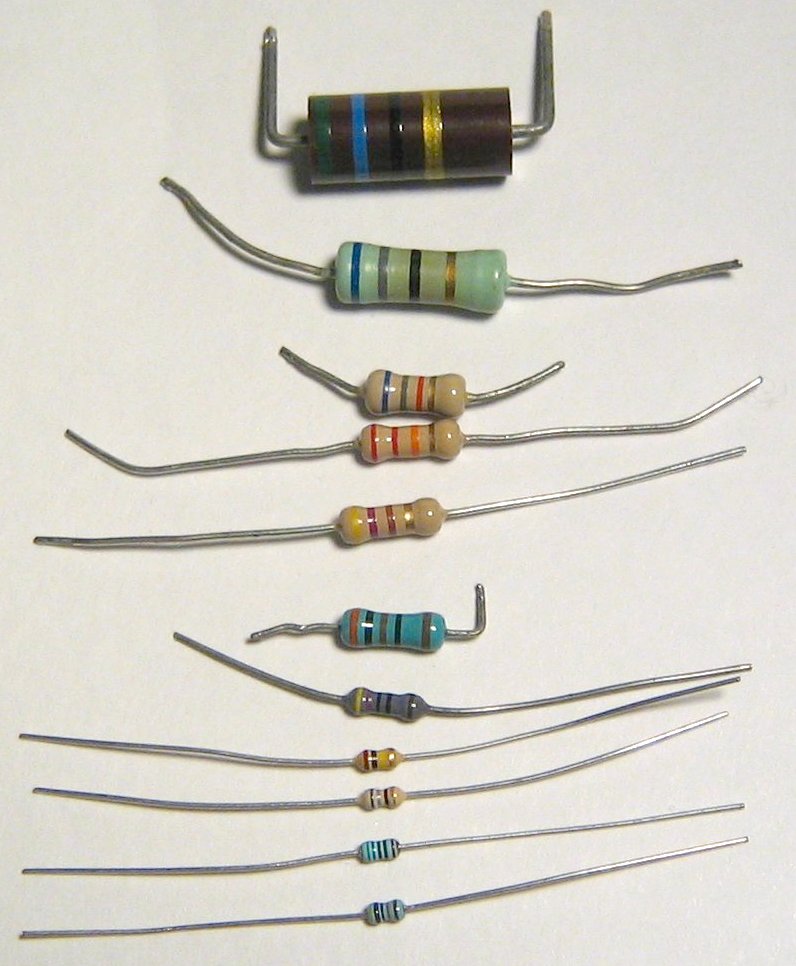
ResistorsAs I said earlier, I recently went to a BigIvyLeague University to give a talk, and I met with a group of young scientists – men and women – for lunch. The meeting turned into a mentoring meeting, as any meeting I have with young scientists tends too. As I said, there were two women postdocs, and we were discussing women’s issues. Another part of the conversation was about the impediments to advancement for women. Different people experienced the resistance at different stages, and this is normal since no two people’s trajectories will ever be exactly the same. Of the two women postdocs, one felt that she was being disregarded and put down even in graduate school. The other had a happy experience in graduate school, but was beginning to feel the resistance now as a postdoc. Of my WomanOfScience friends, many did not feel it until they got to a tenure-track job or even until after tenure. Myself, I had an 8th grade math teacher tell me that I could not advance more than a year in math. Perhaps my early exposure to the resistance is why I am so hyper-aware and intent on changing things.

Studies have shown that the glass ceiling for women in academia is at the full-professor level, as I describe and quoted primary research in this blog post. So, despite the onset age of the resistive load, the trend of the resistance, or other personal factors of each woman’s career, the highest resistance comes just at the precipice of really becoming a fully acting, voting, participating member of your department and college making similar wages as your colleagues. More on this issue in future posts, I think.

The main reason why I wanted to discuss the resistive load was because the meeting directly after the lunch, I met with a young, newly hired WhiteMale Assistant Professor. I had met this guy before at a small conference, and I knew he had been a postdoc at the same BigIvyLeague University where I was visiting, and where he was now tenure track. Some BigIvyLeague Universities do this, when the person is truly a superstar, so I assumed that this was the case, although I didn’t know his full record. This guy is young, and he was very open and honest when I asked him about his trajectory. He said that he had not had many other offers or even interviews, and that he was not, in fact, a superstar. The only places he had interviews were places where people already knew him. He said that this was because he had a low publication rate. Of course, BigIvyLeague University knew him, and his postdoc advisor was key to getting him this position. I consider this a gross case of “The Drift” where someone just continues to advance without any forethought or even any real effort. It is kinda like being in the lazy river at a water park. You get pushed forward.

I often see these people who appear to “Drift” in Second Generation Academics, whose parent(s) were also academics. Second Generation Academics are always typically extremely good at what they do, and in the meritocracy of academia  they advance seemingly effortlessly. In actuality, I think they just understand the game intuitively because they were raised in it, but they are good and working hard. Unlike a Second Gen Academic, this guy is an extreme version of a true Drift. He is literally coasting with no cogent plan. He isn’t applying to grants, or really trying to get students. He is trying to get a few more postdoc publications out because his publication record was reportedly slow.

The juxtaposition of this Drifter with the hard-working excellently bright, quick, and enormously put-down women of the lunch meeting was almost sickening to me. I was somewhat in shock as he told me his path and his non-existent plan. I would like to think that the system would weed this guy out, but given how far he has come, I cannot be sure. Being at a place like BigIvyLeagueU helps in so many areas, like getting good students and postdocs, getting grants, and having papers accepted based on BILU’s reputation. And the worst part was that I really couldn’t blame this guy. He is a nice guy. He is an open and honest scientist. So what if his publication record is slow? What boggles the mind is the system, the structure that promotes this guy and denies even better women and minorities the chance to  work in academia at SecondTierStateU without a hope of even getting to a place like BILU. Or, if you do get an offer at a BILU, they don’t have spousal accommodation, so you have to sacrifice other parts of your life for the benefits of BILU. Indeed, several women I met at BILU did just this.

This post has been long and rambling, so I apologize. These thoughts have been kicking around in my head, and I am not quite sure how to approach them to reconcile the fact that excellent women have so much resistive load against them. What do you think? When did you first feel the resistance to your forward progress? Do you know any female “Drifters”? Even the most excellent and well-promoted women I know really deserve it and still suffer from impostor syndrome, self-doubt, and are truly excellent yet still under-recognized. Post or comment here. Remember to hit +Follow for updates whenever I post. I hope to post more frequently now that classes have ended for the semester!

All the Small Things

Post from another WomanOfScience about some of the little things that drive us nuts as WomenOfScience. Enjoy!

Silverback

Silverback (Photo credit: bergeycm)

I have a Departmental Dirty Little Secret (DLS). An ongoing source of discontent, a small sliver that festers and lies always just beneath the skin. It is not fatal but the “Silverbacks” (my term for the Male Sage Older Faculty) of the Department do not lean over and pull it out.

The Silverbacks agree “‘Tis a shame, how annoying,” they murmur as they pull their beards and stroke their pearls, but still. It is just a sliver (man up!).
“It will work its way out, in time, we have seen worse,” they say, “In our day they proclaim there was….”
But, it is infecting me, bit by bit.

Does each of us have a Department DLS? That small, shameful slight that we may read too much into due to convergence of where we are in time and space that is simply drawing our focus off research, or is an indication of something much worse that must be focused on and would be negligent not to?

Here is mine:
I have never had a graduate student from my program talk to me that I had not had in my courses as an undergraduate. They have never talked me about research, about serving on their committees or just about life. So, our undergrads have been socialized to see us, but why do we find this acceptable in a student coming into our graduate program from the outside?
I think it is a human resource issue as well, all these students are provided stipends. Not being seen is a direct loss of resources.
Worse, even our young DepartmentalGraduateStudents (DGS) is a Silverback in the making and already murmurs, “How unfortunate but what can be done?” Ahh, students, they will learn in time.

What is yours?

Here is my DLS: There is an older male faculty who runs much of the department including class assignments and committee assignments who constantly passes me over for leadership roles. My department gave me pretty much no committee assignments this year – the first year after I have tenure. This is supposed to be the year when they stop “protecting me” from service and really let you have it.  But, nope!

He even had to make  special effort not to give me a chairmanship of a committee. A crap committee that he doesn’t even care about! The department publicity committee! He gave the chair position to an Assistant Professor over me. I specifically asked to be given the chairmanship after the assignments were made, and he said “No.” I pointed out that other committees have chairmanships given to the senior person on the committee, which would be me. He said, “That’s not true.” I gave him several specific examples of when this was the case. He said, “No.” I then wrote him an email that said directly, “When you don’t give me leadership roles, it makes me feel like you don’t trust me, because I am a woman.” He still said “No.”

This Silverback – in the literal sense – is about to retire after Spring semester, so I am looking forward to a future without his presence in the department, but I can’t be lucky all the time.

So, what about you? Comment or post…

Why So Negative?

So, I have a had a number of posts, and by now, you maybe could have realized

Thought Bubbles

Thought Bubbles (Photo credit: Michael Taggart Photography)

that I am a naturally positive person. Not only is the glass half full, but I can give you 2 reasons why you should be happy about it. I am also naturally energetic. These attributes make me very able to organize and lead not only my lab but other committees at both the department, college, and even national level. Yet, I am often faced with immediate negative opinions from my colleagues when I put out new ideas, discuss changes, or organize on the departmental level.

Sometimes, they have non-specific comments including, “We tried that 10 years ago, and it didn’t work.” Although this is non-specific and doesn’t give any hard evidence of the “not-working” nature, at least they claim to have tried something new. Other times, they just say, “That’s not how we do that,” without discussion of if it might make sense for us to even try. These attitudes seem unnecessarily negative.

Another place where I find people are negative is about trying to get awards. I recently asked to be put up for a BigAward. Is it a reach? Yes. Am I a shoo-in to win? No. But, again, being the positive sort of person I am, my thought is that your chances of winning are zero if you don’t even try. It’s not that I think I am so great that I will definitely win, it’s just that I see the benefits of trying. When you submit a strong nomination packet, even if you don’t make it to round two, some BigWig, smart people will have to read it. They might be impressed with you. They might remember your application. It might help you out in the long run – you never know. So, my thoughts are that it is worth the time to help your junior colleague get their name out there and support them.

Again, being positive, my take on these people is that they have taken the idea of “critical thinking” to an extreme. We are all taught to be critical thinkers in science. And criticism turns us to the right direction and is helpful. I am not against criticism. It has definitely helped me write better papers and write better grants. But, sometimes, I think that people are so fixated on the “critical” part that they forget about the “thinker” part. They become negative just to be negative for no good reason. Why? Do they do it with everyone? Or am I special because I am so positive? Sometimes these things get me down, and I start feeling bad and suffering from impostor syndrome due to all the negativity. Luckily, I am positive, and one good science interaction or pat on the back from a visitor makes me happy again, but it is disturbing how often the criticism becomes overpowering. If I was a less positive person, it could be crippling or debilitating.

So, what about you? Have you suffered from overpowering criticism? What is justified? Or unnecessarily over the top? How did it affect you, your science, and your attitude? Tell your story in a post or a comment.

Tag Cloud