Helping the Minoritized Achieve in Academic Science

Archive for the ‘Mentoring’ Category

How to Meet with your Advisor
Conference_de_londresSo, I’m on sabbatical. OK, you know. And, I’ve been having meetings with students over SkyFaceGoogleHangoutTimepe. And, I have to say that, while it is frustrating to be 3000 miles away from the lab which has definitely led to some problems, in general, my individual meetings with students have gotten… better. We have every-other-weekly individual one-on-one meetings, and the students are coming more prepared and more focused than they ever did when I was there in person (exceptions abound, of course). I can speculate all day about the reasons this may be happening, but the fact that it is happening has exposed some best-practices for having meetings with your advisor. I will describe those best practices here, but before I do, I would like to point to a couple posts of related interest including: Effective Meetings, StateOfLab, mentoring.

Bring your notebook: I can’t tell you the number of times I am meeting with a student and I ask a question about their work, results, protocol, and they say, I can’t remember. My response is: no shit. OK, not really. I say that in my head. See, that isn’t surprising because you aren’t supposed to remember everything. That is what a lab notebook is for. The beauty of having a lab notebook is that you don’t need to remember. Indeed, relying on your memory will get you in huge, huge trouble, because our memories are faulty, not everything makes it into long-term memory, and you can only remember about 7 things in your short-term. When the student says they can’t remember, I usually ask if they wrote it in their notebook. That elicits a response of, “oh yeah!” At this point, it is prudent to go get your notebook, but this whole time-sucking activity can be avoided if the student would just bring their notebook to every meeting. So, always bring your notebook to the meeting.

Bring your data: In addition to your notebook, it is best to bring your data with you. Most data nowadays is electronic, so that means bringing your laptop and hard drive. Many labs have some sort of intranet or server to share data. If you upload your data to that well-before the meeting, it will be uploaded and can be downloaded in a timely manner. You may have a lot of data, so you might need to pre-sort. Don’t spend time at the meeting clicking open random files to find the right one. You should have noted before hand in your notebook interesting and remarkable data sets. Also, make sure you have characteristic data sets. It always happens that some look “better” than others, but you should also show the “quintessential” data set. Maybe you are past the raw data part, but there will still be things to show. Show your analysis method. Show your analyzed data. Describe how you calculated the error bars. If the data is a distribution, is it Gaussian? What functional form does the data fit to? Is that reasonable? What is the goodness of fit? Your advisor should not only know how you did this, they should want to know. If you make a mistake, they can catch it early and help you correct it. That is always preferable to finding out after submitting the paper, accepting the paper, or publishing the paper!

Be prepared: Bringing your notebook and data are a part of being prepared for your meeting. But, they are not the only way to be prepared. You should have an idea of what you want to talk about. Do you want to show off your amazing data? Do you have a question about how to analyze your data? Are you worried that a recent experiment isn’t replicating the first couple of experiments properly? Have a list of topics and questions you need to address with your advisor. And make sure you understand how you got the data you are showing. All the questions I describe about data above are things you should be prepared to discuss. Again, you do not need to memorize these things, but be able to quickly locate them in your notebook or within your computer.

Take notes: I can’t tell you how many times I have been talking to a student and giving the most brilliant, insightful information about their work, and then I say, “You got that?” And they look at me, with no pen in hand, no notebook open, no ability to write or recall the rainbows of knowledge I just spewed from my brain. Actually, many times, I diagram things on the white board when I am talking. In a sense, I am taking notes – or making notes, but these are written from my perspective. It is far better if the student takes their own notes. We can always take a picture of the board, and you can paste it in your notebook, but my hieroglyphics might not make sense next week or next month. Best to take your own notes and paste the board in under.

Actively listen – restate and seek confirmation: For any conversation where you want to make sure that all parties are understanding, it is always best to use active listening. This is where you basically double check that you are on the same page. You should restate their ideas or instructions in your own words, and seek confirmation  for what you understand to be the sentiments of the other parties. This is important to do in any conversation, but especially one where instructions are being given or you truly need to ensure that you do the right thing.

Prioritize: Before you leave the meeting, it is best that you prioritize your plan of action and double check that is the right priority for your advisor, too. All too often, a student leaves the office with a long list of action items, but no priority on how to attack them. Best to check the priority before you leave to make sure you are working on the right thing first on the list.

When working from a distance, I have found that, in addition to the things described above, a few extra things are needed.

Send protocols: Because I cannot look at your notebook, I need some information on how you did your assay. I have found with several students over the past semester that I thought I was helping to troubleshoot why their experiments weren’t working. They told me, verbally, what they were doing, but I couldn’t see the notebook or what they were actually doing. The advice I gave them turned out to not help at all. After a couple weeks, and several failed attempts to fix things, I realized that I needed more information on what they were doing. Turns out, the affirmative statements they made when I asked how they were doing their experiments were not the whole story. What I was really lacking was the protocol of how they were doing their experiments. Luckily, all the students were actually taking good notes and using printed protocols. (There is no helping someone who doesn’t write anything down!) Once I got the protocol, I realized why all my advice wasn’t working. The protocols were completely effed. Much of this was either a new protocol or a specific variation of a worked out protocol that drifted way out of the bounds of reasonable. Most of the time, the student was doing something that was fundamentally “unstable” such as pipetting 0.2 ul or something equally prone to uncertainty.

Send slides: Because I cannot look at all your data, it is best when students send a powerpoint with representative data and analyzed data. Most of my students have gotten used to this, because I usually have weekly group meetings where everyone presents every week and they have to have one slide each (meetings, meetings). Unfortunately, sometimes this means they only send me one slide, but it is better than no slides.

Share your screen: Another way to effective communicate and share data and knowledge is to share your screen with your student. I have done this several times, especially when showing a student a new data analysis. But, the students can also do that with me to share data. When doing this, the same rules as above for bringing and pre-selecting the data need to be done. A word of caution – when using GoogleHangouts, you must pick the application, and you can only share that application – it is annoying. Skype is better at this.

Let me re-iterate: Take Notes! Actively listen! It is so much more important for the student to take notes and to check what you heard when the advisor is a little head on a screen. Once, during my sabbatical, I was talking to a student. As I was vomiting pearls of wisdom, the student looked up and said, “Wait! I need my notebook to take notes!” The student ran out of the room to grab the notebook, and began scribbling furiously upon returning. Of course, I didn’t say anything about the notebook, because I had no idea that the notebook wasn’t there. I could tell that notes weren’t being taken, but it didn’t occur to me to say anything. Since that time, this student has never forgotten their notebook again at an online meeting. A lot of the follow-up I have been doing has been taking pictures of my notebook where I took notes and sending that. Often those notes are multi-colored and with illustrations.

So, this is what I have come up with. But, I am sure I am missing something. If so, post here with a comment!! Push the +Follow button to get an email every time I post.


Hiring – Better Advice

HelpWantedI have tried to write about this before (post), but I think I was asking more questions and had fewer answers. After almost a decade of doing this, I think I have now learned some things – or at least made enough mistakes – that I can speak relatively intelligently about how best to hire. As always, there are multiple types of people you can hire for a research group. Undergraduates, technicians, graduate students, postdoctoral students, research scientists, administrative assistants, etc… Of course, as a faculty member, you will also have the opportunity to have a say about other faculty and staff hires in the department. Those are typically done by committee, and I have opinions about that process, too (more to come in future posts). This post is about some recent new practices that have been successful to hire people for your research group.

  1. Undergrads. OK, I don’t have much of a bar for undergrads. I do have a small hurdle. They have to fill out an application to be in the lab. The application is available on my website, or I send it to them when they request information about how to join the lab. When they turn in the application, they have to make an appointment to see me.  At that meeting, I describe the lab, some of the science, and how we run things. If they are still interested, they have to fill out an undergraduate contract. The contract has more specific expectations for hours and work. On the front, we decide together on how we will compensate the student: money via work study, credit via independent study, or volunteering. I am specific about the weekly hours, compensation, and I email the undergraduate program director or the personnel person in charge of getting the students paid at that meeting. We flip the contract, and outline the science that the student will do during their semester. I photocopy the contract – front and back – and keep the original, signed by both myself and the student, and they keep the copy. I have outlined this in previous posts, but it was a bit buried (post). Basically, if you are interested enough to fill out an application and make a meeting with me, you can be an undergrad in the lab.
  2. Grad students. I am apart of two different graduate programs because what I do is interdisciplinary. One program has formal rotations. The students actually work in your lab for a semester, and get to know how you work and vice versa. After two rotations, they pick an advisor, and that is where they stay until they graduate (or leave the program). The other program I am in does not do rotations. In fact, there is no formal, helpful mechanism for students to find their advisors. They basically have to try a couple, have some false starts, and then decide. It is like the most awkward dating game ever (previously described here).  They usually decide based on science, which I do not advocate (see post). For the students from the second program, I basically make them do a rotation over the summer for three months that I pay for out of pocket. At the beginning, I explain that it is a trial period, I even put it in writing. I pay them for their summer work, but that is the only commitment I make until the end of the trial. After the trail period, we have a meeting to discuss if they would like to continue to work in the lab.
  3. Postdocs. I recently hired a few postdocs. I had trouble getting good applicants for one, but had several reasonable applicants for the other. For both positions, I put out ads online. I think that was good because figuring out who has openings can be hard for recent grads who are applying (see post). In order to post an ad, I have to go through a formal process through my university equal opportunity office. Honestly, it totally sucked. They made it really long and difficult to get my ad out and to complete the hiring process. It basically took 6 months to fill one of the positions. This is terrible if you have to have results within a year for a grant. Once the ads were official and posted online, I started getting applications, and I definitely think I got applications from candidates who would not have applied if I had gone through the grapevine only. I made a spreadsheet for the applicants and set up a series of requirements including minimal requirements (which eliminated some applicants, but not many), and then preferred requirements. All the applicants who made it past that point were contacted to have a Skype interview, and I contacted all their references. In the Skype interview, I asked them about their work and described the lab. I basically tried to tell if they had some sort of red flag, but it is difficult to determine. The most important thing was to contact the references and ask them very direct questions about the applicant. I had a two-page set of questions (it really only took 30 minutes) where I asked about their research abilities, communications skills, work ethics, goals, and their personality and ability to get along with others. The last two questions I ask are: 1. Would you hire this person in your lab as a postdoc? and 2. Are there any red flags? You would be surprised at the number of people who say “no” to the first question. For the second question, this is important to make it clear that I cannot tolerate having a bad personality in a small lab, and I need to know if the person has issues. Honestly, every time I have called the references, and asked these questions over the phone, I made good hires. When I didn’t, I made bad hires. So, the most important thing in my mind is to CALL THE REFERENCES! After the references were good, and when possible, I had the applicant interview in person in the lab. I set up a whole day where they talked to other professors, gave a one hour talk on their research, and had lunch with the lab members at the faculty club without me. This last step was the most crucial because it was a litmus test of personality for the lab. I did not hire people based on this test if the people felt the interviewee was a jerk. In a small lab, the personality is crucial, but difficult for me to judge. The lab is a better judge, and I have to remember to always listen to them, no matter how good an applicant looks on paper.
  4. Technicians. I have hired a couple technicians/lab managers that didn’t work out so well. I now use the same process as for postdocs, and I think that will work better. Currently, I have a new technician who “grew up” in my lab starting as an undergrad and then a master’s student. This is a really great way to get a technician, but it is not exactly easy or common to find an excellent undergrad who wants to go this route.
  5. All. Lunch with current lab members. The lunch with the lab is the most important part of any interview, I think. I can’t tell you the number of interviewees who say stupid shit to the students when covering up their crazy for me. Plus, the personality meshing is so important, especially for a small lab. There could be a concern about racism or sexism, but educating students about their cultural biases, they can work to overcome them, as we all could and should.

So, what do you think? Any good advice on how best to hire people for your research group? Comment or post here. o get an email every time I post, push the +Follow button.

Choosing an Advisor: Choosing Wisely

indiana-jones-last-crusade-grailRemember that scene in Indiana Jones and the Last Crusade when he makes it through all the trials to the room full of “Holy Grail” cups? When the old knight who kept watch on everything tells them to choose a cup and cautions them to “choose wisely,” and the Nazi totally screws up and picks the prettiest cup, and he basically melts into a puddle of Nazi-scum. Then the knight says, obviously, “He chose poorly.” Then Indie comes along and chooses an ugly, small, little cup, and he drinks and is fine, and Capt. Obvious lauds Indie for choosing wisely? Why am I bringing this up? Because, you need to choose wisely when choosing an advisor. There are many time points when you will choose an advisor including undergraduate, graduate, and postdoc. Interactions with your advisor can make your job a joy or a living hell. So, choosing wisely is very important.

I was asked to write this post months ago, and I went out to a number of students and postdocs to get their opinions. Unfortunately for you, dear readers, none of them responded. So, you will have to hear my personal opinions. Maybe by writing things, some of which they may or may not agree with, they will be prodded into the act of writing? Maybe not.

OK, so here are my *pearls of wisdom* for you.

  1. Work-Life Balance. If you want to have work-life balance, make sure that the advisor you pick has work-life balance.  If they do not, they will not allow you to have it. Warning – just being a woman or having kids does not mean the person has work-life balance. My first time out, I picked an advisor who was a woman with a kid, and she had no concept of work-life balance. She was also very unsympathetic toward people without children trying to have work-life balance (see this recent post). She felt like people without kids should just work all the time.
  2. Type of criticism. Science is critical. See this post about taking criticism (post). Different advisors deliver critique in different ways. You need to find one that you can tolerate. Advisors are like coaches. You should see them that way. Like a coach or piano teacher, they will always find something wrong, even when you do it great. There is always room for improvement in science – especially when you are still learning. But, if someone delivers the criticism in a way you cannot tolerate, you will have a very hard time taking it.
  3. Time to degree/completion & post-job placement. How long is it going to take for you to get your Ph.D? How fast did previous students graduate? Do they have one paper? Several papers? What do they do when they leave the lab? Do they get good jobs? Do postdocs get jobs as faculty, if that is what they want? Do they go to industry? Where? Do grad students get good postdocs? Do undergrads go to good grad schools?
  4. Funding. Some people put this as the most important thing. I agree that if you have to TA the entire time as a grad student, it will limit how fast you can get your thesis done. And, if a person doesn’t have money for a postdoc, they obviously can’t hire you for one. The advisor needs to be successful at getting funding. Will they train you at getting funding yourself (fellowships or scholarships)?
  5. Resources. Funding is one type of resource, but are there other resources available? Is there time on the equipment? Or too few instruments to get on to do your experiments? Is there money to go to conferences? What about other knowledge or skills? What happens when the advisor wants to do learn something new? Do they let you flounder? Or send you to learn it from another lab?
  6. Other students. To me, this is the most important thing to do when visiting a lab. You must talk to the current students about the lab. They will likely be very frank with you about what they like and dislike. How happy are they? Do they have work-life balance? What do they not like about the advisor? When trying to decide about an advisor, I would definitely try to have lunch with the people already in the lab to see how they like the advisor. Ask about how the advisor gives criticism? How well other previous students have done with finding jobs after? How well is the lab managed for resources? Is there enough equipment? The right equipment? If you have to do something new, does the advisor let people flounder? How are new skills brought into the lab? How are the lab meetings run? Do people cry or get upset often? How does the advisor handle conflict in the lab? Avoidance? Do they micromanage? Does the advisor listen to complaints and criticism themselves? How does the lab operate? How do they give instruction? How do they set expectations? What is the make-up of the lab? How many undergrads, grad students, postdocs? I recommend having a list of questions for the lab members and making sure they answer all your questions.
  7. Advisors are not perfect. They make mistakes. If you found someone who is genuinely interested in your development as a scientist, they will probably still have a lot of other aspects you don’t like. As they say in the Muppet Movie, “peoples is peoples.” To me, that means that everyone has strengths and weaknesses. You are not entitled to a perfect advisor. Nobody is perfect. You are entitled to a certain level of respect and civility from your advisor. You are also entitled to expectations being set. You are entitled to progressive discipline if you make a mistake. The advisor is also entitled to respect because they have achieved a lot to make it to the professoriate. They are able to fire you if you are insubordinate – not even a union can protect you, if you do not do what is asked of you.
  8. How to work with a difficult advisor. I should write a whole post about this – hell, I should write a whole book about this – and I probably will someday. Let’s be honest, even good advisors can say and do stupid shit that pisses you off and is disrespectful. I apologize for anything I have ever done like this, and I know I have done it. If the advisor is mostly good, you can forgive these transgressions.  If you are having a hard time with your advisor, I suggest speaking to them in private about what is bothering you. But, you don’t want to come off as entitled or complaining. I suggest trying to come up with a solution and bring that to the meeting, as well as your complaint. Believe me, I have tried other things, and this works best. It can be hard to do, because they have power over you, in the form of your letter for future jobs. It can also be hard because many advisors have egos and some are really big egos. A bad advisor will not care what you think or have a problem with regarding the lab or his/her management style. A good advisor will consider your words, and see if it is anything that can be done (sometimes there is nothing that can be changed). But, letting something that is bothering you go and fester can make everything worse. Also, remember that your advisor is not thinking about you all the time. Remember, professors have all-consuming jobs, so they really cannot and should not be thinking about you all the time. So, return the favor, and don’t worry about what they think about you all the time. This will help your relationship.

Notice what isn’t on my list? Science. Because, basically, I think the type of science you do is irrelevant. Yet, when I talk to grad students, they often say the most important thing is the science that is being done in the research group. I think this is very wrong headed. Why? Because there is usually more than one person in each field doing interesting science in that field. Chances are that some of the people in the field will be BigShots with lots of money, students, and postdocs. Some of these BigShots are amazing advisors. (Yes, they do exist! I can think of several in my field.) If you get one of those, you have hit the jackpot! Sadly, many BigShots are crappy advisors. They suck in, chew up, and spit out students like it is their job (when actually, it is part of their job to advise and help the next generation of scientists succeed).  There are also lots of little guys out there, doing good science, plugging away, and often in desperate need of smart, dedicated, and hard working students. They also often care deeply about mentoring and advising. As long as they have the resources for you to succeed, you can do great things at these smaller groups. Finally, I think there are so many great, interesting science questions out there, and you can make advances on anything. Grad school is about learning how to do a long project, so you need to go to a lab that will teach you those skills. But, I’m not sure you need a paper in Science or Nature to learn those skills.

In my time, I have picked several advisors, and I have chosen poorly and chosen wisely. The thing I was most surprised about was that many professors have big egos. Now, I am a faculty member, and students make decisions about me. I’m not exactly sure how to convince them that I am worth the risk. I have been successful with students graduating in a timely manner (five years) with several papers with mostly full funding. But, alas, they often do not care about such mundane, practical matters, despite the fact that it will affect them every single day of their lives in grad school.

I am sure there are lots of things I have forgotten to add, but these are the things I thought of first. Hopefully some other people will help by writing, too. If you have a blog post, feel free to send it to me to post. I hope to hear from you! If you want to get an email each time I post, push the +Follow button.

Work Life Balance – Not Just Kids

ScorpionMamaAt a recent women in science luncheon, we were talking about panels and sessions at women-centric meetings. One of the women complained that all the talk about work-life balance revolved around when to have kids, but she wasn’t ready to think about kids. That makes sense, because she was an undergraduate student. Most grad students aren’t even ready to think about kids or know if they even want them. They complained that the sessions and panels about babies were missing the point for her and were annoying and a waste of time. This is a very good point, and I want to address a different kind of work-life balance in this post – one that is specifically pointed to younger people.

Before that, I do want to defend the baby-mongering of many women’s issue forums. Why are we so obsessed with babies as the only form of work-life balance that needs to be discussed? Here are my personal thoughts (and I welcome all others to comment).

  1. Preparing you. Having a baby is a lot of work and much of that work specifically falls to women. Having a baby is a medical condition that NO MAN will ever face or understand. It starts very early with morning sickness and fatigue for many women. You continue to have crazy medical issues that are routinely checked with medical appointments. The event of having the baby concurs with a hospital stay and a surgery for many women. And then there is a long recovery afterwards. I felt like I was hit by a truck after delivering my first kid. Couple that with postpartum sleeplessness, learning curve, and perhaps even depression, and this is basically a year-long, or more, medical condition. WomenOfScience who have gone through it want to prepare others for this condition. So, they want to help you with these sessions. I am sure after that description, you will never want to have a baby!
  2. Letting you know that you can do it. Having a family is often cited by women as a main driver for their leaving STEM fields. Since many women “know” they want to have kids – just not the specifics of when, where, and with whom – the thought that a life in STEM is at odds with having them is enough to drive many women away. So, the point of these panels is to convince you that you can have children and still be a WomanOfScience. Wouldn’t it be weird if we had sessions for men about being a dad and staying in science. For a funny twitter account along those lines, I recommend: @manwhohasitall. Funny stuff.

So, what kind of work-life balance do young people need? Many older people with kids might say, “You should work all the time! It’s not like you have kids to take up your time.” A lot of my friends without kids hate it when people with kids say that kind of thing, and it is no less annoying to young people. So, if I had to do it all over again, here is what I would do (BTW – as I was writing this, I realized that I already did most of these things and had fairly good work-life balance even as an undergraduate).

  1. Basics. You need to get your basics covered for your health. There are four things you need to do to be healthy and balanced as a young person:
    • Sleep. I know this is hard to do. You have 4-5 classes and each demands a lot of time to devote. STEM classes are notoriously bad about this. Sometimes it seems like professors think that their class is the only one in the world. If there is a perfect storm of lab reports, term papers, and midterms, it can be hard to get a good amount of sleep. But, you really need to try. It is so important to help you to remember and make new connections. This is what you need to actually learn something. You are in college, doing a science major to learn, right? How can you learn, if you never give your brain time to process and cool down? When I was your age, I slept ~8 hours per night. I only pulled one all-nighter in all of undergraduate – for studying. (I pulled other all-nighters for fun – see below). I would have all sorts of dreams about science and math. I once dreamed my legs were test tubes when I was taking organic chemistry. These crazy dreams were my brain’s way of processing the science I was learning.
    • Eat. Along with sleeping, eating regularly and healthily is essential to your learning. Why? The brain uses up a large amount of your calories each day. You know when you have low blood sugar, and you can’t process and you might even get “hangry” (hungry + angry)? That is because you actually do not have enough calories for your brain to function properly. Your higher-order functions that control your impulses and emotions go bye-bye, and you snap at people. Your brain uses a ton of fuel, and is the number one user of calories. So, you need to feed it often with good food. A large number of undergraduates don’t go to lunch, or eat breakfast. They substitute caffeine for food. This is not good for you, and it really won’t work. You need to eat. Schedule your lunch and dinner times. Breakfast is a lifestyle choice, but you will be low of fuel in the morning. When I was in college, I did a good job of eating lunch and dinner every day. I did schedule it. I also often ate a late snack and went without a significant breakfast. That was a choice I made, and you have to do what is right for you. I could do that, because I was more of a morning person. I needed less uppers in the morning than in the evening to get work done. Food is an upper.  BTW – your brain can survive on both protein and carbohydrates. If you need to fast for some reason, it will take 4 days for your brain to switch from incoming fuel to using your own stored fat to function. You will be very stupid for 4-5 days, so do not do anything drastic or important!
    • Exercise. I am super impressed by the number of undergraduates I see regularly going to the gym. I totally didn’t do this when I was an undergraduate, so me telling you to do this is a bit hypocritical.  Anyway, it would have been good, if I had done this.
    • Bathe. OK, I know it sounds weird to have to tell adults to shower, but the number of scientists and engineers who are too stinky to stand next to is alarming. So, for the love of yourself and everyone else around you, please take showers (and wash your clothes) regularly.
  2. Explore, try, have fun.
    • Try new stuff. When you are an undergrad you should make time to try new things. This is one of the times in your life where people expect you to try new stuff. Do you like sushi? How do you know if you never tried? If you don’t give yourself the opportunities to try new stuff, you will never know what you like and do not like. How can you decide to go to grad school and devote yourself to a life of science if you haven’t ever done anything else? I used to DJ on the college radio station and go to see shows with my friends. I also programmed events for campus. It was fun, and I met a lot of people outside of science I never would have known who were super awesome. After trying those things, I decided I didn’t want a job in the music industry, and wanted to stick with science, but at least I knew there were other things out there. College is also where I tried Thai food for the first time (it wasn’t as common back then) and learned to dance like a mod.
    • Take a day off every week. In college, I tried (and mostly succeeded) to take one day off each week. It was usually a Saturday or Sunday. I wouldn’t work on problem sets or read for Japanese literature class. I would just hang out, go into town, catch a movie with friends. The other day of the weekend, I had my nose in a book working on problem sets for my science and math classes, so I would have them mostly done before our week-night study sessions. But I always took one day to relax and try new stuff. When classes and midterms got to be too much, I would work on that day of rest, and I would always turn into a raving bitch for the next week because I never relaxed and destressed. I actually still try to do this even now. It is very important for my psyche to have a day to lounge around and goof off with my family.  Starting these habits early help to cement them in later.
    • Who are you? Most importantly about all this is being open to exploring who you are and what you want. If you think you might be someone who wants a significant other in their life, the first step is knowing who you are and what you want in life. In order to know yourself, you have to try things and figure it out. Once you know yourself and what you want to do and what you want out of life, then you are ready to get to know someone else to share your life. Typically, the best relationships are between people with the same values and want the same things out of life. If you are the jealous type, you probably should: 1. know that about yourself, and 2. not date someone who is into open-relationships.  If you never want kids, you should probably: 1. know that about yourself, and 2. make sure your significant figure agrees with that.

I hope this was helpful. And to the young women out there: yes, there is way more to work-life balance than having kids. Half of work-life balance is having a life. So, go out, explore and determine who you are and what you want out of life.

What do you think? Did I miss anything? Comment or post here! To get an email every time I post, push the +Follow button.

Act Like A Woman

Think-Like-a-Man1I feel like a lot of advice for women in male-dominated fields leans toward the “act like a man” type. I have definitely given that type of advice here. For instance, in previous posts (here, here), when I advocated to modulate your voice during public speaking about science. And I also have given advice about what types of clothing to wear (here, here, for the men: here), and I typically say to error on the side of modest. There is also advice about acting confident and negotiating for yourself. These actions are stereotypically seen as male-oriented traits, and women are stereotyped as “less aggressive” and “less self-confident.” Frankly, I know a lot of really successful women who do these things really well, and they are not particularly gendered – except as how society views such activities.

Sometimes, fitting in is important and “acting like a man” in some ways can be helpful. But, in general, I think there are a lot of great things about being more stereotypically “feminine” that can really benefit collaboration, criticism, and science in general. So, I titled this post, “act like a woman.” I do understand that every woman is different, and I do not mean that all women act as I might describe (I include caveats below). Rather, I think that, in our society, women are socialized in certain ways and men are socialized in certain ways. Women are socialized to be better communicators (but, women are not all great communicators) and men are socialized to be more aggressive (but, not all men are aggressive). My point with this post is to point out some of the stereotypically “female” social constructs and how they could be beneficial to science discourse. I also want to say that many of my male colleagues do already act in these nice ways that I describe below, and it is enjoyable and a pleasure to work with them. If you disagree or have other points, I missed, feel free to comment or write a response post for me to post up here.

Saying “I’m Sorry” There was a fabulous sketch on Inside Amy Schumer where she shows a panel of high-achieving, amazing women and they spend the entire panel saying “I’m Sorry,” (episode, sketch, interesting articles about the sketch: above average, Huffington Post). As often with comedy, and especially with Amy Schumer, the sketch had a social point and then went haywire when one of the women apologized herself to death, basically.

I find myself doing this all the time. I apologize for things that are and are not my fault. In my very progressive local environment, many people will actually respond, “There is no need to be sorry.” True, sometimes I say sorry when it isn’t needed, but what I am really saying is, “I see you. I recognize you are there and you are a person who deserves a comment.” It doesn’t always actually mean, “I’m sorry.” Sometimes it means, “I empathize with you,” or “I acknowledge you.” I suppose I could say those other things, but “I’m sorry” is what always pops out of my mouth.

Saying “I’m sorry” is one of those things that men, women and others try to de-socialize out of women. They say it undermines your power to apologize all the time. But, does it? I have male colleagues who are sweet and kind, and guess what? I have noticed that they apologize a lot, too. It doesn’t seem to take away their power. Plus, it is not exactly distracting or bad or anything else (unlike in Amy Schumer’s sketch). In general, it is minor and not even noticeable. Why are we trying to remove people acknowledging each other and, in a sense, just trying to be nice? So, I am keeping the “I’m sorries.” I’m sorry if this bugs you.

Saying “I was Wrong” I find it ironic how adamant scientists can be even in the face of their utter incorrectness. We have to be able to acknowledge that we are wrong, or we might as well stop doing science at all. In general, although, again, not always, I find that women are more capable of accepting their incorrectness, moving to a new thought and accepting the possibility of other options in their science. But why? Is the proverbial woman more empathetic and thus more capable of seeing someone else’s view? Is it that we are bashed and criticized so much (more?), that we are more open to such critique?

Whatever the reason, the ability to accept that you might be wrong is essential, especially in this time when about 30-60% of studies have been shown to be “false.” There was a nice NPR story about this, just this week, actually, talking about the fact that many studies, especially in medicine or biology, are shown to be incorrect. In my opinion, this has to do with:

(1) Biology and parts of science are inherently statistical, yet we do not do a good job of quantifying our results and making the uncertainty clear. For many of their fields, a one-sigma difference is called “significant.” Think about that. One sigma. That means, statistically speaking, you are likely to be incorrect about 30% of the time. That is what a one-sigma difference means!! So, why are we shocked?

(2) People have a hard time admitting their uncertainty in their publications. Indeed, there is not incentive to accurately report your uncertainty when we are pushed to make big, broad claims about our work to publish in “high impact” journals. I find it weird that the old standard journals with good, solid work, much of which is reproducible, have the lowest impact factors. I find it even weirder that the newest journals on the street often have crazy high impact factors, when they have only been around a short time. That system is clearly flawed even more than the one-sigma significance system. At least one-sigma significance has a quantifiable uncertainty!

In the NPR story, the scientist double checking all the work said that he had some of his own original work debunked. He was asked why it is so hard for scientists to face the fact that they might be wrong. He said it was because we feel like the fact we discovered is a personal procession – we own it. I disagree. I am not so tied to my personal possessions, and many scientists are similarly minded. I think it is more that it feels like family or even a part of your own self-identity. Your scientific discoveries define you. To realize that they may be wrong is like realizing you, yourself, are not who you think you are.

So, I see that it doesn’t pay to clearly say “I could be wrong, and it may be by 30%.” On the other hand, your short-term gain is science and society’s long-term loss because we are working off of faulty data. So, overall, I think we could all benefit with being a little more honest with ourselves about our short-comings and admitting that we could be wrong, by as much as 30%.

Listen and summarize – don’t just contribute your own ideas all the time. There is a saying, “You have two ears and one mouth, so you should listen twice as much as you speak.” I have a majorly hard time with this, especially when the topic is something I am excited or passionate about. But, I have found myself in a number of meetings, especially over the summer, where the room was dominated by big voices and personalities talking about things I wasn’t as interested or passionate about. I noticed that the domination was coming mostly from males… OK, entirely. This is partly because I am in a male-dominated field. But, it was more than that. To me, in these meetings, I distinctly had the impression of male animals marking turf and competing with rivals for dominance of the room, ideas, and airtime. If I were to draw a picture, it would look like this:


WomenAtMeeting

This situation happened twice in recent memory. In the first instance, I was one of two women in the room. Both myself and the other woman worked with the group to synthesize the discussion and the loud ideas coming from the men. I also contributed many ideas that were incorporated. I felt valued and heard in that instance. It was clear to both myself and the other woman in the room that, without us, very little would have been accomplished because no one else was doing this oversight and group dynamic management that were were doing.

Another more recent occasion, there were three women. We all shirked our responsibilities as the “women who help” to synthesize and steer the conversation to productive avenues (see this article). Why did we do this? It seemed fruitless and a waste of time, given the personalities in the room and the way they interacted with each other. It was easier to keep our heads down. Every now and then, we three women would discuss separately, come to a good idea, and then patiently wait, literally with hands raised, until the males calmed enough to see us. We would give our idea, which was good, and often accepted, and another topic would follow with more “hoo-hoo” and “haa-haa” (gorilla noises in my head, see image) about the next topic. In this second venue, all three of us felt under-valued and unheard, despite the fact that our contributions were significant to making progress for the group. It is demoralizing and marginalizing and off-putting, and worst of the worst – wasteful and impeding to progress.

Again, yes, “Not All Men” and “Not All Women” but what I am advocating is the end of that type of behavior at all. Good leadership and meeting management can help avoid these types of meetings and interactions, but it would be better if such people just acted politer and more gracious – act like a woman – in the first place. I guess I am just saying that the aggressive posturing doesn’t actually work to make progress to solve problems, so why bother doing it?

Be constructive and nurturing – not destructive and critical for the sake of being critical. Many scientists are teachers, many are not – even if they work at a university. Even those who do teach, don’t always value or develop that part of their jobs. Teaching, especially at the K-12 levels, is a primarily female occupation these days, but the opposite is true at the professorial level. Why? Is it because the endeavor of actual teaching is seen as more nurturing and caring than other professions (such as scientific researcher) and women are the nurturers of the society, so they are steered toward those jobs? Whatever the reason for the switch from women educators at lower levels to men at higher levels, is not really my point here – sorry to lead you astray.

Here, I am advocating that science would be more fun, more collaborative, more productive, and more welcoming to under-represented groups if we could be more pedagogical with our criticism. As I have said before (above and in prior posts), criticism is vital for the re-evaluation and assessment needed to understand right and wrong (see above). What many people say though, is our current form of critique is too harsh. This relates to the points made above about impact factors and the cut-throat granting environment. As an editor and scientist who is reviewed, is that reviewers are often emotional, unhelpful, and frankly, a$$h0les, when doing reviews. This attitude doesn’t help science or the authors you are reviewing.

Instead of being harsh, I wish people would try to be educational. As with everything I am saying, there are always specific places where this is not true. I have a favorite “home base” journal where I like to publish. This journal is great because mostly, the reviewers are helpful and pedagogical without being pedantic, patronizing, or condescending. The reviews are helpful to making our papers better. Needless to say, this is not a “high-impact” journal in the short-run. But I have been able to replicate experiments published from that journal, AND using the experimental methods outlined in the papers as published. In the long-run, these papers will be the truly impactful ones – the ones that are correct.

I would like to note, when being pedagogical, try not to be patronizing or fatherly. This can be a hard line to walk. Just remember that the thing you are reviewing is actually written by “the expert” on that subject. You are brought in as an expert on what you do, which is not exactly what the authors you are reviewing do. They are the experts – it is their science. You are there to offer advice to help improve the manuscript or proposed science. Consider them a colleague seeking advise. If you blast off a review and act like a know-it-all, that is a$$h0lish, too. Basically, follow the golden rule – treat these authors the way you would want to be treated by a reviewer. Keep calm, don’t get emotional. Stick to the science and the facts – not your opinion of science and the facts. And, for heaven sake – cite your references in your review!

Man, that was a long one. What do you think? Comments are welcome. If you want to get an email every time I infrequently post, push the +Follow button.

Tenure Tips

USAFbrochureI was recently visiting another school for a seminar (traveling again!). I was chatting about some of the strategies I had when coming up for tenure. I have blogged about this before, but more generally about networking (networking on campus).

Keep your eyes open to the politics of the department and college. Do you know who the senior people (usually men) in your subfield or in related subfields who are well-respected in the department? I am being perfectly frank here: not all full professors are equal. In my department, there are several men who are well-respected and always listened to. There are others who are seen as extremists – they are the Fox News of my department. They make outlandish over-statements, and they are not respected for it. In my department, the measured, considerate people are listened to and have power of persuasion. There are other types of full professors, too. There are some who are too new to be respected because they do not understand the culture or value system of the department. Relatively new senior hires are often like this.

Why am I talking about these types of politics? Because keeping this in mind will help you to determine which people you need to convince of your excellence at tenure time. This sounds very cynical, but I am not implying that you should “kiss up” or somehow play up to these people once you identify them. I am going to suggest that you make damn well sure that those people know what you are doing. The people in your department whose opinions matter most (and there are always some) must know what you are doing and why it is important before they see your packet, before they read the outside letters, before they go in the room to vote, long before the decision is being made. This is not sucking up, but it is being smart and savvy. I am sure you are doing excellent work, but if you department doesn’t realize it, they could make a mistake. If the wrong people know it, or the right people don’t know it, your career might be in jeopardy.

How can you make sure the right people know about your work? Once you have identified the right people to make sure know about your work, you have to go about making sure they know about your work. I am sure there are many methods to do this. Here is what I did. Over the year before putting in my tenure packet, I went to lunch with each of these influential people. At the lunch, I was blunt. I told them that I was coming up for tenure, and I wanted to make sure that they knew exactly what work I have done, the importance of the work. We talked about my science mostly, what papers I had published and which were underway. We also discussed teaching – my evaluation scores and how they got better and my teaching philosophy. For these lunches, I tried to go off campus or to the faculty club so that we wouldn’t be interrupted by others. These influential people actually seemed to be genuinely interested and happy to chat about my tenure packet. They appreciated having the heads up.

So, what do you think? Any other helpful tips from your personal experience of getting tenure? Post or comment here. To get an email every time I post, push the +Follow button.

Management: Progressive Discipline

Skamvrån_av_Carl_Larsson_1894OK, the final topic from my management course that was new to me was Progressive Discipline. I am sure my friends in industry and the private sector will scoff and laugh at my ignorance, but I had no idea what this was. I also had no idea how to enforce what I wanted to happen in my group. If someone didn’t listen to me (they were insubordinate – another word that I “knew” but didn’t use before my management course), I would ask them to change and when they didn’t I would fire them. It wasn’t usually one strike and you are out, but I would not have any nuanced response. I didn’t have the  knowledge of progressive discipline.

So what is progressive discipline? Progressive discipline is the process of using increasingly severe steps or measures when an employee fails to correct a problem after being given a reasonable opportunity to do so. As you know, I have a Research Group Rules document, when I have described in the past (described here and here). After learning about progressive discipline, I updated the lab rules to include a section about it. Here is what the new section says:

Progressive discipline

  • Failure to comply with these rules or other requests made by me or failure to fulfill your assigned duties will result in the initiation of progressive discipline.
  • Warning. First indication of a problematic action will result in a conversation with me. A follow-up email to you from me will follow the conversation so that you are clear about the problem and the solution.
  • Official Verbal Warning. If the problematic actions persist, you will receive a verbal warning. The verbal warning will be documented and the documentation will be sent to your union (postdocs or other unionized workers), to your graduate program director (graduate students), to your undergraduate/major program director (undergraduate) and to the departmental personnel and business directors.
  • Official Written Warning. If the problematic actions persist after the verbal warning, you will receive a written warning. The written warning will be documented and the documentation will be sent to your union (postdocs or other unionized workers), to your graduate program director (graduate students), to your undergraduate/major program director (undergraduate) and to the departmental personnel and business directors.
  • Dismissal. If the problematic actions persist after the written warning, you will be dismissed from the laboratory. The dismissal will be documented and the documentation will be sent to your union (postdocs or other unionized workers), to your graduate program director (graduate students), to your undergraduate/major program director (undergraduate) and to the departmental personnel and business directors.
  • For undergraduates receiving a grade for credit, a verbal warning or worse will result in a lower grade for the semester.
  • There are two offenses that will result in immediate discipline and possible dismissal from the lab:
    • Safety violations. Actions that endanger the safety of the lab, yourself, or your labmates will result in immediate dismissal from the lab. You have many opportunities to learn how to conduct your experiments safely in the lab including Health and Safety training classes and online courses, the BootCamp, and this Lab Rule guide. Safety violations will not be tolerated.
    • Insubordination. Failure to perform your duties as outlined in your contract, in this Lab Rule guide, or verbally conveyed from WomanOfScience will result in immediate verbal warning (see above) or higher level discipline depending on history of insubordination.

This all sounds very strict and formal, but I think it is better than randomly firing people, which is what I felt like was my only recourse before. For each type of discipline that requires documentation, there are example letters with fill-in-the-blank regions to put the name and date and to fill in the offense. Examples can be found at your HR office and online.  Another note is that the written warning is a big step because it the last straw before termination/dismissal. For that step, you must have a lot of documentation. This is partly why you are documenting about your people (see last post), but also, you may need corroboration from others in the group.

Although this may feel like gossip or talking behind someone’s back, you need to gather this evidence. If someone keeps leaving the door to the -80C freezer open, you must find out who is doing it. If all fingers point to ParticularPerson, you must be able to find out to have a talk with ParticularPerson. Often other students in the group don’t want to rat out someone else, but you need to tell them that you cannot remedy the situation if you do not know the specifics. It is important that they feel comfortable telling you what is going on. Further, if you ask all the people in the lab, and 4/5 say it was ParticularPerson, but ParticularPerson says it was SomeoneElse or there isn’t an issue, then you have decent evidence that it was probably ParticularPerson doing the offensive activity.

Finally, different unions might have different rules for progressive discipline and the steps in the process. That being said, I have never once had a union-rep come to talk to me about this or tell me what the steps are. They are praying on your ignorance. If you fire a unionized person without using progressive discipline, and that person complains to the union, you could get in serious trouble and risk being sued by the union. Make sure you are aware of what the unions require.

So, what do you think? Going to try progressive discipline? It can really work to turn someone around and help you manage them better. It can also relieve you of guilt and stress because you have a rubric for getting rid of someone. You don’t have to sit with a terrible, lazy, nogoodnick in your research group waiting for the grant or contract to expire. You can take action and cover your butt at the same time. If you have other ideas, post or comment here. To get an email whenever I post, push the +Follow button.

Management: Documentation

documentationMy management course is now officially over. I feel that I learned a lot. I think I will actually be a better manager. That doesn’t mean I am terrible now, or that I will be perfect later, but I have gained the knowledge of several specific activities/actions that I can do to be a better manager. The last two things I will endeavor to do better are (1) documentation and (2) progressive discipline. In this post, I will discuss my new approach to documentation.

When I took the management course I thought I was documenting what was going on in the lab enough. Here is what I was doing before:

  1. I have people give weekly lab meetings. They make a weekly Powerpoint that goes into a Dropbox Folder.
  2. Everyone is supposed to write a report at the end of each semester and at the end of the summer. The report has specific things for them to write about. It includes them doing a self-evaluation.
  3. When I met with people one-on-one, I took notes in some notebook.

But, I realize that I can’t remember what people in the lab did over the entire last year. I can only remember the last 3 months. And, I don’t go back to look at those things they produced before. Sometimes they don’t do what I ask, and I don’t have Powerpoints in Dropbox or end of semester reports. Then, I have nothing to document what they did. Further, these are all self-documentations of stuff they did as they saw it. It is useful, but they are not necessarily my impressions of what they did or (more importantly) how they performed. I realized I needed a new system.

My first thought was to have paper files for each person where I write my thoughts and comments, but then I was worried my office might look like that picture above, and decided against it. Instead, I asked around at the management course, and a couple of people there were already documenting things well. They have a word document (or other program- pick your favorite) for each employee. Whenever the person does something good, they write it down and date it. If the person does something bad, they write it down and date it. By the end of the year, when they need to do an annual review, they have all the goods and bads documented, and can just pull up the document and read it to remind themselves.

Based on this approach, I made my own plan. Here is my plan:

  1. I have a word document for each person.
  2. When I have a one-on-one meeting with the person where we discuss what will be done, experiments, things for graduate program, tasks, I will write it up there and date it. For tasks and assignments, I will copy and paste it into an email, so we are all on the same page.
  3. I will also monthly or twice a month write my impressions from the most recent weeks. I will say things like, “GradStudent did a good job this week on xyz experiment,” or, “Postdoc was OK, but needs to focus on ABC and defocus from LNMO. Jenny will have a discussion with Postdoc about this within a week.”
  4. I will use this information for grad students when talking to their committees. I will use this information for postdocs when writing their letters for jobs. I will use this information for undergrads when writing letters of recommendation or determining their grades for semester research credits. I will use this information for technicians when performing their yearly evaluations.
  5. I will use this information when documenting performance and if I need to implement “progressive discipline.” What is progressive discipline? Tune in next time to find out more.

So, what do you think of this plan? I think the hardest part will be remembering to do it. Remember to bring your computer. Remember to open the document while talking. Remember to make notes on the person once a month or so. I have held on for a month so far.

Are their any suggestions you would recommend? I am open to alternatives. Comment or post here. Also, to receive an email every time I post (I promise to be better once I get over the current hump in work load), push the +Follow button.

Management: Delegation

I was feeling pretty down about how crappy my meetings are. I am glad to hear that not all academic meetings are so bad from readers and friends. It gives me hope that my meetings will go better if I try and practice good meeting habits.

The same week, we also talked about delegation. As bad as my meetings are, my ability to delegate was inversely awesome! We took a little quiz, and I scored great on it. Take the quiz here:

Delegation Quiz:

YES NO
1. I spend more time than I should doing the work of my students. Y N
2. I often find myself working while my students are idle. Y N
3. I believe I should be able to personally answer any question about any project in my group. Y N
4. My inbox mail is usually full. Y N
5. My students usually take the initiative to solve problems without my direction. Y N
6. My research group operates smoothly when I am away. Y N
7. I spend more time working on details than I do on planning or supervising. Y N
8. My students feel they have sufficient authority over personnel, finances, facilities, and other resources for which they are responsible. Y N
9. I have bypassed my students by making decisions that were part of their job. Y N
10. If I were incapacitated for an extended period of time, there is someone who could take my place. Y N
11. There is usually a big pile of work requiring my action when I return from an absence. Y N
12. I have assigned a task to a student mainly because it was distasteful to me. Y N
13. I know the interests and goals of every student in the research group. Y N
14. I make it a habit to follow up on jobs I delegate. Y N
15. I delegate complete projects as opposed to individual tasks whenever possible. Y N
16. My students are trained to maximum potential. Y N
17. I find it difficult to ask others to do things. Y N
18. I trust my students to do their best in my absence. Y N
19. My students are performing below their capacities. Y N
20. I nearly always give credit for a job well done. Y N
21. My students refer more work to me than I delegate to them. Y N
22. I support my students when their authority is questioned. Y N
23. I personally do those assignments one I can or should do. Y N
24. Work piles up at some point in my operation. Y N
25. All students know what is expected of them in order of priority. Y N


Scoring:

Give yourself one point each if you answered “Yes” for #5, 6, 8, 10, 13, 14, 15, 16, 18, 20, 22, 23, 25

Give yourself one point each is you answered “No” for #1, 2, 3, 4, 7, 9, 11, 12, 17, 19, 21, 24.

Score 20-25: You have excellent delegation skills that help the efficiency and morale of your research group. You maximize your effectiveness as a leader and help develop the full potential of your students.

Score 15-19: Your score is adequate, but not excellent. To correct, review the questions you did not receive a point for and take appropriate steps so as to not repeat the mistakes.

Score <14: Inability to delegate is reducing your effectiveness as a leader. This results in lower performance. Determine if you are unwilling to relinquish power and why. Inability to delegate can cause dissatisfaction among your students. They will not develop job interest and important skills unless you improve.

How did you score? I had a 22/25. The other classmates, who all work in regular offices or as crew managers, were grumbling about my awesome score. One person said, “I know what the correct answers are, but I answered honestly,” (not meanly, but in a dejected sort of way). The thing is, delegation is essential to running a research group. If you do not properly delegate, you will probably not succeed at running a research group in academic science.

The reason for this is two fold:

1. You cannot do all the things to get this job done by yourself. You will not be able to do all the research, write all the papers, make all the figures, write all the grants, teach all the courses, review all the papers and grants, serve on all the committees, yadda yadda yadda. Delegation is a matter of survival.

2. Your job is to train people. The best way to train someone to replace you is to give them some parts of your job to try out. This means not just doing the research, but all practice writing the papers and making figures, practice giving the talks, even practice reviewing papers. These things will have to be done with more or less supervision depending on the student’s abilities and maturity in research. But, by delegating tasks, the student will learn, feel apart of the team, and you will get more work done.

Another reason why I can delegate more than my peers in the management course is that running a lab is like running a small business. I can run it how I see fit. Delegating certain responsibilities of the job to my students make me more effective and efficient, so I take full advantage. I can also hire and fire, which many of my peers cannot do. If someone really can’t handle any task I give them (including research), I let them go. I don’t think it does anyone any good to keep someone in the lab who cannot make any contribution at all.

What do you think? Is delegation important? How well do you delegate? Is there a difference between delegation and training? Post or comment here. To receive an email every time I post, push the +Follow button.

Management: Effective Meetings

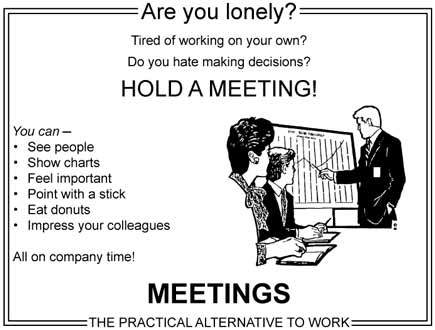
hold-a-meetingThis week at my supervisory management course, we learned about something I wish every single one of my colleagues would learn: how to have an effective meeting. As I am one of only a couple of faculty members in this course, it was quite startling to compare/contrast the types of meetings I am used to, to the types of meetings my colleagues on staff have. I would say that many faculty meetings have a lot of talking. In fact, in recent meetings that I have run (poorly), all I did as the meeting lead was stand at the front, mentally note who raised they hand when, and make sure people spoke in order and didn’t trample over each other. We spoke for over an hour! Just talking one after another. I also took notes in a notebook or on a black board so that I could transcribe them later. There are so many things wrong with how I run my meetings, it is ridiculous. But, these meetings are weird, because they are between a bunch of people who are basically equals who all like to talk – a lot, and all think that they are the smartest person in the room. That makes faculty meetings harder. When I have a lab meeting, where I am clearly the top of the hierarchy, they run very differently – maybe more like my counterparts’ meetings. I run the meeting, I set the agenda. People talk and comment, but I control it and don’t let it derail. Actually, sometimes I do let it derail because I like to make a fun environment and chatting is part of that.

What is the definition of an effective meeting? Meetings are effective when the goals of the meeting are achieved using a minimal amount of time and all participants are satisfied. Most meetings can be classified into two types: Information and Decision Making. Information meetings are used to convey information to a group or convince a group of something. Decision Meetings are used for goal setting, problem solving, and action planning. Most of the meetings I seem to have in academia, both with my research group and with colleagues on committees seem to be the second type. Straight information is (thankfully) usually conveyed in email format. Although sometimes it is useful to convey information in verbal forms (if it might get people upset, for instance).

Below are 10 characteristics of Effective Meetings. Here is a fun exercise: score your typical faculty meetings using the following rubric:

0 points if this never happens/never done for meetings,

1 point if you are not so good at this or this rarely happens in your meetings,

2 points if you are OK at this, or this occasionally happens in your meetings,

3 points for being generally good at this and this normally happens in your meetings,

4 points is your meetings always have this.

Score       Attribute

____     Seating in the room is arranged so that every person can see everyone else.

____     Equipment is available at the front of the room to record ideas/plans.

____     Your meeting has an agenda.

____     The agenda has time estimates for discussing each topic of the meeting.

____     At least 1-2 times in the meeting, there is a probe into how effective the meeting is going.

____     During the meeting someone records the ideas and decisions of the meeting. The data is prepared and handed out afterward to all concerned.

____     Meeting notes indicate who has agreed to do what before the next meeting.

____     Dates of future meetings are set in advance so people can arrange to attend.

____     Those in attendance decide who else should be involved for future meetings and those people are included.

____     At the end of the meeting, people review and confirm who is doing what.


So, how did you score? I score quite badly (about 13 out of possible 40) – getting a zero in many of the attributes. I often do not have an agenda and it certainly doesn’t have times set for each part. We always have a place to write notes – chalk/white board and projector, but most of the time someone doesn’t take note. I usually take notes, but sometimes I don’t have the time to transcribe and distribute them. Have you ever been to a meeting where it was stopped and someone asked how it was progressing? Big, fat goose egg on that one for me. Never, ever happened ever. Dates of meetings set in advance. Does 24 hours ahead of time count?

Are these things feasible to do at meetings in academia? I think they are, and I think it would make meetings more useful and less dreaded. I am going to endeavor to implement these attributes into my meetings from now on. I hope my colleagues say, “I love having meetings with WomanOfScience running them. They are so efficient and effective. We get stuff done without wasting time!” OK, that might be wishful thinking! What do you think? Post or comment here. To get an email every time I post, click the +Follow button.

Tag Cloud