Helping the Minoritized Achieve in Academic Science

Getting It All Done

TimeManagementv2In science, there is a lot to be done. When you are an undergraduate, you had problem sets, lab reports, maybe even a capstone to complete. You were maintaining your grades while having some fun and doing some extracurricular activities. As a graduates student, you passed classes, TAed, performed novel research, became the world’s expert in your exact experiments, perhaps organized some science-related on-campus activities, attended conferences, made posters and talks, wrote papers and a thesis, and got a postdoc. As a postdoc, you juggled multiple projects, learned new techniques, wrote proposals for fellowships, mentored graduate students and undergraduates, perhaps juggled multiple mentors, wrote papers, edited papers, edited theses, attended conferences, networked, gave talks, wrote papers, applied to jobs, interviewed, got a job, and wrote papers.

Now, as a faculty member, your job tripled because in addition to doing all the stuff above, you are now having to manage other people (posts), get enough funds to support other people (write grants, see post), teach courses (perhaps some that you never took yourself, see post), work on service for the department and college (post), and take on larger and larger service roles for your scientific community. Each of these has a huge number responsibilities and components to it, and could be a job unto itself. So, how do you do everything?

I have had some posts about starting a new job here and here, but at the beginning, the job isn’t as much. It definitely ramps up over time. I have one post that is good for helping to organize yourself over a yearly time frame, but there is also something to be said for a monthly or weekly schedule that is conducive to getting everything done. One extra issue with academia, is that your schedule changes throughout the year depending on when you are teaching, what you are teaching, who is in your lab, and other what naught. I will give some examples of weekly schedules that worked well for me over the years, in a hopes that they will help you to organize your schedule, too.

Example 1 – 10am class for 1 hour. Several semesters, I taught at around 10am for about an hour three days per week. This time slot was pretty close to ideal, which is probably why they are so popular in the schedule. The students were awake, I had time for last minute prep before class, and I took the entire morning for “teaching.” Here is how I actually arranged my schedule. On the days I was teaching, I got in around 9am and did some last minute psyching up for class, making sure I had demos, and my computer was set up. I would print off and make copies of anything needed for class. I would go 15 minutes early to the classroom to set up projectors and demos and also talk to students as they came into the lecture hall. After teaching, I would go to the gym for an hour to get exercise and decompress after teaching. After the gym, I would shower and go to lunch. I would spend the afternoon working on leftover class stuff, like scanning and posting my notes or homework solution sets, office hours, and meeting with students. On the other days, I would try to take the entire day for writing grants and papers. In the evening the day before I would teach, I would spend a couple hours in the evening re-writing my lectures.

Example 2 – afternoon lab course. Other semesters, I taught afternoon lab courses two times per week for several hours in the afternoon. Lab classes take less preparation because there are not lectures to make up. I usually try to keep all the teaching stuff on the same day, so any preparation, photocopying, or equipment set-up that I might need to do would be done in the morning. Again, the other days are reserved for research. I would also try to go to the gym first thing in the morning on research days before going into work but after getting the kids to school. Sometimes working out was a great way to kick my brain into gear and get it working for the rest of the days on research days.

The key to all of these ideas is to give myself the time I need to do what I need to do. I block out full days for research and I do not allow committee meetings to be made on those days. The days I teach classes, I put other meetings and office hours, so that it is all on the same day. Although I have been failing recently, I also try to get to the gym 3 days per week. Also, I eat lunch with friends almost every single day, and I try to sleep 7-8 hours per night.

Also, none of this includes any family stuff, which happens outside of 9-5. But, here is the key, by giving myself time for stuff like rest and the gym, I have some slack that I can take up with family stuff happens. The week when the baby has a fever and he has to stay home, I cut out gym and some other stuff so that I can still get the important stuff done take the time I need to be with the baby at home. (My spouse and I split days off with sick baby, and negotiate which days/times we can be home. We often don’t schedule important, non-rearrageable meetings at the same time not he same days, so we can do this. We have a joint-shared set of calendars.) If my time is already stretched to the breaking point, a sick kid or other family emergency will wipe me out. If I am giving up going to the gym for a week, so I can get more research done, it isn’t as bad.

So, what do you think? Do you have a way to arrange your time that enables you to get it all done? Post or comment. You can receive an email every time I post by pushing the +Follow button.

Bullying Backfire

bullyFor the past several years, the topic of bullying has been hot in the media. Most people, especially nerds, realize that bullies have always been there. Although academia is supposedly some liberal bastion of cushy touchy-feely softies who “can’t do,” so they teach, it is actually full of bullies. Those nerds who were bullied most as young people are the most likely to bully others in the future. It is a cycle of abuse that is disturbing. It doesn’t help that many of the people in academia are not good communicators and can often be stubborn and unyielding in their emotional ideas. All of these circumstances lead to a high amount of workplace bullying. In addition to sexual harassment that is still pervasive, the more subtle workplace bullying by chairmen, peers, or even students can make women and minorities feel bad about their job and abilities.

Currently, UState is requiring a workshop on Workplace Bullying. Based on what I discussed above, this would seem like a great idea, right? Ironically, these workshops appear to have a backfire effect. What I mean by this is that known bullies are coming out of the workshop convinced that they are being bullied themselves. Mostly, they are claiming to be bullied by the very people they are bullying! Why is this happening? Because the bullies and the bullied are in fact having a disagreement. Unfortunately, the inept abilities of most scientists to communicate mean that the more aggressive person comes across as a bully. The less aggressive person seeks relief, help, or just a chance to gripe, and they are branded as talking behind someone’s back, forging alliances against the other person, or just a troublemaker. In the new definitions of bullying, these defense mechanisms are also a form of bullying.

In talking to my female peer-mentors, it seems like most women coming out of the workshop think to themselves, “Oh no, I have been inadvertently bullying someone. I need to try to adjust my way of acting.” On the other hand, many men have come out saying, “OMG, I am being bullied by everyone.” I think it would be interesting to perform a follow up survey to see if it the reaction to the workshop aligns with gender. There are always exceptions, I am sure, but my hypothesis would be that women are more likely to be introspective about the workshop. This is what I mean by a “Bullying Backfire.” The bigger a bully someone is the less likely they are going to see themselves as the bully, and the more likely they are to see how everyone else is bullying them. In my opinion, this is part of the mentality of a bully – to blame others for your problems.

So, how do we respond to bullying? Once we identify it occurring, we can only change our own actions toward others. Is it possible to change the actions of others who are bullying us? It is worse when you are a graduate student being bullied by your advisor, or an assistant professor being bullied by a senior faculty member? Do you act like the “bigger man,” and just pretend it doesn’t affect you? That can backfire, too. Especially if your bully is trying to tear you down and make you feel bad on purpose.

Popular culture tells me to stand up to bullies, and I have been accused of being brave. I am not sure if I am brave or just really stupid, but surviving can be a sort of standing up for yourself. I certainly did stand up to bullies in high school, and I fought back. I was protected by my honor-student status against being sent to detention or being suspended. I was able to fight back immediately at the time, and move past my bullies.

Now, revenge may need to be placed on the back burner and served cold. Much like my honor-student status, one can always overcome and get back at your science bullies through your science-cred. See, in science, she who has the best publication track-record laughs last. At the end of the day, if you have better, more publications, you will get more respect than your bully. I have done this with several of my science bullies. It takes having a long-view, because it is not a quick solution. So, sometimes I just keep my head down and move my science forward and try to ignore my bullies. Obviously, this only works if your bully isn’t seeking you out to suck up your time.

All this being said, it is absolutely essential that you have a support network to help you handle these situations. You need a good partner to listen and offer sympathy. You need a peer network, or group, to offer advice, consolation, and cheer-leading about how great you are. Most people will not admit this, but you probably also need a therapist. In all the times when I had to deal with a bully, I sought out a therapist to talk to on a weekly, or every-other weekly basis. These people are not in science, necessarily, but they can give you can outlet to gripe, a confidential confidant, and someone to help with people-solutions.  I am not ashamed to say I have been in therapy numerous years over my life, and I am a more well-adjusted, and better person for having done it. Younger generations of people do not see it as a stigma, but as a means to help to deal with difficult people. Older generations often see it as a signal that you are “crazy,” but the only crazy thing is to not use every option in your reach to deal with these problems.

So, what do yo think? Are you being bullied? Is it persistent? Or sporadic? Comment or post. You can follow the blog by pushing the +Follow button.
1114_universe-crop-500x416So, are you watching COSMOS? We are. In fact, we are watching it twice each week – once live and once with our kids because they didn’t get to see it (their bedtime is too early). It was fortuitous because our daughter was just asking about where babies come from (she is in elementary school). Since we don’t like to lie to her we were giving her the scienciest explanation we could must with very little information on the dynamics of S-E-X. So, we were talking about DNA with a lot of hand-waving. We were super excited to watch COSMOS after both kids went to bed, and see the DNA illustrated. We were recording it, and are watching it tonight to show the kids. Both kids are super excited about it! I couldn’t be prouder. (We also watched Gravity this weekend, and my daughter thought it was scary but exciting and cool.)

I was also ecstatic because some of the science I work on was mentioned in COSMOS in episode 2! It was awesome to see it illustrated in beautiful graphic arts and brought to life. When it came on while my kids were watching, I ran to the TV, pointed at the stuff I study, and said, “That is the science I work on!”

I am super excited about COSMOS because I think science outreach to the public is so important. It is important to educate our representatives in government to ultimately improve science funding. It is important to educate people who deny evolution and global climate change. It is really important to educate future scientists to get them excited about discovery so we have enough hard working people to make new breakthroughs in science.

Also, I find that people are really jazzed and excited about science in general. I do a lot of random science outreach. Mostly, I do a lot of talking about it on airplanes, in airports, in taxis… I’ve been doing a lot of traveling, lately, have I mentioned it? When people sit next to me and ask what I do, they are often excited to learn I am a scientist. I have taken the opportunity to explain some of my science, why it is important to them, and what we could learn. They are often really excited and impressed.

Also, it is a great way for me to learn better ways of communicating my science not just for the public, but also to my classes. Teaching big service courses to hundreds of students is an essential way to make a science-literate public. For some, especially those taking ScienceForPoetsCourses, this may be one of the last times they come into contact with science in a class in college. The experience should be a positive one, and it should make them literate of what science can do for them.

Another place I have been doing a lot of outreach is to my Representative in the U.S. Congress. I have been going for the last several years to a Capital Hill visit day with one of the ScienceSocieties I am a member of. The first year I visited my Rep, I was happy to see that his office had pennants from the universities and colleges in his district. He was taking over our region due to an “ungerrymandering,” so I made sure to bring him a pennant from UState when I went to visit the second year. Mostly, I spent a lot of time talking to his staffer responsible for science, and informing her about how science works. I told her about how federal funding works, which she didn’t realize. I told her how the university only gives a research professor money to start a lab, but after that, we have to sustain it ourselves with outside funding. I told her how we don’t get paid to do research in the summer unless we bring in enough money. I told her that after we figure out how much we need to budget, we multiply it by 60% to determine how much overhead we give to the university. I told her how funding agencies typically still don’t give you what you ask for in your budget, and you get cut and have to make tough choices. Most importantly, I have kept in touch. When I get a grant funded, I email the staffer and let her know. I offer to show the representative around, if he should want a tour of some labs on campus. I offer to help with any science policy issues that might come up. The staffer knows my name and work enough to email me when she sees an announcement that my research got funding.

The next step, in addition to this helpful blog, is to try my hand at OpEds. I tried one, but it didn’t go anywhere. I was told by an expert that it wasn’t personal enough. I actually hate personal OpEds. Who knew I was supposed to like them?

I am not advocating that everyone, especially those pre-tenure write OpEds of even blogs (unless you want to write an entry here…), but emailing or visiting congress and talking science to random strangers is relatively easy and important. I do advocate that we all try to advocate a little more in our daily lives. COSMOS should help. It is easy to strike up a conversation about, “Did you watch COSMOS this week?” Then, you can talk about the stuff that was on there, if and how it pertains to your research, and the significance of the work for human-kind. What do you think? Post or comment. Push the +Follow button to get an email every time I post.

Conference Thoughts

2475011402_bf70c92575_oAs I am sitting in a session at the world’s largest conference in MyFieldOfScience, I am thinking about conferences. I am thinking about how important they are for your career in a lot of ways. For those of you who recently joined the blog (thanks for following!), you may have missed some previous posts about networking. I had one about general networking and another on networking on campus, which are both super important for getting tenure, getting jobs and just good for your career. Conferences are key for networking, being seen, and building your mentoring and scientific connections vertically and horizontally. I have come to the realization that networking is basically “professional flirting.” You can chat about science, but most convos are about family, travel, weather, grants, clothes, students, jobs, or whatever. Academic life has other aspects that we can talk about too. I had a great conversation about teaching and how to teach 400+ effectively with a colleague from another university.

Another thing conferences are great for is energizing your science. When I was young, and I think this is the case for my students, I loved going to conferences because it gave me confidence that people were actually *interested* in my science. I was able to talk about my work, have some people listen, and get validation that what I was doing was of worth. Further, seeing the work of other people that was similar to my own made me feel like I had a community of scientists who were interested in the science. Conferences re-energized me and made me look forward to working on more science and getting my work published.

Now, my science gets energized, but in a different way. Now, I look around and say, “Oh crap, we are more behind than I thought! Everyone is doing the cool experiments I thought of but haven’t gotten off the ground yet!” This is both bad and good. First the bad. It is scary to compete with your science against other groups that are better funded, have more students, and might be ahead on the same ideas you have. Also, I am so so crappy at hiding my science. I cannot keep secrets about the cool stuff we are doing. In some fields, telling people what you are doing helps to mark your territory. In others, it can be giving them the keys to all your best ideas. I have to be careful, but I can’t help but be communicative, open, and excited about our newest stuff. It might hurt me sometimes, but in the long run, I would rather collaborate than compete.

Now the good. Much like when I was young, seeing all the great stuff my colleagues are doing that is similar to my own work can be energizing and maybe even light a fire under your ass to get going. Further, it helps you to focus. If you had an idea to do X experiment and you see it done (probably slightly differently) at a conference, you can refocus your idea to probe the still open questions. Another good thing about people working on similar stuff – it shows your work is hot, important, and in fashion. As in other realms (like fashion) styles change, but if you are hitting hot you have a better chance of getting high profile publications and getting noticed.

So, those were my thoughts about conferences. What do you think? Post or comment here!

WomenPrisonRiot-1950sThere has been a flurry of conversations recently about women speakers at conferences. This was all spurred by a recent article in Salon.com about the fact that a “theoretical chemistry” conference had ZERO women speakers. Here is the article. The subsequent, real, and valid outrage by women in the field resulted in a boycott of the conference by women of the field. It seems odd that we have to keep having the same conversations about how it is important to have diversity, yadda yadda. And women have to keep fighting to get invited to talk at conferences in their field.

When this situation occurs, the OrganizingGuys always claim that they invited A woman, but she turned them down. What are they to do?

As usual, they should ASK A WOMAN for the solution to this problem. No one asked me, but I am going to give my opinion anyway, because I have an advice blog! Here is a solution to the OrganizingGuys:

Let’s say, you want a program with a person you does fields/subfields/specialities we will call A, B, C, and D. Because there are so few women – especially at a certain level – there may only be 1-2 women in each of those fields/subfields/specialities. What is the first inclination for most organizers? Typically, you might invite 3 men who specialize in A, B, and C. Then you ask the one woman who does D. And, guess what, that woman cannot come because she is doing 100 other things. Now, there are “no more women who do D,” so you “have to ask a man.” (This statement may be debatable, but let’s assume that is true for some fields like “theoretical chemistry.”)

Here is how you can get more women: ASK THE WOMEN FIRST. Then backfill with men. If you ask your favorite woman in fields A, B, C, and D first, and some say no, you are likely to still get a woman. Whichever women say no, replace with a guy. The worst case scenario? A session of ALL WOMEN? Which doesn’t sound bad at all, actually. If all 4 women say “no” you could have a back-up list of women, but I feel the likelihood is pretty low that they would ALL say no unless you are competing your event against another event in your field (bad idea for conference/event planning in general).

This solution is very easy and results in a high representation of women, assuming that is actually what you want.

In an interesting side note to this story, I was recently asked to participate in a proposed session for a major national conference in a field related to my own. The organizers, two women, specifically put together an entire program with all women. Their goal was not only great science, but also a nod to the women in the field. Their session was rejected and told it was “not diverse” enough. I do not see one field in science where women are the at majority or even at parity with men at the faculty level. Please correct me if I am wrong. Thus, I feel like any session that is trying to bring the inequality of women in the field to light by having a session with mostly women should be applauded – not rejected – for their efforts. Alas, although we are ready to accept that “there were no available or acceptable women” resulting in a session with 100% men, we cannot accept a session with 100% women?

I also want to point out that the plight of minorities is EVEN WORSE. Many scientific societies cannot even publish statistics on minority graduation rates at the PHD level, because there are too few, and the results can be directly linked to the 1-2 minorities graduating each year. It’s not exactly anonymous aggregate data when there are 0-3 of you.

What do you think? Post or comment! You can follow this blog by pushing the +Follow button and putting in your email address.

mary_poppins_by_nightwing1975In my last post about traveling, I mentioned the plight of my poor HusbandOfScience while I was away. Since he is a HusbandOfScience, he had several deadlines during the time when he was shoveling snow while tending to 2 children. I think I have finally convinced him that we should get a housekeeper/nanny. But, how do you find one?

Here are some helpful tips from WomanOfScience, Robin:

For new parents, it’s understandable if they both prefer to minimize travel for 12-18 months postpartum, especially for lactating moms. Pumping milk and pouring it down the sink in the women’s bathroom at a conference is not my idea of a good time.

Once you are ready to travel again, I would recommend having a nanny (or, possibly, a grandparent) available at home to assist the parent left behind, to alleviate the stress of solo parenting. It’s especially helpful if the nanny can help with laundry, shopping, driving kids to activities, cooking, and at least light housekeeping.

Nannies deserve decent pay so prepare to have less disposable income. An ideal candidate might be a semi-retired adult who will mostly work a few hours/day before or after school/daycare (or both), and who is also available on an emergency basis to cover the daytime hours in case of (heaven forbid) a sick day or snow day.

When our kids were little we spent a lot on nanny salary (often nanny-sharing with another family); and, later, private school tuition + after school nannies. The trade-off is that for a long time we drove older cars (purchased used and kept for well over 10 years) and lived in an older home in a not particularly trendy neighborhood.

I viewed each nanny as a professional co-parent and we did our best to treat them with kindness and respect. Most stuck around for a long time. There were a handful of nannies who didn’t really work out and stayed for less than a year, but most stuck around for two to five+ years. A tip: One way to promote a nanny’s loyalty to your family is to put her on your family cell phone plan, on the condition that she will keep the phone handy when on duty.

With good support at home you and dear husband should both be able to travel without too much stress on either of you. And with all the frequent flyer miles you earn, you can take the whole family on a nice vacation.

The tricky part is what to do when both you and your dear husband need to attend the same conference. Your best bet is to have both a familiar nanny and a beloved grandparent stay at home with the kids. That way they at least have their familiar environment even if not all the familiar people.

Here is something that we did for you to consider: hire a personal assistant. This is one benefit of living in a college town. There are often college students who will do stuff you need for money. I currently have a personal assistant. Sounds weird, right? It’s totally awesome. Here is how I did it: Last year, at the beginning of the fall semester, I had a small infant, a 6-year-old, and a basement crowded with crap. I needed someone to help me while I was on maternity leave to get my house in order. HusbandOfScience and I had spent the past 5 years living in a house, but not really maintaining it or organizing it. No time while trying to get tenure.

So, I put an ad on the electronic job board at UState. I specifically asked for a personal assistant/organizer. I was specific about heavy lifting and cleaning. I had several applicants, and one very good one in particular. We worked out a deal for hourly wage and discussed some of the grosser aspects of the job. She didn’t run away screaming, and thus we landed someone to help us clean and organize the house. The basement went from impenetrable to organized and actually clean. This year, we hired the same student to watch and drive our oldest to after school activities, such as gymnastics class. Unfortunately for us, and happily for her, our amazing helper is graduating this year.

Next year, I want to graduate to a real housekeeper/nanny. I figure, in the 1900’s people who did even work had staff in their house. Now, HusbandOfScience and I work 60 hours per week on our jobs and we are supposed to be able to keep our house tidy, clean, with fresh sheets, and clean toilets? No fair! We can’t afford full time staff, but I think it would be better to have a functional house with a house keeper instead of a rats nest and new stuff that just gets trashed because we can’t do the upkeep.

What do you think? At what stage do you make the leap to full housekeeper? Post or comment? Push the +Follow button to receive an email every time I post.

On the Road Again

Travel-smallI am wrapping up the end of a couple weeks of travel. At first, it was nice to have a break from my gigantic class and my crazy household and the snow snow snow, but I am ready to go back home and get into a comfortable groove again. I am sure my HusbandOfScience will also be happy to have my help around the house again, too.

HusbandOfScience and I seem to do a lot of traveling. This semester, I am traveling for 3 conferences and 3 seminars. That doesn’t really seem so bad, unless you add in the travel of HusbandOfScience. If we each travel once per month, than someone is traveling every other week!

I think I should start phasing out most seminars, but people come back and ask every semester. You feel flattered and you feel guilty for saying no. The requesters come back and ask you again so nicely and politely.  So you make a date for a year in advance hoping that FutureYou will be in a better position than PresentYou as far as traveling. But FutureYou has always been in a worse position because PresentYou is an a-hole who keeps schluffing her travel onto FutureYou. This is all screwed up even more because some fancy, exciting invitations might come up on shorter notice than one year causing all wave function to collapse into a coherent travel particle.

But, here is a problem with phasing out going to give seminars – we get evaluated every year on our research accomplishments that help to determine the measely 0.5-0.7% raise you might get. People who don’t travel are dinged because they must not be important enough. Seminar invitations count toward your visibility as an academic, so you don’t want to ignore them completely. So, what is a happy medium? How many seminars is enough to make sure you are getting out your research message, but no so much that you drive your wonderful SignificantOther bonkers because you are never there? And is it really important to travel at all?

Some of my WomanOfScience friends who have new babies are having trouble getting back into the groove of travel. They are saying “no” and feeling guilty because it is for family reasons. Again, I ask if this is hurting their career? It seems to me that if they get out a reasonable number of scientific papers and other written works each year (say, 2-5?) then their scientific research “cred” is really not in jeopardy. I think not getting manuscripts submitted and published is a more negative issue for your career than the number of talks you give. So, I don’t think these MothersOfScience should worry about getting back to the swing of travel so fast, if they want to take a few years to settle into motherhood before hitting the road again. For when you are ready to get back, I have a lovely post contributed by one of my mentors and AllAroundWomanOfScience about this topic called, “Back in the Saddle” you might want to check out.

One thing I do want to say is that I get a lot more manuscript writing and submitting while away traveling and on the road (actually mostly on the airplane) than I do at home. So, for me, keeping up that paper count may depend on my seminar schedule being full.

What do you think? How essential is travel? Does it matter more before or after tenure? Comment or post. Push the +Follow button to get an email every time I post.

Chicks Be Crazy

CrazyLadyI wanted to call this post, “Bitches Be Crazy” but Robin told me that I shouldn’t swear so much.  I do try to limit my swearing here, and those of you who know me know that I have quite a potty mouth in person. But, to engender the positive, problem-solving atmosphere I try to create in this blog, I will try not to throw it in your face so much.

So, I called it “Chicks Be Crazy” and I will take time to explain what I mean by this. First, I wanted to use “Bitches” because in academic science, being a tough, but liked women is often hard. You get stereotyped as either a Mommy-type, a Whiner, a Push-Over, or a Bitch.  Of these, being a bitch is probably the most powerful, and is often the side to which successful women often error.

But, actually, it isn’t the word bitch that upsets me so much, perhaps because I am over feeling bad about it. Instead, I am more concerned with the word, “Crazy.” I call crazy “the c-word” (yes, I am aware of what the real c-word is). The problem with the word crazy is that it shuts down all argument in science because, whatever science is, it cannot be crazy. Crazy means illogical and wrong. Science is based on facts and cannot ever, ever be crazy. Yet, the c-word is something we often call women to describe their actions.

So, my first plea is that we stop using the c-word for other women. As I have said before, WOMEN ARE AWESOME! But, sometimes women are not awesome. We are all guilty of woman-on-woman crime of calling another women crazy when they are acting out about whatever issue is concerning them. So, let’s come up with something more specific and concrete to describe their actions instead of jumping to the c-word. If another woman is panicking and running around like a chicken with her head cut off about something, let’s call it stress or panic, which is what it actually is. If someone is disorganized and scattered, that is different. If someone is yelling or crying, then they are angry or sad. See, it is easy to avoid the c-word.

Also, I feel fewer people call men “crazy” even when they act out. If a man is mad and yelling, he is angry or pissed off. If a man is running around, trying to get things done quickly, he is stressed out. If a man is disorganized and a bad manager, what do we call him? Not crazy, just crappy, I guess.

As I look around my department or other departments, I find that the women who are more likely to be c-word are older women in male-dominated fields. I realize that these women have been driven c-word by their male colleagues. To put this in context, we have to do a little role-playing. Imagine if you will, you are a smart, driven, dedicated person. At some point in your career, you come into contact repeatedly with some person/people who do not listen to you, cut you off, undermine you, or otherwise put you down. These people are likely your colleagues in your department and avoidance is not an option when you must serve on committees with them, have meetings, and just run into them in the hall. Although this is a low level of being put down, and this person/these people may not do it all the time, you never know when you ideas and suggestions will be ignored or disparaged. Now, you are in that situation for 15-20 years. To make matters worse, when you go outside of your organization to give talks or attend conferences, you are successful, people listen and respect you, and you are often honored for your work and how smart you are. These praises from the outside are in stark contrast to the disrespectful treatment you get on the inside. And over time, you just get nuttier and nuttier, especially when dealing with the buttheads in your organization.

As one of my good friends and WomanOfScience put it:

I think this is all related to the phenomenon that I have seen which I call (for lack of a better phrase), “there’s another one, but she’s nuts.”  You meet a young female faculty member in a STEM department, and you say, “Oh great!  They finally hired a woman in (Physics, Chemistry, Engineering, etc.).” Then you catch yourself and say, “Oh no wait, there is that older female faculty member in (Physics, Chemistry, Engineering, etc.) but she’s not very active/bat**** crazy.”   It seems like many STEM departments have a young, energetic, fabulous woman and then an older woman who has made it through but is isolated, not very active, nuts, or all three.  It’s like there is this crazy old auntie staying in the guest bedroom.  She’s become so isolated that you forget she is there most of the time.

I know you are asking, as I am: What is the cure? I don’t want to be a crazy, bitter old lady in my department. Luckily, there is a treatment, and it is free. Your colleagues have to treat you professionally and with respect. This treatment may not be available in all areas, unfortunately. The solution is to move to an area where the treatment is available.The other solution is to not care at all, but most women in science aren’t so socially out of it that this is a true possibility. It seems that these are the only hopes of not becoming the department nutter.

What do you think? Post or comment. Push the +Follow button to receive an email every time I post.

Yawning-1I was recently having an email conversation with another WomanOfScience. She was describing her concerns about getting a tenure-track faculty position. She has a HusbandOfScience, and a one-year-old BabyOfScience, and they will all be on the job market very soon. She relayed a story about how, two weeks after giving birth, she was on the phone with a program officer at a FederalFundingAgency. The baby cried, and she was embarrassed and had her HusbandOfScience move the screaming baby to another room. She felt that the PO might think she wasn’t serious because she had a baby. This made me think of several things:

Would a man with a kid crying in the background have been as anxious about the sound?

People have all kinds of noises in the background of phone conversations. What if a dog had barked? That is annoying, but does owning a dog make you less serious of a candidate?

She was worried that having a baby would make her seem less dedicated, but she was having a phone conversation with a program officer 2 weeks after giving birth! What could be more dedicated?

I think we need to discuss that maternity leave is partially a medical leave! It isn’t just women being hard on themselves. When I was prego as a postdoc, I had two advisors. One was a WomanOfScience who had two kids, and knew that having kids can actually make many dedicated WomenOfScience more efficient and productive. The other was an OldWhiteMaleProfessor who had a stay-at-home wife while his kids were young. When I told him I was pregnant, he was happy. And he said how I was lucky that I had such a supportive advisor like him. This, as I know now, was a red flag.  Anyone who says they are super supportive is probably trying to convince themselves. As the end of my pregnancy loomed closer and my belly loomed larger, he started driving me harder. He would make me stay late – until 9pm to meet with him on a couple of occasions. My belly became too big to actually work on parts of my project. In particular, I was aligning optics, and I noticed the beam shoot across the room because my belly had accidentally moved the mirrors in the front of the optics table. I decided it was getting dangerous to be a fat prego in the optics lab. There was plenty other stuff to do, so I decided to work on other stuff.

One of the other things I was working on was a manuscript. My WomanAdvisor was reading drafts, making edits, and pushing it forward. My OWMP Advisor would not read it. WA said it would be best if I got it submitted before the baby came. I agreed. OWMPA still wouldn’t read it.  He finally read it and said it was ready to submit AFTER I gave birth!

One night I was working late, OWMPA asked me, “What are you doing on your vacation?” I said, “What vacation?” He said, “You know, when you are away.” I said, “That’s not a vacation, its maternity leave.” I was flabbergast. He said that he just wanted to check that I would be working while I was away. This was pretty ridiculous because up to this point, I have had one paper published in a high profile journal, a second that he wouldn’t read, and I already had a job waiting for me at UState, which I was postponing for a year to stay in the lab. In what world would I not come back to work? How could I possibly quit and give it all up just when I was getting everything I wanted?

Further, I have something to say else: MATERNITY LEAVE IS NOT A VACATION! It is a not a leave for fun. VACATIONS DO NOT START BY HAVING YOUR WHOOHA BLOWN OUT OR BEING CUT IN HALF LIKE A MAGICIAN’S ASSISTANT! Maternity leave is a medical leave because you have had a traumatic event destroy your body. It feels like you got hit by a truck, and you can barely move the next day. And, it takes you 6 weeks to physically recover from the experience. So, I hate when people act like maternity leave is anything but what it really is – a medical leave!

Let’s put it in terms an OWLP can understand: If you have surgery for, let’s say, a kidney transplant which cannot be done laparoscopically, and requires you to be cut in half, you would not expect that person to be reading papers and coming into work before the doctor-prescribed recovery time, right? It would be insensitive to expect that person to work, so why is to cool to ask that person to, say, submit a manuscript 6 days after giving birth?

So, let’s get real.

Women: don’t put so much pressure on yourself to act like everything is totally normal right after giving birth. Your husband may be able to go back to work right away, but you cannot because your body needs to HEAL. Don’t be so hard on yourself. Take your leave, get some sleep, and figure out being a mom. The time is really very short, and will not harm your career to be away for 6 weeks. What if you were in a car accident? and had to recover for 6 weeks?

Men: don’t act like maternity leave is not a real, medical leave. Women need time to recover, and it doesn’t mean they aren’t dedicated. It doesn’t mean they aren’t going to come back. Give them time to adjust. It will be alright.

I hope my description of the post-birth experience didn’t swear anyone off of having kids. Post or comment. Push the +Follow button to get an email every time I post.

Productivity and Effort

ProductivityPlotI just gave my State of the Lab address to orient the newest students joining the group to the ways of the lab. I have described the State of the Lab address before herehere, and here. In that address, I have a slide on how important it is to rest in science and to take breaks. It is very important to get a good nights sleep. It is essential to stop and eat. Doing exercise is also good for the body and mind. Taking breaks and getting sleep gives your mind a chance to work out solutions to problems. Ultimately, it makes you more productive to take these breaks. In the lab, I have been known to supply modeling clay for students to use during breaks. We ended up with a wonderful menagerie of little animals thanks to these breaks.

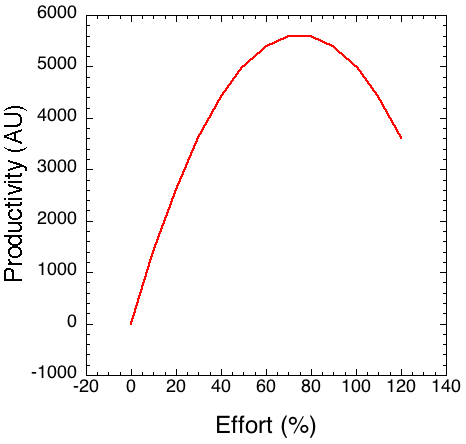
The entire discussion was prompted by the fact that I sometimes get a very hardworking and dedicated student who starts doing overnight runs and working non-stop. Inevitably, their Productivity goes down. I think that people of all ranks and stations do not realize that Productivity is not always a linear function of Effort. Figure 1 shows the true dependence of Productivity on Effort, which is really more of a parabola. I want my students to be in the linear regime of the curve. Although this is not the most productive location, the linear regime is good because if they need to give a little more Effort it will likely result in more Productivity. Indeed, being up at the apex, which does maximize Productivity, is very dangerous. If you need to add a bit more Effort, you will actually be less Productive. Further, that’s the region where small mistakes could cause accidents in the lab.

I was thinking about this over the past 2 weeks because I am living at or near the apex currently. Even my students told me that I need to get back into the linear part of the curve. They are right. I am running myself ragged, and it is only the second week of classes. This is because I am co-teaching 440 students in 2 sections for the first time and flipping the class to boot. The email burden alone is astounding. The most stressful part for me is having 30-50 unread emails in my inbox all day. I don’t even read them because I don’t have time to respond, so I read and respond in the evenings. This has been perhaps the most stressful, and I did not realize how much anxiety this would give me.  In addition, I had a paper returned from review that needed to be revised with 10 days (that’s the shortest turn around time I ever had).  Before I was given this teaching assignment (mid-semester last fall), I already made arrangements to travel 3 weeks during this semester for conferences. I am planning to use this time to actually work on research during the semester, which I would probably not have the opportunity for if I wasn’t co-teaching. I have two half-finished manuscripts that I need to get out before spring break! My service has also picked way up, and I am just barely performing there. I  dropped out of a few of the less important service items – even though one was university-wide.

I should say that even though I feel like I am at the apex, or perhaps past it, I am still getting 8 hours of sleep per night. Somehow I magically found Friday was easier, so it could just have been an adjustment period? Or maybe all the students don’t do my class on Friday. Only time will tell. So, I finally did have time to write this post on Saturday night.

So, where are you sitting on the Effort-Productivity curve? Post or comment!

Tag Cloud