
Helping the Minoritized Achieve in Academic Science

Nagasakibomb-colorThe recent linked post about being a “good girl” in STEM focused a lot on following the rules and how that can actually be bad for you. I was particually happy with the list of practical things that you can do to resist, but they were all geared toward “after tenure.” BTW – there is a male-equivalent to being a “good girl.” I call it being a “boy scout.” Many of the men in my department are boy scouts, which makes being a good girl not so out of the ordinary or weird.

In the original post, there was an undertone that you should be a “good girl” before tenure, because you don’t jeopardize your tenure case. Seeing how a large number of my male colleagues get away with doing little or crappy service – even before tenure – I think it is worth exploring things you can do to avoid or get out of service before tenure. This is especially important if your department doesn’t have a protection policy for untenured assistant professors. It is even more important if you were protected pre-tenure, are now tenured, and are staring down the barrel of a sh*t-ton of service.  Here are a couple solutions of some ways to get out of service, or at least spend time on service you value so it isn’t a “chore.”

  1. Mildly suck at your service. A senior faculty in an adjacent department gave HusbandOfScience and me some advice when we first got our jobs – don’t do a good job at your service assignments. This means not going the extra mile for service. You should prioritize it last, do it at the last possible minute, and perhaps miss assignments and deadlines sometimes. Spending only a quarter of the time on it you “think” you should. I definitely did this on some committees like graduate admissions and personnel committee stuff. It’s not that I did a bad job, per se. I am still basically a boy scout/good girl at heart, but I definitely didn’t spend a long time on these things. Why is this OK? A. Service is not going to get you tenure. B. On campus service never got anyone tenure. C. No one is going to not give you tenure because you sucked at your service. D. They might not ask you to come back.
  2. Play one service role off another. This basically means to use any other service you have as leverage to say no to the thing you are being asked. When I was asked to serve on admissions for GradProgramX, I was able to say no because I was already serving on admissions for GradProgramY. I ended up serving on both in consecutive years for about 4 years total – flipping between GradProgram X  and Y. This was great, because I learned a lot about how each program did things and could communicate successes and failures between the programs. Once you are committed to a big service role like admissions, personnel committee, or quals committee, you can use that commitment to say no to a lot of other department and college service.
  3. Make Up Your Own Service. When I got to UState DepartmentOfX, there was no women’s group, despite the department having a very small fraction of women and minority students. So, I started a women and minority group. We met for tea, and there was a lot of bitching because there was a lot to bitch about. The students told me they didn’t have a venue to give 1-hour talks, so I started a student seminar series where they could talk to each other and practice job talks and just exchange ideas. We discussed professional development and work-life balance. I told the department chair that I was doing this, and that it should be a service assignment (and not just assigned to women and minorities). And he made it one, and I got to do a service role that I really cared about. Along the way, I have invented or help invent with others other service assignments including Publicity committee (to fix and update the website more regularly) and a Departmental Teaching Luncheon working group. These were all things I cared about and were providing a service for the department. In addition, because I was doing these roles, I was also able to say no to other requests on my time (see #2 above).
  4. Question Yourself. One question you can ask yourself when considering a request of your time is: “If I had only a limited time to live, would I spend my time doing this?” If the answer is “Yes, this is important. It will help me leave a mark and affect a positive change,” then say yes. If the answer is, “No, this is a waste of my precious time,” then say no. I had a minor breast cancer scare a couple months ago (don’t worry it was a cyst!), and I went through all my commitments and thought, “If I do have breast cancer, do I want to work on this?” and for most of the things I was doing (my made-up service) the answer was yes. I feel like the service I am doing and have been doing is really good to affect positive change in the lives of students and my department colleagues, and it is worth doing.
  5. Armageddon: Blow Up Your Service. OK, I am NOT recommending this, and certainly don’t do this before you get tenure, but… another way to get out of service is to be so miserable and heinous to work with that no one wants to work with you. Call everyone assholes to their face. Accuse them all of being racists. Act racist yourself. Start flame email wars and never, ever let anyone else get the last word. Be super negative and disgruntled about everything. This behavior is what we call, “un-collegial,” and it will get you out of service. But, there is a price. Just as the price of being a good girl/boy scout is that you get dumped on. The price of being a truly heinous colleague is that you never get to do service. You are not trusted with the responsibility. You certainly will not be trusted to lead or have any important service. In fact, you might get stuck with the worst service, having no impact, but high work load, if you act this way. If you are fine with that, go for it. But, if you think you are important and you should be heard, don’t act like this.

So, what do you think? Are there other ways to get out of bad service? Not all service is bad, and you can get out of anything, actually. You can even back out of service you already said yes to. People won’t hold it against you, especially if you are over committed and won’t get the work done. Also, if you get better service and don’t have time for something that isn’t good or interesting to you, you should back out. To get an email every time I post, push the +Follow button.


A Good Little Girl

Yep, yep, and yep. This is a good one, and far be it from me to deprive my readers of some sound advice. It also makes me think about how I have avoided some major crap service assignments and teaching assignments. I should write about that sometime soon.

xykademiqz's avatarxykademiqz

When you are a woman in a male-dominated STEM field, weird things happen to you. People say weird shit or give you weird looks or write weird letters of recommendation for you. And this is just the good guys, the male colleagues who are at the core respectful and supportive of you.

A few years ago, there was some paperwork to be submitted by a deadline as part of a large collaboration. I was stressing out about it, and a very senior collaborator (older than my father) was mocking me for wanting to make the deadline “like a good little girl.”

And you know what? He was right. As a woman in science, who’s always done well in school, I have always been a good little girl who played by the rules. I see the same thing with the students in my undergraduate courses. Young women are very rare, but the average performance quality of the women is much higher…

View original post 1,593 more words

808px-Queen_Elizabeth_I_by_George_GowerSo, I went to an Academic Leadership Workshop. If you are interested in leadership at all or think you might want to run your department or college, I highly suggest going to something like this. The workshop was short, as these things go. It was about two jam-packed days. It was really informative and interesting. After attending, I really want to move into more leadership in various ways at my university. Here are some things we did that I thought were excellent about the conference.
  1. Types of leadership roles. When people think about academic leadership, they immediately think of being dean or provost, but there are many types of leadership roles. One thing I liked about the workshop I went to was that it discussed being a chair, dean, provost, chancellor, etc. But, it also talked about being the lead on a center grant within your institution or a multi-instiutional center. Further, there are a lot of leadership skills you need just to run your group, or lead a committee within a department. We talked about all these types of leadership roles and how leadership skills are important for all of them.
  2. Workshopping. A lot of “workshops” say they are workshops, when really they are just panels or lectures. This workshop actually allowed us to “work.” We were split into different groups and each group was assigned a different academic leadership role. My group was all people who would be applying for multi-institutional center grants. Other groups were people applying for chair positions at other schools (outside hires), dean positions, and provost positions. This part was really hard, which is to say that I learned a lot. The experts who were helping us were really good at pushing us to shore up our deficiencies in our proposals and hone our messages. It was pretty cool. We also had a lot of group work discussions about difficult situations and conversations revolving around making choices with your time, development (gift giving), and difficult conversations that leaders often have.
  3. Expert Panels. Just because we did a lot of workshopping doesn’t mean their weren’t panels. The panelists were pretty awesome. Some of the most important things I learned included: 1. Being an academic leader means you can help enable more science on a broader level than just doing science yourself. 2. You can have a life and be an academic leader. 3. You should maintain your research as an academic leader because then you will always have your research career to “fall back on.” 4. With more responsibility comes even more freedom to choose your own schedule.
  4. 360 Evaluation. Perhaps the most important and informative part of the workshop was the 360 evaluation of my leadership skills. If you haven’t heard of this, a 360 is where you ask people above, below, and at your peer level questions about your management and leadership style. They answer questions, and these questions address specific leadership style attributes. The interesting thing is that you don’t have to be good at every one of the 16 attributes to be a great leader – you only need to be good at 5/16 attributes. If you are not strong in 5 regions, you can work on complimentary strengths to get stronger as a leader overall. Finally, there isn’t one way to be a good leader. Perhaps people realize that now after seeing successful leaders of various types in popular culture. The interesting part of this exercise was to discover that I am a pretty good leader, and to understand what else I need to work on to continue to mature and become an excellent leader.

So, over the next few months, I will likely share more from this workshop. I won’t be able to capture all the excitement and enthusiasm that the experts gave, which really sold academic leadership for me, but I hope to communicate some of these ideas to help you become a great leader of your research group or departmental committee. To get an email every time I post, push the +Follow button.


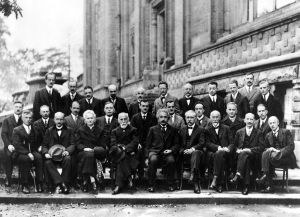
1600px-Solvay_conference_1927So, I just went to a BIG Nerd Conference this week. You know the one. No, not that one – I went to the other one.

I had a lot of fun talking with everyone and doing some service committee work. I met new people and connected with friends. I did a lot of mentoring. It was pretty exhausting, even though I only went 3 days. And, I noticed something… there were many times when I was the only one. Don’t make me say it. I was the only woman in a big group of men. It wasn’t all the time or every dinner, but it was noticeable and fairly often.

It got me to thinking… where were the women? I talked about it with HusbandOfScience, and we realized there were women at the meeting, but there were almost no women at my stage… that’s the post-tenure, associate professor stage. There were lots of young women – grad students and postdocs – even undergrads! There were lots of post-tenure, associate-level men, but there were only a small handful (a couple) of associate women. There were also about 2-3 full professor women floating around visibly. We brainstormed about women who were missing to figure out where they were. For each one, I realized they had told me in the past that they were going to “not travel so much” after tenure. Or, in some cases, they had a baby after tenure and couldn’t travel. And, now they are MIA.

At dinner, I was sitting with two pre-tenure women, and I asked one of them if she would continue to travel when she (inevitably) got tenure. Her answer was a clear “no.” And the reasons were multi-faceted. She said she would probably travel, if she were invited to speak. But, she didn’t want to go to as many big conferences (such as the one we were attending). She has two kids at home under the age of 5 and she wanted to spend more time with them. She felt that she was a better mom when she was with them. She, herself, had a stay-at-home mom, and she felt a lot of guilt from being away. She had a two-body problem, and her husband was going on the market. These are all really good reasons, but it just made me sad because it was another woman pledging to become less visible after getting tenure. Sometimes I think that it isn’t that women aren’t in science, it’s just that no one knows we’re here because we are diligently doing the science and not out there selling our science the way many men do (I realize #NotAllMen).

So, I am writing this post to plead with the women for them to come back to big conferences. Please – see, I asked nicely.

Here are three good reasons to return.

  1. Do it for you. Attending, networking, and participating at big conferences is important for  maintaining your enthusiasm, your creativity, and your visibility in the field. At the big conference this week, I saw two talks: my student’s talk and part of the one before my student. They were great. I wish I could have seen more, but I was too busy networking (schmoozing) and talking science in the hallway outside of the rooms. I had several meetings with collaborators, established some new collaborations, and met a ton of students and mentored them (see below). These connections with students, who will ultimately join our ranks, are just as important as the ones with the older fellows (of the society). The reinforced connections with my peers and near peers lead to continued invitations to conferences, seminars, colloquia, and nominations for awards. And, even though I didn’t see any talks, I did learn a lot of science (from the network). I learned what people are excited about and interested in. I talked to a program officer or two about big new ideas from my group. I was just obviously and actively engaged in the meeting.
  2. Do it for me. OK, that first one wasn’t convincing because you are a self-less, government(-financed) servant who works on science for the thrill of discovery, and you don’t give a f*ck what anyone else thinks now that you have tenure. I hear you. Well, how about you come back to big conferences for me? You are probably thinking that I don’t need you. But, I do. I need you so that I am not the only woman at dinner or after dinner drinks 3 out of 4 nights of the conference. I need you because I can’t talk to all the students myself and be the representative for my entire gender at this age/stage of career. It’s a lot of pressure. I have never been so sought-after for my advice. In fact, similar situations are what drove me to start this blog in the first place. And most of them didn’t even know I have a blog full of advice on exactly what they were asking me!
  3. Do it for them. And this brings me to my final reason, which piggy-backs on the last one. I shouldn’t be the representative woman. There should be other examples of women who do it differently. I am navigating my career in a particular way that works for me, but I am a big mouth feminazi. The students need examples of other types of women. What about if you are shy? What if you do theory? What if you are pregnant? What if you are conservative? What if you don’t want kids? What if you are gay? I’m not many of these things. We need lots of women to go to conferences who have successfully navigated tenure and are still visible to serve as role-models. OK, you don’t think of yourself as a role-model, and you didn’t have a lot of women role-models? Fine, but don’t you think there should be more women at the big conference who are successful, normal, middle-aged people who can relate to lots of different kinds of women? Because, the way this conference looked, if you were a woman, you were either pre-tenure or you had very limited options.

So, that is why I think it is important for women to continue to attend big conferences in their broad field. Your impact can be in just being yourself and reminding everyone you exist. What do you think? Will you continue to go to the big conference? Will you come back? I hope so. It is very lonely for me without you. If you want to get an email every time I post, push the +Follow button.

CHRIS ROCK

THE OSCARS(r) – THEATRE – The 88th Oscars, held on Sunday, February 28, at the Dolby Theatre(r) at Hollywood & Highland Center(r) in Hollywood, are televised live by the ABC Television Network at 7 p.m. EST/4 p.m. PST. (ABC/Image Group LA) CHRIS ROCK

Did you see Chris Rock’s monologue at the Oscars? At the end, he mentioned that there should be black-only award categories. He said there are already arbitrary men/women categories that didn’t need to be there, so why not arbitrary white/black categories? In science, we do have awards that are specifically for women or minorities. I have heard both men and women say that they are dumb to have for various reasons, but I would like to cast some light onto why they are crucially important with a some examples.

Example 1: When I applied and was admitted to graduate school, two different programs offered me little fellowships. One was not specifically for women and was a few bucks to help with cost of living or moving. The other was specifically for women and minority students. The point of offering me these minor pittances was to recruit me to the school that offered the fellowship over other schools. I am not sure if they realized it, but it had a secondary effect. I felt more welcomed at the school.Whether it was real or all in my head, I felt a little special that they had actively recruited me to the school. It helped mollify the imposter syndrome that plagues us all and the stereotype threat that only plagues minorities.

A few years later, I was in a lab and being productive. I was riding to an event with a new male graduate student who was trying out the lab and my female advisor. The male graduate student was complaining that he didn’t get a fellowship or enticement to go to graduate school, and he should have. It “wasn’t fair” that women and minorities get these things when he, a white male, did not. I probed a little further and realized that this guy wasn’t a stellar student. He had As and Bs, but I had a 4.0 GPA. I also asked him if he expected to get into graduate school, and he of course did. I explained that, this was a big difference between the two of us. Despite my 4.0 GPA and my extensive self-driven research experiences as an undergraduate, I did NOT expect to get into graduate school anywhere. When the first school accepted me, it was all I could do to not accept back right away. I had to actively be patient to wait for the others. I got into 6/8 school, but not the two most prestigious/highest ranked schools. My subject GRE was low – average for a woman from a liberal arts school – and many schools look at that exclusively (for a nice article on why that is a terrible idea if you want women and minorities in your programs, click here). I explained to the other graduate student that the purpose of the very tiny award was not to actually reward me, but was to say, “we want you, you’re ok,” when all other cultural signals were pointing to this being the wrong way to take my career. The purpose was to help my self-esteem and make it clear that I belonged in science.

Example 2: Recently, one of my awesome postdocs, who happens to be a black woman in science (sorry to my postdoc, I know you are probably reading this) was informed that she is being selected for a postdoctoral fellowship. This fellowship is specifically for minorities and had other stipulations. First, my postdoc would not read the email. I grabbed her phone from her hand and read it. I handed it back with a casual, “You got it. Why wouldn’t you read it earlier?” I told her to read the email that validated her excellence. And she began to tear up. And I totally got it. I knew why she wouldn’t read it. She was worried about not getting it, and what the blow would do to her self-esteem, which is already (unreasonably, considering how amazing she is) low. She started crying because she did not consider herself good enough or worthy enough for this prize. This award is only for minorities in life science. There aren’t that many. Further restrictions mean that there are very few applicants. That sounds like I am trying to diminish her award, but I am not. What I am trying to say is that, in my mind, there was no way should wouldn’t get this award. But, in her mind, there was no way she would. This award is doing for my postdoc what the tiny graduate award did for me. It is pointing toward the signs that “You belong here.”

And that is why we still, to this day, need minority only and women only awards. Because, despite all the grit and all the challenges, it is still not obvious to the excellent that they belong here. They constantly feel like they are doing the wrong thing because of their gender, their skin color, their weight, their country of origin, their health, etc…

Example 3: Finally, while I was at a meeting recently, my roommate and I were talking about the Society’s fellowships. My roomie successfully nominated some women in her field, and she was aiming to nominate more this year. A couple women protested saying, “I’m not old enough, I haven’t done enough, etc, etc…” These all basically translated into “I’m not good enough,” which is complete BS. If these women were not good enough, no one would think to nominate them. My roomie correctly pointed out that these women needed to win in order to “get out of the way.” What that means is that no other women who is younger will ever be able to win the award or fellowship unless these more senior, more established women get it. When put that way, many of the protesting women caved and agreed to be nominated. Interestingly, these women felt so self-negative that, despite their excellence and despite the call from others to be nominated for that excellence, they didn’t think they were good enough. It was only when the argument was framed as helping others (getting out of the way, so others can have a chance) that they agreed to be honored. Again, women/under-represented groups do not feel they are good enough or will ever be good enough. Society tells us we are not good enough because this is not what women do. I have advocated again and again in this blog to self-nominate and to try to win awards (here, here, here). It is hard to put yourself forward when society’s bar and your own bar are so damn high.

Example 4: I wrote most of this a week ago, but another thing happened just yesterday that also reminded me of this issue in the opposite way. As you know, I am on sabbatical. I have a desk in an office suite for three on a hallway of similar offices. These offices are filled with graduate students, postdocs, and some undergrads. It is close quarters, and I can often overhear the students’ conversations (including one where they were discussing golf and the penalty reward for scoring a hole-in-one, which was to have breakfast at a strip club {I can’t believe that is something anyone would want}). Anyway, yesterday a postdoc in some lab was discussing with a relatively new grad student about his job search. He was so, so confident that he was going to have an offer. He had about 6 interviews, and had heard back early from AnIvyLeague that he was not the top choice. He was confident that he would be hearing from the others soon. They all said the decision would come in 4-6 weeks, and this was week 6. Any second, he would get that call from PrivateSchool or BigMidWestU saying that he was the one. I was pretty blown away by his confidence. Despite having as many interviews and 3 solid offers from pretty good schools, I was never confident that I would get an offer from any of them. I was happy to have been given an interview. I think I performed pretty damned well at most of the interviews, but I never thought they would call me up for sure.

Further, if I am being honest, I didn’t even apply to the top schools. I had the excuse that I had a two-body issue, and I was pretty confident that the spousal accommodation policies were non-existent at these schools. But, mostly, I didn’t apply because I didn’t think I had a snowball’s chance in hell at getting an interview or offer. I may have been wrong about that. In fact, the one IvyLeagueU where I did apply, I got the interview and the offer. I’m not sure if other women held themselves back as I did, but looking back, I wish I hadn’t. I know now that the rejection is minor and hiring has many whims and issues (there are words like “fit” thrown around that are subjective), so I wouldn’t and don’t take the rejection so personally now. I do feel like I have more confidence now, but I don’t think I will personally ever have the level of ballsy self-confidence that I overheard from my office. I’m not sure many other women/minorities would either. How about you?

So, what do you think? Are minority-only awards good? Do we still need them? I don’t personally think we are post-sexism or post-racism yet in science. As Chris Rock says, “Is Hollywood racist? Yes. Hollywood is sorority racist. They’re like, We like you Rhonda, but you’re not Kappa material.” Replace Hollywood with Science, and I think the same sentiment is true. Scientists are nice, liberal people, but they want to hire, work with people who look like themselves. “We want opportunities!” (-Chris Rock). Since the bar is so high for us, winning awards (even ones where no one else is qualified) is important to helping us overcome the self-doubt and the unnaturally high bar of being an under-represented person in academic science.

Sabbatical Update

Sabbatical-1So, we’ve been on sabbatical for about 8 weeks. I have had several people ask me what I have been doing. So, this is an update on my work during my sabbatical.

Grant Writing: I have written and submitted two proposals, and I am working on another.  There might be a few others along the way.

Visiting Collaborators: I spent 5 days going to a single city that is within a few hours of the location of my sabbatical that happened to have multiple collaborators. With one collaborator, the three PIs were all together and we “ran experiments” but telling a postdoc what experiments to do for 3 days. With another collaborator, I worked with his students to train them on the protocols from my lab.

Visits Back Home: I have visited back home two times in the past 8 weeks. Once was for about half a week. The second was for a week. I scheduled a lot of meetings with the lab. I put a bunch of student committee meetings that week and got one student advanced to candidacy for the Ph.D. and another passed their Master’s.

Conferences: I have attended one conference where most of my lab was in attendance. I was able to have some good meetings with them. It felt good that some progress was made and we had cool ideas from the talks and posters we were watching. I have another conference in a few weeks. It is closer to home, so I will swing by and see the lab.

Lab Work: OK, the real low mark for me is my ability to get into the lab and actually do some experiments myself. First, it basically took me 8 weeks to get fully trained to access the labs. The training consisted of 5-8 videos on chemical safety, PPE, and autoclaves. After getting all this training, I had to have one-on-one training with the faculty of each lab I want to access in order to get a key or card access. This means getting two faculty members’ schedules in sync. It took a ridiculous amount of time to get trained, but I am finally trained and trying to get in a lab next week.

Staying in Touch: Based on advice from others, I am staying in contact with my lab in two ways. Every other week, I am having a lab meeting where I skype in. These have been annoying due to connectivity issues. I am not happy with my home institution’s internet. The other week, I have one-on-one meetings with my lab members. This is hard to coordinate and takes a ton of time. I am happy that people are making progress in the lab. This is not surprising, because I have excellent people, but it is a bit nerve-wracking to worry about.

I’ll try to update again in about a month or so. Hopefully I will have some experimental results by then…


Hiring Faculty

1600px-Solvay_conference_1927Although hiring for your own research group is a difficult task, most people you bring on to do research with you will have a limited lifetime in the group. Oppositely, hiring faculty colleagues can have a lifetime impact on you, the department, and the college. Having great colleagues can be inspiring, uplifting, and enhance your creativity and science. Having terrible colleagues can make you anxious, depressed, and unwilling to go to work each day.  All departments have a mix, and not everyone feels the same way about all colleagues. Further, much of these issues come down to personality, which can be hard to evaluate during even long, 2-day interviews that faculty candidates must endure.

There is another issue, which is the gender and race gap in most STEM departments. We are certainly no where near parity on diversity with the population at large in this country. Most STEM departments have the same racial make-up that they did in 1950. That is to say, they are very white. We are doing a bit better with women, although most of them are white, too.

I am very proud of my department this year because they overcame some bad behavior to do things in a better way and actually get some diversity during their hiring this year. First, I am going to bag on them a little. Just know that I feel like they saw the error in their ways and course-corrected for this year. Learning from your mistakes is something that my department can do, but I am not sure all departments even recognize their mistakes.

Not so good behavior: Last year, we had only one “token” woman in our searches. To me, this is not enough, especially when we are so far down on the percentage of women in the department. We did have some non-white candidates. Most were Asian of some sort. The top candidate of the search was actually non-white, but he took an offer somewhere else.

When we closed the search, we had to write a memo about the people who did not make the cut (most of the candidates including the one woman). The faculty were presented the reasoning outlined in the memo. The male candidates were lauded for their credentials, despite the fact that they were not chosen. Sometimes the reasoning for not being chosen was also forgotten. The description of the woman was very different. Her credentials were not lauded quite so much. Odder than that, the reason why the woman was not made the offer was stated that “she did not know enough physics.” I had to step in here, since this is not exactly specific or clear. It is definitely the kind of vague critique people use to bash women’s competence when there is no good reason. Further, I felt that the higher-ups might be suspicious of this logic. Truly, if the candidate did not “know enough physics” why did we bring her here in the first place?

Second chance at good behavior: This year, we were allowed to try the search again. The search committee did several good things to help prevent some of the problems from the last year. The chair of the search attended, and paid attention to, the information from the equal opportunity office. *YAY*

Before the candidates files were downloaded and examined, the committee came up with an agreed-upon set of criteria for the candidates. Using this criteria, they judged the files and invited two women in the pool this year. *YAY*

Next, when the candidates came, they were treated as equally as possible. *YAY*

When the candidates were evaluated, they were judged against the criteria already established. *YAY*

Both of the female candidates were placed above the bar and many more of the male candidates faired better was well. Perhaps it was a special year with an exceptional pool? Either way, I felt the process was more equitable and resulted in a better outcome for the women.

Side Effect: The side effect of this process is that I am feeling much better about my department and about my place as a woman in that department. Good scientists should be able to learn and understand that random metrics are not a good way to evaluate candidates. My colleagues showed that they can learn and be better people and better scientists. For me, it is more than just the possibility of hiring more women in the department. There is a collegiality and respect that I feel to/from my peers that makes going to work much nicer these days.

So, what do you think? How does your department make hires? Do you feel the process is fair? Does it bring in the best candidates? Comment or post here with more ideas on best practices for hiring and helping with diversity.


catenary_bikeI swear, I do not ask for these things to happen to me. They just do. I am simply reporting the facts as they occurred…

It seemed to be a perfectly nice visit to a school with a good reputation who has enough money to purchase national academy members in order to increase their prestige. I was happy to have been invited to give a talk to this school. I was looking forward to impressing the scientists there with my cool science and my fast wit.

For those of you who don’t know, when you go to give a seminar, they put you through your paces. Not only are you there to perform for the people of the university who might happen to have the time to come to your seminar, but you also have 30 – 45 minute, back-to-back meetings all day with various faculty members. You typically eat lunch with students or faculty and then also have a dinner with faculty members. At each meeting you typically discuss the science of the person with whom you are visiting. It is possible to be talking about all matter of science within the span of 20 minutes, so you have to bring your A-game. I was ready for my long, exhausting day of fast-paced science. I wore a smart outfit and had updated my talk with some new data and cute animations and movies. I had great meetings all morning. The seminar is over lunch, but they gave me my food early, so I could eat (this sometimes doesn’t happen, so you should always bring snacks in your bag just in case). By the way, this is the same way an interview goes except for 2+ days.

So, I was having a good day. I got up to give my talk and just before it started an older gentleman came and sat in the second row. It was clear that he was a big deal. A national academy member (NAM). This group had three, and I know two of them pretty well. Of course, the two guys I know were out of town that day. I had never met this guy before, but the other two were pretty nice to me and liked my science. I began my talk with my usual quiz. See, I do a lot of active learning in my talks because (1) people remember it, and (2) people don’t fall asleep, and (3) people like it. Seriously, it is much more entertaining when you break the 4th wall (see post). 99% of people who hear one of my talks, love this style. At about the 3rd slide, NAM leans over the his neighbor and whispers something. Not too loud, but obvious to me what he is doing. I explain to the audience that I am using active participation of the audience to engage and to keep you from sleeping during my talk. That gets a few laughs.

The next time I have an activity for the audience, NAM does it again – he whispers. It is clear that he isn’t digging my talk style. But, I dig in. This is my talk, and I am not going to let him passively bully me… I didn’t have to wait long for him to stop being so passive about his bullying. About 20 minutes into the talk, I ask something of the audience like, “What do you think this means?” And NAM says very loudly, “Why don’t you just tell us instead of making us answer?” I get embarrassed. My face heats up (apparently red to match the temperature). My heart is pounding. I want to burst into tears.

I make a comment about how this style is the best way to learn. NAM responds by saying, “Yeah, yeah. I know the literature, and that’s fine for a class where you want the students to remember what you say 5 weeks later for an exam, but this is a seminar.”  WTF? Like, I don’t want people to remember my talk 5 weeks later? I want them to remember my work a year later. And, of course he knows the literature. The effing National Academy literally wrote the book on best practices in the classroom.

I respond with something like, “Well, this is how I made my talk, so I guess we’ll just have to continue on.” The very next slide has another quiz. I say, half apologetically, “Well, there’s another one. I guess we need to do it.” The students still give answers and respond. The next quiz I look at NAM and say, “Oh no, I know you don’t like this, but here we go again!” I make it into a joke that he doesn’t like what I am doing and I keep doing it. Making light of the situation does make me feel better, but I feel like total shit. This creep just fucked up my awesome talk.

Prior to this talk, only one person had ever criticized my “active learning” talk style. I gave a talk at a Gordon Conference and used candy as props to talk about a subject everyone in the room already knew and understood. Afterwards, one woman came up to me and say, “I thought that using active learning was really bad for a seminar or conference talk. Don’t get me wrong, I teach at a liberal arts school, and I use active learning in the classroom, but I just think it doesn’t have a place in conferences.” I was surprised that someone who is clearly an up-to-date educator would say that, and my face must have betrayed it, because she continued to say, “But you know what? Your talk is the only one of the morning session that I remember. So, I think I was wrong. I think active learning is useful at conferences, and I am glad you did it.” So, although she gave me crap for active learning at a conference, I actually changed her mind!

Of course, my day wasn’t over. In fact, I had a whole slate of meetings for the entire afternoon. The meeting just after my talk was with my host. He apologized for his NAM colleague. He told me some terrible stories about how he is like that to everyone, in the hopes that I wouldn’t feel like it was personal. But, it was personal. Just because he is a personal jack-ass to everyone, doesn’t mean it isn’t personal.

My next meeting was with the NAM. The first thing he does, is exactly what I expect. He fake apologizes for his behavior. He knows he was unacceptably an asshole. His apology is something like, “I’m sorry I spoke up and was rude, but that style is not good.” I said, back, “You are the only person I have ever met who thinks that.” He said, “Well, I’m not wrong.” I can’t help it anymore. I try to hold back, but the tears come. They fill my eyes. He avoids eye contact. I find an old tissue in my bag and try to dab away the tears of anger and unsaid words when he isn’t looking. But, part of me wants him to see. Part of me wants him to know that his words are hurtful. That I am a human. I sit there and I am crying at you. I do not run. I am not weak for crying. I am strong. Are you strong enough to see me cry? No, you are not.

He spent 3/4 of an hour mansplaining my research back to me. I didn’t get to talk at all. He gave me reprints in a little folder. Homework for me to read and educate myself on his brilliance in my field. He’s not actually in my field, but he has dabbled. My tears dry up within about 15 minutes, so 30 minutes are spent with me listening and trying to tell him what the latest in what he is saying is. Or explain why what he is saying isn’t right with what we know now.

The rest of the visit is good. Only 3 students show up to my student time (all men). I have lots of advice, but only three have time to hear. I worry that it is because I was publicly shamed about my talk. I wish his critique had been about science, so I could fight back. It was about style. How do you fight back against that? It’s like standing up in someone’s talk and saying you don’t like their voice or haircut.  The students who showed up apologized for NAM. They said he is a dick and he does that to everyone. They said that they liked my talking style. We talk about two-body problems and how to get jobs after grad school. Typical stuff young people are concerned about.

Other faculty apologize for NAM. I get a couple emails upon my return apologizing for NAM. I certainly don’t blame any of these other people. But, none of them calls NAM out. I put up the most fight against him of anyone. It definitely altered my visit. I message some WoS friends. I post about it on FaceBook. People are flabbergast that someone would say something like that. I don’t out NAM at first, but people can figure out where you are talking, and they can figure out who’s the asshole at that place.

So, here is a question. How do you handle this situation? And how do you handle the standing up for yourself. I did go to social media, but I kept it low and of course, my FB page is closed to friends only. I do not believe that any one asshole’s comments of this nature should get them grilled in the arena of public opinion (outright sexist or racist comments are very different). I do want to let people know who is an asshole, so they can prepare to defend themselves. I do want to learn from this event – what would you do? How can you fight back? Was it sexist? I don’t know. I’m sure he was more likely to be an asshole to me, but I would have thought he would attack my competence as a scientist – not as a presenter. Plus, who attacks someone’s strength? Maybe that means I showed no other weakness? That’s a nice way to read this.

I hope to hear back from you. Comments, suggestions, ideas are all welcome. Post or comment here. If you want to get an email every time I post, push the +Follow button.

Hiring – Better Advice

HelpWantedI have tried to write about this before (post), but I think I was asking more questions and had fewer answers. After almost a decade of doing this, I think I have now learned some things – or at least made enough mistakes – that I can speak relatively intelligently about how best to hire. As always, there are multiple types of people you can hire for a research group. Undergraduates, technicians, graduate students, postdoctoral students, research scientists, administrative assistants, etc… Of course, as a faculty member, you will also have the opportunity to have a say about other faculty and staff hires in the department. Those are typically done by committee, and I have opinions about that process, too (more to come in future posts). This post is about some recent new practices that have been successful to hire people for your research group.

  1. Undergrads. OK, I don’t have much of a bar for undergrads. I do have a small hurdle. They have to fill out an application to be in the lab. The application is available on my website, or I send it to them when they request information about how to join the lab. When they turn in the application, they have to make an appointment to see me.  At that meeting, I describe the lab, some of the science, and how we run things. If they are still interested, they have to fill out an undergraduate contract. The contract has more specific expectations for hours and work. On the front, we decide together on how we will compensate the student: money via work study, credit via independent study, or volunteering. I am specific about the weekly hours, compensation, and I email the undergraduate program director or the personnel person in charge of getting the students paid at that meeting. We flip the contract, and outline the science that the student will do during their semester. I photocopy the contract – front and back – and keep the original, signed by both myself and the student, and they keep the copy. I have outlined this in previous posts, but it was a bit buried (post). Basically, if you are interested enough to fill out an application and make a meeting with me, you can be an undergrad in the lab.
  2. Grad students. I am apart of two different graduate programs because what I do is interdisciplinary. One program has formal rotations. The students actually work in your lab for a semester, and get to know how you work and vice versa. After two rotations, they pick an advisor, and that is where they stay until they graduate (or leave the program). The other program I am in does not do rotations. In fact, there is no formal, helpful mechanism for students to find their advisors. They basically have to try a couple, have some false starts, and then decide. It is like the most awkward dating game ever (previously described here).  They usually decide based on science, which I do not advocate (see post). For the students from the second program, I basically make them do a rotation over the summer for three months that I pay for out of pocket. At the beginning, I explain that it is a trial period, I even put it in writing. I pay them for their summer work, but that is the only commitment I make until the end of the trial. After the trail period, we have a meeting to discuss if they would like to continue to work in the lab.
  3. Postdocs. I recently hired a few postdocs. I had trouble getting good applicants for one, but had several reasonable applicants for the other. For both positions, I put out ads online. I think that was good because figuring out who has openings can be hard for recent grads who are applying (see post). In order to post an ad, I have to go through a formal process through my university equal opportunity office. Honestly, it totally sucked. They made it really long and difficult to get my ad out and to complete the hiring process. It basically took 6 months to fill one of the positions. This is terrible if you have to have results within a year for a grant. Once the ads were official and posted online, I started getting applications, and I definitely think I got applications from candidates who would not have applied if I had gone through the grapevine only. I made a spreadsheet for the applicants and set up a series of requirements including minimal requirements (which eliminated some applicants, but not many), and then preferred requirements. All the applicants who made it past that point were contacted to have a Skype interview, and I contacted all their references. In the Skype interview, I asked them about their work and described the lab. I basically tried to tell if they had some sort of red flag, but it is difficult to determine. The most important thing was to contact the references and ask them very direct questions about the applicant. I had a two-page set of questions (it really only took 30 minutes) where I asked about their research abilities, communications skills, work ethics, goals, and their personality and ability to get along with others. The last two questions I ask are: 1. Would you hire this person in your lab as a postdoc? and 2. Are there any red flags? You would be surprised at the number of people who say “no” to the first question. For the second question, this is important to make it clear that I cannot tolerate having a bad personality in a small lab, and I need to know if the person has issues. Honestly, every time I have called the references, and asked these questions over the phone, I made good hires. When I didn’t, I made bad hires. So, the most important thing in my mind is to CALL THE REFERENCES! After the references were good, and when possible, I had the applicant interview in person in the lab. I set up a whole day where they talked to other professors, gave a one hour talk on their research, and had lunch with the lab members at the faculty club without me. This last step was the most crucial because it was a litmus test of personality for the lab. I did not hire people based on this test if the people felt the interviewee was a jerk. In a small lab, the personality is crucial, but difficult for me to judge. The lab is a better judge, and I have to remember to always listen to them, no matter how good an applicant looks on paper.
  4. Technicians. I have hired a couple technicians/lab managers that didn’t work out so well. I now use the same process as for postdocs, and I think that will work better. Currently, I have a new technician who “grew up” in my lab starting as an undergrad and then a master’s student. This is a really great way to get a technician, but it is not exactly easy or common to find an excellent undergrad who wants to go this route.
  5. All. Lunch with current lab members. The lunch with the lab is the most important part of any interview, I think. I can’t tell you the number of interviewees who say stupid shit to the students when covering up their crazy for me. Plus, the personality meshing is so important, especially for a small lab. There could be a concern about racism or sexism, but educating students about their cultural biases, they can work to overcome them, as we all could and should.

So, what do you think? Any good advice on how best to hire people for your research group? Comment or post here. o get an email every time I post, push the +Follow button.

indiana-jones-last-crusade-grailRemember that scene in Indiana Jones and the Last Crusade when he makes it through all the trials to the room full of “Holy Grail” cups? When the old knight who kept watch on everything tells them to choose a cup and cautions them to “choose wisely,” and the Nazi totally screws up and picks the prettiest cup, and he basically melts into a puddle of Nazi-scum. Then the knight says, obviously, “He chose poorly.” Then Indie comes along and chooses an ugly, small, little cup, and he drinks and is fine, and Capt. Obvious lauds Indie for choosing wisely? Why am I bringing this up? Because, you need to choose wisely when choosing an advisor. There are many time points when you will choose an advisor including undergraduate, graduate, and postdoc. Interactions with your advisor can make your job a joy or a living hell. So, choosing wisely is very important.

I was asked to write this post months ago, and I went out to a number of students and postdocs to get their opinions. Unfortunately for you, dear readers, none of them responded. So, you will have to hear my personal opinions. Maybe by writing things, some of which they may or may not agree with, they will be prodded into the act of writing? Maybe not.

OK, so here are my *pearls of wisdom* for you.

  1. Work-Life Balance. If you want to have work-life balance, make sure that the advisor you pick has work-life balance.  If they do not, they will not allow you to have it. Warning – just being a woman or having kids does not mean the person has work-life balance. My first time out, I picked an advisor who was a woman with a kid, and she had no concept of work-life balance. She was also very unsympathetic toward people without children trying to have work-life balance (see this recent post). She felt like people without kids should just work all the time.
  2. Type of criticism. Science is critical. See this post about taking criticism (post). Different advisors deliver critique in different ways. You need to find one that you can tolerate. Advisors are like coaches. You should see them that way. Like a coach or piano teacher, they will always find something wrong, even when you do it great. There is always room for improvement in science – especially when you are still learning. But, if someone delivers the criticism in a way you cannot tolerate, you will have a very hard time taking it.
  3. Time to degree/completion & post-job placement. How long is it going to take for you to get your Ph.D? How fast did previous students graduate? Do they have one paper? Several papers? What do they do when they leave the lab? Do they get good jobs? Do postdocs get jobs as faculty, if that is what they want? Do they go to industry? Where? Do grad students get good postdocs? Do undergrads go to good grad schools?
  4. Funding. Some people put this as the most important thing. I agree that if you have to TA the entire time as a grad student, it will limit how fast you can get your thesis done. And, if a person doesn’t have money for a postdoc, they obviously can’t hire you for one. The advisor needs to be successful at getting funding. Will they train you at getting funding yourself (fellowships or scholarships)?
  5. Resources. Funding is one type of resource, but are there other resources available? Is there time on the equipment? Or too few instruments to get on to do your experiments? Is there money to go to conferences? What about other knowledge or skills? What happens when the advisor wants to do learn something new? Do they let you flounder? Or send you to learn it from another lab?
  6. Other students. To me, this is the most important thing to do when visiting a lab. You must talk to the current students about the lab. They will likely be very frank with you about what they like and dislike. How happy are they? Do they have work-life balance? What do they not like about the advisor? When trying to decide about an advisor, I would definitely try to have lunch with the people already in the lab to see how they like the advisor. Ask about how the advisor gives criticism? How well other previous students have done with finding jobs after? How well is the lab managed for resources? Is there enough equipment? The right equipment? If you have to do something new, does the advisor let people flounder? How are new skills brought into the lab? How are the lab meetings run? Do people cry or get upset often? How does the advisor handle conflict in the lab? Avoidance? Do they micromanage? Does the advisor listen to complaints and criticism themselves? How does the lab operate? How do they give instruction? How do they set expectations? What is the make-up of the lab? How many undergrads, grad students, postdocs? I recommend having a list of questions for the lab members and making sure they answer all your questions.
  7. Advisors are not perfect. They make mistakes. If you found someone who is genuinely interested in your development as a scientist, they will probably still have a lot of other aspects you don’t like. As they say in the Muppet Movie, “peoples is peoples.” To me, that means that everyone has strengths and weaknesses. You are not entitled to a perfect advisor. Nobody is perfect. You are entitled to a certain level of respect and civility from your advisor. You are also entitled to expectations being set. You are entitled to progressive discipline if you make a mistake. The advisor is also entitled to respect because they have achieved a lot to make it to the professoriate. They are able to fire you if you are insubordinate – not even a union can protect you, if you do not do what is asked of you.
  8. How to work with a difficult advisor. I should write a whole post about this – hell, I should write a whole book about this – and I probably will someday. Let’s be honest, even good advisors can say and do stupid shit that pisses you off and is disrespectful. I apologize for anything I have ever done like this, and I know I have done it. If the advisor is mostly good, you can forgive these transgressions.  If you are having a hard time with your advisor, I suggest speaking to them in private about what is bothering you. But, you don’t want to come off as entitled or complaining. I suggest trying to come up with a solution and bring that to the meeting, as well as your complaint. Believe me, I have tried other things, and this works best. It can be hard to do, because they have power over you, in the form of your letter for future jobs. It can also be hard because many advisors have egos and some are really big egos. A bad advisor will not care what you think or have a problem with regarding the lab or his/her management style. A good advisor will consider your words, and see if it is anything that can be done (sometimes there is nothing that can be changed). But, letting something that is bothering you go and fester can make everything worse. Also, remember that your advisor is not thinking about you all the time. Remember, professors have all-consuming jobs, so they really cannot and should not be thinking about you all the time. So, return the favor, and don’t worry about what they think about you all the time. This will help your relationship.

Notice what isn’t on my list? Science. Because, basically, I think the type of science you do is irrelevant. Yet, when I talk to grad students, they often say the most important thing is the science that is being done in the research group. I think this is very wrong headed. Why? Because there is usually more than one person in each field doing interesting science in that field. Chances are that some of the people in the field will be BigShots with lots of money, students, and postdocs. Some of these BigShots are amazing advisors. (Yes, they do exist! I can think of several in my field.) If you get one of those, you have hit the jackpot! Sadly, many BigShots are crappy advisors. They suck in, chew up, and spit out students like it is their job (when actually, it is part of their job to advise and help the next generation of scientists succeed).  There are also lots of little guys out there, doing good science, plugging away, and often in desperate need of smart, dedicated, and hard working students. They also often care deeply about mentoring and advising. As long as they have the resources for you to succeed, you can do great things at these smaller groups. Finally, I think there are so many great, interesting science questions out there, and you can make advances on anything. Grad school is about learning how to do a long project, so you need to go to a lab that will teach you those skills. But, I’m not sure you need a paper in Science or Nature to learn those skills.

In my time, I have picked several advisors, and I have chosen poorly and chosen wisely. The thing I was most surprised about was that many professors have big egos. Now, I am a faculty member, and students make decisions about me. I’m not exactly sure how to convince them that I am worth the risk. I have been successful with students graduating in a timely manner (five years) with several papers with mostly full funding. But, alas, they often do not care about such mundane, practical matters, despite the fact that it will affect them every single day of their lives in grad school.

I am sure there are lots of things I have forgotten to add, but these are the things I thought of first. Hopefully some other people will help by writing, too. If you have a blog post, feel free to send it to me to post. I hope to hear from you! If you want to get an email each time I post, push the +Follow button.

Tag Cloud